
Homework Answers

Add Answer to:
1. (3 pts) Based on the balanced equation below, calculate the volume (in HNO3 needed to...
What mass of Cu metal is required to react with 6.8 drops of 16M HNO3? Assume...
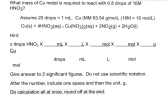 What mass of Cu metal is required to react with 6.8 drops of 16M HNO3? Assume 20 drops = 1 mL. Cu (MM 63.54 g/mol), (16M = 16 mol/L) Cu(s)+4HNO3(aq) a Cu(NO3)2(aq) + 2NO2(g)+ 2H20(0) Hint x drops HNO3 X Cu XLX mol X drops mL mol mol Give answer to 2 significant figures. Do not use scientific notation. After the number, include one space and then the unit, g. Do calculation all at once, round off at the end.
5) Use the following balanced equation to answer questions (a)-(i). 3 Cu(s) + 8 HNO3(aq) →...
5) Use the following balanced equation to answer questions (a)-(i). 3 Cu(s) + 8 HNO3(aq) → 3 Cu(NO3)2(aq) + 2 NO(g) + 4 H2O(l) a) What is the minimum number of moles of nitric acid required to react with 10.0 moles of Cu? b) How many moles of NO are produced when 0.50 moles of Cu react completely? c) If 0.80 moles of H2O are formed, how many moles of NO must also form? d) How many moles of Cu...
Use scratch paper if necessary, and copy your completed calculations to this sheet. Shown below are the 4 reactions...
 Use scratch paper if necessary, and copy your completed calculations to this sheet. Shown below are the 4 reactions involved in the Cu cycle listed in random order Cus(PO4)2 (s)+HCI (aq)CuCl2 (aq) + HsPOs (aq) CuCl2 (aq)+ Mg (s) MgCl2 (aq)+ Cu (s) Cu (s)+4 HNO, (aq) Cu(NOs)2 (aq) +2 NO2 (8) + 2 H2O () Cu(NO) (aq)+ Na POs (aq)Cus(PO)2 (s) + NaNO, (aq) Place them in the proper order such that the first reaction starts with elemental copper...
Calculate the volume of nitrogen dioxide produced at 707.4 torr and 22.0°C by the reaction of...
Calculate the volume of nitrogen dioxide produced at 707.4 torr and 22.0°C by the reaction of 8.45 cm3 copper (density = 8.95 g/cm3) with 202.3 mL of concentrated nitric acid if the acid has a density of 1.42 g/cm3 and contains 68.0% HNO3 by mass). Cu(s) + 4HNO3(aq) → Cu(NO3)2(aq) + 2NO2(g) + 2H2O(l)
Write a balanced equation for the reaction of copper with nitric acxid tp produce nitric oxide...
Write a balanced equation for the reaction of copper with nitric acxid tp produce nitric oxide (NO). Predict whether this reaction would occur with more, or less concentrated nitric acid than equation (1) : Cu(s) + HNO3(aq) ---> Cu(NO3)2(aq) + NO2(g) +H2O(l)
Question 39 2 pts How many mL of 0.583 M HNO3 are needed to react with...
 Question 39 2 pts How many mL of 0.583 M HNO3 are needed to react with 2.5 g of Hg2Cl2 (molar mass = 472.08 g/mol)? Hg2Cl2 +5HNO3 +2Hg(NO3)2(aq) + HNO2(aq) + 2HCl(aq) + H2O(1)
a) Given the following balanced equation, calculate the volume of 0.287 M Nal that would be...
 a) Given the following balanced equation, calculate the volume of 0.287 M Nal that would be needed to react with all of the Hg2+ ion from 15.50 mL of a 0.422 M Hg(NO3)2 solution. 2Nal(aq) + Hg(NO3)2(aq) → HgIz(s) + 2NaNO3(aq) b) For the amounts above, what mass (in g) of Hg12 can form?
Complete lonic Net lonic: 2. Using the balanced chemical equation below... 4 Zns) + 10 HNO3(aq)...
 Complete lonic Net lonic: 2. Using the balanced chemical equation below... 4 Zns) + 10 HNO3(aq) → 4 Zn(NO3)2 (aq) + N2O(g) + 5 H2O a. Calculate the theoretical yield of H2O, if 10.45 g of Zn are reacted with 18.5 g of HNO3. (4 pts) b. If 2.15 g of H2O was collected, what is the percentage yield? (2 pts)
) Calculate the volume (in mL) of nitric acid that you plan to use in Reaction...
) Calculate the volume (in mL) of nitric acid that you plan to use in Reaction 1 in the procedure. Cu(s) + 4HNO3(aq) -----> Cu(NO3)2 (aq) + 2NO2(g) + 2H2O (l) 2) Calculate the amount of zinc granules (in grams) that must be added in reaction 5 in part 1 of the procedure CuSO4 (aq) + Zn (s) ------> ZnSO4 (aq) + Cu (s) Additional Information from procedure 1) . Weigh out approximately 0.50 g (starting material) of copper wire...
In lab, you reacted copper metal with aqueous nitric acid to produce aqueous Copper (11) nitrate,...
 In lab, you reacted copper metal with aqueous nitric acid to produce aqueous Copper (11) nitrate, nitrogen dioxide gas and water. Cu (s) + 4HNO3 (aq) ---- > Cu(NO3)2 (aq) + 2NO2 (g) + 2H20 (1) a) If 0.210 gram of copper is reacted with 35.0 mL of 0.551 mol/L nitric acid, how many molecules and how grams of copper (II) nitrate are produced? b) How many moles of the reagent that is in excess are left over? c) If...
 What mass of Cu metal is required to react with 6.8 drops of 16M HNO3? Assume 20 drops = 1 mL. Cu (MM 63.54 g/mol), (16M = 16 mol/L) Cu(s)+4HNO3(aq) a Cu(NO3)2(aq) + 2NO2(g)+ 2H20(0) Hint x drops HNO3 X Cu XLX mol X drops mL mol mol Give answer to 2 significant figures. Do not use scientific notation. After the number, include one space and then the unit, g. Do calculation all at once, round off at the end.
 Use scratch paper if necessary, and copy your completed calculations to this sheet. Shown below are the 4 reactions involved in the Cu cycle listed in random order Cus(PO4)2 (s)+HCI (aq)CuCl2 (aq) + HsPOs (aq) CuCl2 (aq)+ Mg (s) MgCl2 (aq)+ Cu (s) Cu (s)+4 HNO, (aq) Cu(NOs)2 (aq) +2 NO2 (8) + 2 H2O () Cu(NO) (aq)+ Na POs (aq)Cus(PO)2 (s) + NaNO, (aq) Place them in the proper order such that the first reaction starts with elemental copper...
 Question 39 2 pts How many mL of 0.583 M HNO3 are needed to react with 2.5 g of Hg2Cl2 (molar mass = 472.08 g/mol)? Hg2Cl2 +5HNO3 +2Hg(NO3)2(aq) + HNO2(aq) + 2HCl(aq) + H2O(1)
 a) Given the following balanced equation, calculate the volume of 0.287 M Nal that would be needed to react with all of the Hg2+ ion from 15.50 mL of a 0.422 M Hg(NO3)2 solution. 2Nal(aq) + Hg(NO3)2(aq) → HgIz(s) + 2NaNO3(aq) b) For the amounts above, what mass (in g) of Hg12 can form?
 Complete lonic Net lonic: 2. Using the balanced chemical equation below... 4 Zns) + 10 HNO3(aq) → 4 Zn(NO3)2 (aq) + N2O(g) + 5 H2O a. Calculate the theoretical yield of H2O, if 10.45 g of Zn are reacted with 18.5 g of HNO3. (4 pts) b. If 2.15 g of H2O was collected, what is the percentage yield? (2 pts)
 In lab, you reacted copper metal with aqueous nitric acid to produce aqueous Copper (11) nitrate, nitrogen dioxide gas and water. Cu (s) + 4HNO3 (aq) ---- > Cu(NO3)2 (aq) + 2NO2 (g) + 2H20 (1) a) If 0.210 gram of copper is reacted with 35.0 mL of 0.551 mol/L nitric acid, how many molecules and how grams of copper (II) nitrate are produced? b) How many moles of the reagent that is in excess are left over? c) If...
Most questions answered within 3 hours.
-
Where is the error in this code sequence?
String s1 = "Hello";
String s2 = "ello";...
asked 10 months ago -
Financial data for Joel de Paris, Inc., for last year
follow:
Joel de Paris, Inc.
Balance...
asked 10 months ago -
Consider this reaction:
Al2(SO4)3 (aq)+ BaCl3
(aq) Al2Cl6 (aq)- +
3BaSO4(s) . What is the...
asked 10 months ago -
Suppose that Savneet is considering increasing her
recent random sample from 20 car rentals to 40...
asked 10 months ago -
Trucks arrive at an unloading terminal at an average rate of 120
per hour.
Trucks arrive...
asked 10 months ago -
Why are methanol and ethanol completely soluble in water while
octanol is not very little soluble....
asked 10 months ago -
A facilities manager at a university reads in a research report
that the mean amount of...
asked 10 months ago -
When the CuSO4 is rehydrated by adding water to the anhydrous
compound, is this an endothermic...
asked 10 months ago -
A ray of sunlight is passing from diamond into crown glass; the
angle of incidence is...
asked 10 months ago -
A block of mass 0.249 kg is placed on top of a light, vertical
spring of...
asked 10 months ago -
how do the kidneys compensate in the presences of acidosis
a) trigger hyperventilate
b) reserve acid...
asked 10 months ago -
Question 501 pts
The rental rate of capital to the firm increases. Which of the
following...
asked 10 months ago