3) Name two solvents that are commonly used for SN2 reactions. because they considerably slow down SN1 reactions.
Homework Answers
1. For SN2 reaction polar aprotic solvents are the best solvents.
2. So DMSO, Acetone, DMF or acetonitrile are the solvents which we can use for SN2 reaction.
3. We use polar protic solvents then they will stabilise the nucleophile and slow down the SN2 reaction.
4. So polar aprotic solvents will not stabilise the nucleophile and slow down SN2 reaction and it moves toward SN1 reaction.
Add Answer to:
3) Name two solvents that are commonly used for SN2 reactions.
because they considerably slow down...
4) Can you ever have only SN2 or only SN1? Introduction Alkyl halides can be prepared...
 4) Can you ever have only SN2 or only SN1?
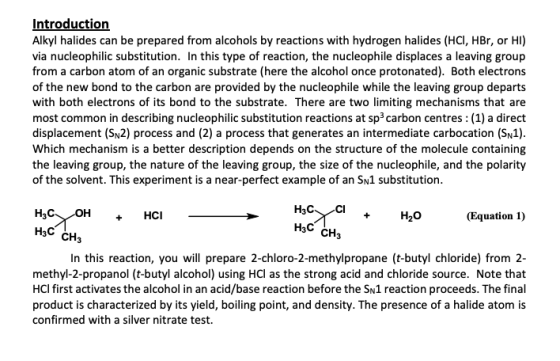
Introduction Alkyl halides can be prepared from alcohols by reactions with hydrogen halides (HCI, HBr, or HI) via nucleophilic substitution. In this type of reaction, the nucleophile displaces a leaving group from a carbon atom of an organic substrate (here the alcohol once protonated). Both electrons of the new bond to the carbon are provided by the nucleophile while the leaving group departs with both electrons of its bond to...
4) Can you ever have only SN2 or only SN1?
Introduction Alkyl halides can be prepared from alcohols by reactions with hydrogen halides (HCI, HBr, or HI) via nucleophilic substitution. In this type of reaction, the nucleophile displaces a leaving group from a carbon atom of an organic substrate (here the alcohol once protonated). Both electrons of the new bond to the carbon are provided by the nucleophile while the leaving group departs with both electrons of its bond to...
5) Iodine is a better leaving group than bromine. But iodine is a better nucleophile than bromine. Why is that? Introdu...
 5) Iodine is a better leaving group than bromine. But iodine is
a better nucleophile than bromine. Why is that?
Introduction Alkyl halides can be prepared from alcohols by reactions with hydrogen halides (HCI, HBr, or HI) via nucleophilic substitution. In this type of reaction, the nucleophile displaces a leaving group from a carbon atom of an organic substrate (here the alcohol once protonated). Both electrons of the new bond to the carbon are provided by the nucleophile while the...
5) Iodine is a better leaving group than bromine. But iodine is
a better nucleophile than bromine. Why is that?
Introduction Alkyl halides can be prepared from alcohols by reactions with hydrogen halides (HCI, HBr, or HI) via nucleophilic substitution. In this type of reaction, the nucleophile displaces a leaving group from a carbon atom of an organic substrate (here the alcohol once protonated). Both electrons of the new bond to the carbon are provided by the nucleophile while the...
8) Draw a mechanism with all the proper arrows for the reaction from this experiment. Introduction...
 8) Draw a mechanism with all the proper arrows for the reaction
from this experiment.
Introduction Alkyl halides can be prepared from alcohols by reactions with hydrogen halides (HCI, HBr, or HI) via nucleophilic substitution. In this type of reaction, the nucleophile displaces a leaving group from a carbon atom of an organic substrate (here the alcohol once protonated). Both electrons of the new bond to the carbon are provided by the nucleophile while the leaving group departs with both...
8) Draw a mechanism with all the proper arrows for the reaction
from this experiment.
Introduction Alkyl halides can be prepared from alcohols by reactions with hydrogen halides (HCI, HBr, or HI) via nucleophilic substitution. In this type of reaction, the nucleophile displaces a leaving group from a carbon atom of an organic substrate (here the alcohol once protonated). Both electrons of the new bond to the carbon are provided by the nucleophile while the leaving group departs with both...
10) Provide the results of the silver nitrate test. Introduction Alkyl halides can be prepared from...
 10) Provide the results of the silver nitrate test.
Introduction Alkyl halides can be prepared from alcohols by reactions with hydrogen halides (HCI, HBr, or HI) via nucleophilic substitution. In this type of reaction, the nucleophile displaces a leaving group from a carbon atom of an organic substrate (here the alcohol once protonated). Both electrons of the new bond to the carbon are provided by the nucleophile while the leaving group departs with both electrons of its bond to the...
10) Provide the results of the silver nitrate test.
Introduction Alkyl halides can be prepared from alcohols by reactions with hydrogen halides (HCI, HBr, or HI) via nucleophilic substitution. In this type of reaction, the nucleophile displaces a leaving group from a carbon atom of an organic substrate (here the alcohol once protonated). Both electrons of the new bond to the carbon are provided by the nucleophile while the leaving group departs with both electrons of its bond to the...
7) Name four reagents you can use to dry solvent. Why do we use magnesium sulfate...
 7) Name four reagents you can use to dry solvent. Why do we use
magnesium sulfate in this lab instead of them?
Introduction Alkyl halides can be prepared from alcohols by reactions with hydrogen halides (HCI, HBr, or HI) via nucleophilic substitution. In this type of reaction, the nucleophile displaces a leaving group from a carbon atom of an organic substrate (here the alcohol once protonated). Both electrons of the new bond to the carbon are provided by the nucleophile...
7) Name four reagents you can use to dry solvent. Why do we use
magnesium sulfate in this lab instead of them?
Introduction Alkyl halides can be prepared from alcohols by reactions with hydrogen halides (HCI, HBr, or HI) via nucleophilic substitution. In this type of reaction, the nucleophile displaces a leaving group from a carbon atom of an organic substrate (here the alcohol once protonated). Both electrons of the new bond to the carbon are provided by the nucleophile...
2) Rank the nucleophiles given below based on high, mediocre, and low nucleophilicity and reason why...
 2) Rank the nucleophiles given below based on high, mediocre,
and low nucleophilicity and reason why based on their structures.
HO-CH3, H2N-CH3, KO-CH3, KO-C(CH3)3
Introduction Alkyl halides can be prepared from alcohols by reactions with hydrogen halides (HCI, HBr, or HI) via nucleophilic substitution. In this type of reaction, the nucleophile displaces a leaving group from a carbon atom of an organic substrate (here the alcohol once protonated). Both electrons of the new bond to the carbon are provided by...
2) Rank the nucleophiles given below based on high, mediocre,
and low nucleophilicity and reason why based on their structures.
HO-CH3, H2N-CH3, KO-CH3, KO-C(CH3)3
Introduction Alkyl halides can be prepared from alcohols by reactions with hydrogen halides (HCI, HBr, or HI) via nucleophilic substitution. In this type of reaction, the nucleophile displaces a leaving group from a carbon atom of an organic substrate (here the alcohol once protonated). Both electrons of the new bond to the carbon are provided by...
1) State which of the electrophiles given below will react preferentially by i) SN1, ii) by...
 1) State which of the electrophiles given below will react
preferentially by i) SN1, ii) by SN2, or iii) capable of reacting
by either of the two mechanisms depending on the given conditions.
How can you affect those conditions to favour SN1 or SN2? Reason
your predictions based on the structures of the compounds. Br-CH3,
Br-CH2CH3, Br-CH(CH3)2, Br-C(CH3)3, Br-CH2-C5H6; C5H6 = phenyl
Introduction Alkyl halides can be prepared from alcohols by reactions with hydrogen halides (HCI, HBr, or HI) via...
1) State which of the electrophiles given below will react
preferentially by i) SN1, ii) by SN2, or iii) capable of reacting
by either of the two mechanisms depending on the given conditions.
How can you affect those conditions to favour SN1 or SN2? Reason
your predictions based on the structures of the compounds. Br-CH3,
Br-CH2CH3, Br-CH(CH3)2, Br-C(CH3)3, Br-CH2-C5H6; C5H6 = phenyl
Introduction Alkyl halides can be prepared from alcohols by reactions with hydrogen halides (HCI, HBr, or HI) via...
9) What are we removing with the water wash? Why don’t we just add the sodium...
 9) What are we removing with the water wash? Why don’t we just
add the sodium bicarbonate directly to the reaction mixture instead
of doing a water wash? 10) Provide the results of the silver
nitrate test.
Introduction Alkyl halides can be prepared from alcohols by reactions with hydrogen halides (HCl, HBr, or HI) via nucleophilic substitution. In this type of reaction, the nucleophile displaces a leaving group from a carbon atom of an organic substrate (here the alcohol once...
9) What are we removing with the water wash? Why don’t we just
add the sodium bicarbonate directly to the reaction mixture instead
of doing a water wash? 10) Provide the results of the silver
nitrate test.
Introduction Alkyl halides can be prepared from alcohols by reactions with hydrogen halides (HCl, HBr, or HI) via nucleophilic substitution. In this type of reaction, the nucleophile displaces a leaving group from a carbon atom of an organic substrate (here the alcohol once...
Tulung ate n illud aludke place in a single step. In the Sn2 reaction, the nucleophile...
 Tulung ate n illud aludke place in a single step. In the Sn2 reaction, the nucleophile attacks the a-carbon from the backside and displaces the leaving group with an inversion of configuration occurring at the carbon. In the E2 elimination reaction, strong base removes an acidic hydrogen from the B-carbon and an alkene is formed as the leaving group is expelled from the a-carbon. This elimination follows Zaitsey's rule whereby the more substituted alkene is generally formed. In E2 elimination,...
CHEM 2123/Pre-Lab Study Questions /Exp. #6 Reactivities of Alkyl Halides in Nucleophilic Subs. Reactions Amonda salas...
 CHEM 2123/Pre-Lab Study Questions /Exp. #6 Reactivities of Alkyl Halides in Nucleophilic Subs. Reactions Amonda salas Name 1. Classify the following substrates as 1°, 2, 3, aryl, allylic, or benzy lic: CH OCH CHB сна 2. Identify the substrate, nucleophile/base, and the leaving group in the following reactions and indicate the type of reaction (i.e. SN1, SN2, EI, E2) taking place: Br Nal Accionc H.с н.с Нас, CH,OH HEAT сH,он CH-Br Н-о CH CHs CH,CH-ONa HEAT Нс CH3 3. Rank...
 4) Can you ever have only SN2 or only SN1?
Introduction Alkyl halides can be prepared from alcohols by reactions with hydrogen halides (HCI, HBr, or HI) via nucleophilic substitution. In this type of reaction, the nucleophile displaces a leaving group from a carbon atom of an organic substrate (here the alcohol once protonated). Both electrons of the new bond to the carbon are provided by the nucleophile while the leaving group departs with both electrons of its bond to...
4) Can you ever have only SN2 or only SN1?
Introduction Alkyl halides can be prepared from alcohols by reactions with hydrogen halides (HCI, HBr, or HI) via nucleophilic substitution. In this type of reaction, the nucleophile displaces a leaving group from a carbon atom of an organic substrate (here the alcohol once protonated). Both electrons of the new bond to the carbon are provided by the nucleophile while the leaving group departs with both electrons of its bond to...
 5) Iodine is a better leaving group than bromine. But iodine is
a better nucleophile than bromine. Why is that?
Introduction Alkyl halides can be prepared from alcohols by reactions with hydrogen halides (HCI, HBr, or HI) via nucleophilic substitution. In this type of reaction, the nucleophile displaces a leaving group from a carbon atom of an organic substrate (here the alcohol once protonated). Both electrons of the new bond to the carbon are provided by the nucleophile while the...
5) Iodine is a better leaving group than bromine. But iodine is
a better nucleophile than bromine. Why is that?
Introduction Alkyl halides can be prepared from alcohols by reactions with hydrogen halides (HCI, HBr, or HI) via nucleophilic substitution. In this type of reaction, the nucleophile displaces a leaving group from a carbon atom of an organic substrate (here the alcohol once protonated). Both electrons of the new bond to the carbon are provided by the nucleophile while the...
 8) Draw a mechanism with all the proper arrows for the reaction
from this experiment.
Introduction Alkyl halides can be prepared from alcohols by reactions with hydrogen halides (HCI, HBr, or HI) via nucleophilic substitution. In this type of reaction, the nucleophile displaces a leaving group from a carbon atom of an organic substrate (here the alcohol once protonated). Both electrons of the new bond to the carbon are provided by the nucleophile while the leaving group departs with both...
8) Draw a mechanism with all the proper arrows for the reaction
from this experiment.
Introduction Alkyl halides can be prepared from alcohols by reactions with hydrogen halides (HCI, HBr, or HI) via nucleophilic substitution. In this type of reaction, the nucleophile displaces a leaving group from a carbon atom of an organic substrate (here the alcohol once protonated). Both electrons of the new bond to the carbon are provided by the nucleophile while the leaving group departs with both...
 10) Provide the results of the silver nitrate test.
Introduction Alkyl halides can be prepared from alcohols by reactions with hydrogen halides (HCI, HBr, or HI) via nucleophilic substitution. In this type of reaction, the nucleophile displaces a leaving group from a carbon atom of an organic substrate (here the alcohol once protonated). Both electrons of the new bond to the carbon are provided by the nucleophile while the leaving group departs with both electrons of its bond to the...
10) Provide the results of the silver nitrate test.
Introduction Alkyl halides can be prepared from alcohols by reactions with hydrogen halides (HCI, HBr, or HI) via nucleophilic substitution. In this type of reaction, the nucleophile displaces a leaving group from a carbon atom of an organic substrate (here the alcohol once protonated). Both electrons of the new bond to the carbon are provided by the nucleophile while the leaving group departs with both electrons of its bond to the...
 7) Name four reagents you can use to dry solvent. Why do we use
magnesium sulfate in this lab instead of them?
Introduction Alkyl halides can be prepared from alcohols by reactions with hydrogen halides (HCI, HBr, or HI) via nucleophilic substitution. In this type of reaction, the nucleophile displaces a leaving group from a carbon atom of an organic substrate (here the alcohol once protonated). Both electrons of the new bond to the carbon are provided by the nucleophile...
7) Name four reagents you can use to dry solvent. Why do we use
magnesium sulfate in this lab instead of them?
Introduction Alkyl halides can be prepared from alcohols by reactions with hydrogen halides (HCI, HBr, or HI) via nucleophilic substitution. In this type of reaction, the nucleophile displaces a leaving group from a carbon atom of an organic substrate (here the alcohol once protonated). Both electrons of the new bond to the carbon are provided by the nucleophile...
 2) Rank the nucleophiles given below based on high, mediocre,
and low nucleophilicity and reason why based on their structures.
HO-CH3, H2N-CH3, KO-CH3, KO-C(CH3)3
Introduction Alkyl halides can be prepared from alcohols by reactions with hydrogen halides (HCI, HBr, or HI) via nucleophilic substitution. In this type of reaction, the nucleophile displaces a leaving group from a carbon atom of an organic substrate (here the alcohol once protonated). Both electrons of the new bond to the carbon are provided by...
2) Rank the nucleophiles given below based on high, mediocre,
and low nucleophilicity and reason why based on their structures.
HO-CH3, H2N-CH3, KO-CH3, KO-C(CH3)3
Introduction Alkyl halides can be prepared from alcohols by reactions with hydrogen halides (HCI, HBr, or HI) via nucleophilic substitution. In this type of reaction, the nucleophile displaces a leaving group from a carbon atom of an organic substrate (here the alcohol once protonated). Both electrons of the new bond to the carbon are provided by...
 1) State which of the electrophiles given below will react
preferentially by i) SN1, ii) by SN2, or iii) capable of reacting
by either of the two mechanisms depending on the given conditions.
How can you affect those conditions to favour SN1 or SN2? Reason
your predictions based on the structures of the compounds. Br-CH3,
Br-CH2CH3, Br-CH(CH3)2, Br-C(CH3)3, Br-CH2-C5H6; C5H6 = phenyl
Introduction Alkyl halides can be prepared from alcohols by reactions with hydrogen halides (HCI, HBr, or HI) via...
1) State which of the electrophiles given below will react
preferentially by i) SN1, ii) by SN2, or iii) capable of reacting
by either of the two mechanisms depending on the given conditions.
How can you affect those conditions to favour SN1 or SN2? Reason
your predictions based on the structures of the compounds. Br-CH3,
Br-CH2CH3, Br-CH(CH3)2, Br-C(CH3)3, Br-CH2-C5H6; C5H6 = phenyl
Introduction Alkyl halides can be prepared from alcohols by reactions with hydrogen halides (HCI, HBr, or HI) via...
 9) What are we removing with the water wash? Why don’t we just
add the sodium bicarbonate directly to the reaction mixture instead
of doing a water wash? 10) Provide the results of the silver
nitrate test.
Introduction Alkyl halides can be prepared from alcohols by reactions with hydrogen halides (HCl, HBr, or HI) via nucleophilic substitution. In this type of reaction, the nucleophile displaces a leaving group from a carbon atom of an organic substrate (here the alcohol once...
9) What are we removing with the water wash? Why don’t we just
add the sodium bicarbonate directly to the reaction mixture instead
of doing a water wash? 10) Provide the results of the silver
nitrate test.
Introduction Alkyl halides can be prepared from alcohols by reactions with hydrogen halides (HCl, HBr, or HI) via nucleophilic substitution. In this type of reaction, the nucleophile displaces a leaving group from a carbon atom of an organic substrate (here the alcohol once...
 Tulung ate n illud aludke place in a single step. In the Sn2 reaction, the nucleophile attacks the a-carbon from the backside and displaces the leaving group with an inversion of configuration occurring at the carbon. In the E2 elimination reaction, strong base removes an acidic hydrogen from the B-carbon and an alkene is formed as the leaving group is expelled from the a-carbon. This elimination follows Zaitsey's rule whereby the more substituted alkene is generally formed. In E2 elimination,...
 CHEM 2123/Pre-Lab Study Questions /Exp. #6 Reactivities of Alkyl Halides in Nucleophilic Subs. Reactions Amonda salas Name 1. Classify the following substrates as 1°, 2, 3, aryl, allylic, or benzy lic: CH OCH CHB сна 2. Identify the substrate, nucleophile/base, and the leaving group in the following reactions and indicate the type of reaction (i.e. SN1, SN2, EI, E2) taking place: Br Nal Accionc H.с н.с Нас, CH,OH HEAT сH,он CH-Br Н-о CH CHs CH,CH-ONa HEAT Нс CH3 3. Rank...
Most questions answered within 3 hours.
-
Where is the error in this code sequence?
String s1 = "Hello";
String s2 = "ello";...
asked 10 months ago -
Financial data for Joel de Paris, Inc., for last year
follow:
Joel de Paris, Inc.
Balance...
asked 10 months ago -
Consider this reaction:
Al2(SO4)3 (aq)+ BaCl3
(aq) Al2Cl6 (aq)- +
3BaSO4(s) . What is the...
asked 10 months ago -
Suppose that Savneet is considering increasing her
recent random sample from 20 car rentals to 40...
asked 10 months ago -
Trucks arrive at an unloading terminal at an average rate of 120
per hour.
Trucks arrive...
asked 10 months ago -
Why are methanol and ethanol completely soluble in water while
octanol is not very little soluble....
asked 10 months ago -
A facilities manager at a university reads in a research report
that the mean amount of...
asked 10 months ago -
When the CuSO4 is rehydrated by adding water to the anhydrous
compound, is this an endothermic...
asked 10 months ago -
A ray of sunlight is passing from diamond into crown glass; the
angle of incidence is...
asked 10 months ago -
A block of mass 0.249 kg is placed on top of a light, vertical
spring of...
asked 10 months ago -
how do the kidneys compensate in the presences of acidosis
a) trigger hyperventilate
b) reserve acid...
asked 10 months ago -
Question 501 pts
The rental rate of capital to the firm increases. Which of the
following...
asked 10 months ago