Two, 9-sided, fair die are tossed, and the uppermost face of each die is observed. The following events are defined from this random experiment: Let...
A : represent the event the uppermost faces sum to four
B : represent the event that the absolute difference between the uppermost faces is 2. For example, |die1-die2|=2
C : represent the event that the product of the uppermost faces is four. For example, die1*die2 =4
What is the probability that the top sides of these two dice:
Part (a) do not sum to four?
(If rounding, use at least four decimals in your answer)
Part (b) sum to four or the absolute difference of the top sides is equal to 2 ?
(If rounding, use at least four decimals in your answer)
Part (c) Find P(A^{c} ∪ B^{c})=
(If rounding, use at least four decimals in your answer)
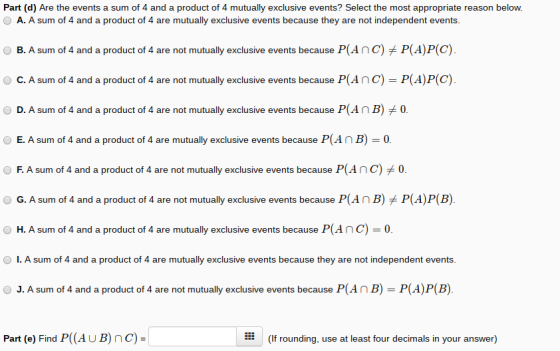
Part (d) Are the events a sum of 4 and a product of 4 mutually exclusive events? Select the most appropriate reason below.
A. A sum of 4 and a product of 4 are mutually exclusive events because they are not independent events.
B. A sum of 4 and a product of 4 are not mutually exclusive events because P(A ∩ C) ≠ P(A) P(C).
C. A sum of 4 and a product of 4 are not mutually exclusive events because P(A ∩ C)=P(A) P(C).
D. A sum of 4 and a product of 4 are not mutually exclusive events because P(A ∩ B) ≠ 0.
E. A sum of 4 and a product of 4 are mutually exclusive events because P(A ∩ B)=0.
F. A sum of 4 and a product of 4 are not mutually exclusive events because P(A ∩ C) ≠ 0.
G. A sum of 4 and a product of 4 are not mutually exclusive events because P(A ∩ B) ≠ P(A) P(B).
H. A sum of 4 and a product of 4 are mutually exclusive events because P(A ∩ C)=0.
I. A sum of 4 and a product of 4 are mutually exclusive events because they are not independent events.
J. A sum of 4 and a product of 4 are not mutually exclusive events because P(A ∩ B)=P(A) P(B).
Part (e) Find P((A ∪ B) ∩ C)=
(If rounding, use at least four decimals in your answer)

Homework Answers
The total number of outcomes (n) in this case are = 92 = 81. The events A, B and C can be written as:
A = { (1,3), (2,2), (3,1) }
B = { (1,3), (2,4), (3,1), (3,5), (4,2), (4,6), (5,3), (5,7), (6,4), (6,8), (7,5), (7,9), (8,6), (9,7) }
C = { (1,4), (2,2), (4,1) }
Let n(A), n(B) and n(C) denote the number of cases favourable to events A, B and C respectively. Thus, n(A) = 3, n(B) = 14 and n(C) = 3.



Part a) P(top sides of the two die do not sum to 4) = 1 - P(top sides sum to 4)
= 1 - P(A) = 1 - 0.0370 = 0.9630
Part b) P(top sides of the two die sum to 4 or the absolute difference is equal to 2) = P(A or B) = P(A+B)
We know that, 
Now, 


Part c) We know that


Part d) Two events are said to be mutually
exclusive if their intersection is  . In this case, the
events 'sum of 4' and 'product of 4' are the events A and C
respectively.
. In this case, the
events 'sum of 4' and 'product of 4' are the events A and C
respectively.

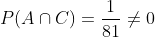
Therefore, the reason F is the most appropriate
answer i.e., sum of 4 and product of 4 are not mutually
exclusive events because  .
.
Part e) 

Hence, 
Add Answer to:
Two, 9-sided, fair die are tossed, and the uppermost face of each die is observed.
You roll two six-sided fair dice. a. Let A be the event that either a 3...
You roll two six-sided fair dice. a. Let A be the event that either a 3 or 4 is rolled first followed by an odd number. P(A) = Round your answer to four decimal places. b. Let B be the event that the sum of the two dice is at most 7. P(B) = Round your answer to four decimal places. c. Are A and B mutually exclusive events? No, they are not Mutually Exclusive Yes, they are Mutually Exclusive d....
One die is rolled. LetA = event the die comes up evenB...
One die is rolled. LetA = event the die comes up evenB = event the die comes up oddC = event the die comes up 4 or moreD = event the die comes up at most 2E = event the die comes up 3give your answer as "yes" or "no" (without the quotation)(a) Are events A and C mutually exclusive?answer:(b) Are events C, D and E mutually exclusive?answer:(c) Are events C and E mutually exclusive?answer:(d) Are events A and B mutually exclusive?answer:(e) Are there any...
Consider a fair six-sided die. Suppose the event A is defined to be rolling an even...
Consider a fair six-sided die. Suppose the event A is defined to be rolling an even number, and the event B is defined to be rolling a number less than 5. a) Find P(A). b) Find P(B^C) c) Find P(A or B) d) Find P(A and B) e) Are the events A and B mutually exclusive/disjoint? Explain.
You roll two six-sided fair dice. a. Let A be the event that either a 4...
You roll two six-sided fair dice. a. Let A be the event that either a 4 or 5 is rolled first followed by an even number. P(A) = Round your answer to four decimal places. b. Let B be the event that the sum of the two dice is at most 5. P(B) = Round your answer to four decimal places. c. Are A and B mutually exclusive events? d. Are A and B independent events?
Two fair dice are tossed and the up face on each die is recorded. Find the...
Two fair dice are tossed and the up face on each die is recorded. Find the probability of observing each of the following events: A:{the difference of the numbers is 1} B:{the sum of the numbers is equal to one} C:{the sum of the numbers is even} P(A)= P(B)= P(C)=
1. Consider a fair four-sided die, with sides 1, 2, 3, and 4, that is rolled...
 1. Consider a fair four-sided die, with sides 1, 2, 3, and 4, that is rolled twice. For example, "1,4" would indicate 1 was rolled first and then 4 was rolled second a) Write down the possible outcomes, i.e., the sample space. (b) List the outcomes in the following events: Event A: The number 4 came up zero times. Event B: The number 4 came up exactly one time. . Event C: The sum of the two rolls is odd...
Two fair dice, one blue and one red, are tossed, and the up face on each die is recorded
Two fair dice, one blue and one red, are tossed, and the up face on each die is recorded. Define the following events: E:{The sum of the numbers is even } F:{A6 on the blue die } Find the following probabilities:(a) P(E)=18 / 36(b) P(F)=4 / 36(c) P(E ∩ F)=Are events E and F independent?A. yesB. no
You roll a pair of fair 6-sided dice: a red die and a blue die. (a)...
You roll a pair of fair 6-sided dice: a red die and a blue die. (a) Consider event A: {the outcome of the red die is more than 3} and event B: {the outcome of the red die is less than 5}. Given that event A occurs, what is the probability that event B occurs? (b) Are A and B mutually exclusive (i.e., disjoint)? (c) Are A and B independent? (d) Calculate the probability of event C: {the outcome of...
You roll a pair of fair 6-sided dice: a red die and a blue die. (a)...
You roll a pair of fair 6-sided dice: a red die and a blue die. (a) Consider event A: {the outcome of the red die is more than 3} and event B: {the outcome of the red die is less than 5}. Given that event A occurs, what is the probability that event B occurs? (b) Are A and B mutually exclusive (i.e., disjoint)? (c) Are A and B independent? (d) Calculate the probability of event C: {the outcome of...
A bicycle company makes two mountain bike models that each come in three colors. Use the...
 A bicycle company makes two mountain bike models that each come in three colors. Use the following table, which shows the production volumes for one week, to answer parts a through d. Model XK-50 FL-99 Color Blue Brown 290 90 38 207 White 191 127 a. Based on the relative frequency assessment method, what is the probability that a manufactured item is brown? P(brown) = (Round to four decimal places as needed.) b. What is the probability that the product...
 1. Consider a fair four-sided die, with sides 1, 2, 3, and 4, that is rolled twice. For example, "1,4" would indicate 1 was rolled first and then 4 was rolled second a) Write down the possible outcomes, i.e., the sample space. (b) List the outcomes in the following events: Event A: The number 4 came up zero times. Event B: The number 4 came up exactly one time. . Event C: The sum of the two rolls is odd...
 A bicycle company makes two mountain bike models that each come in three colors. Use the following table, which shows the production volumes for one week, to answer parts a through d. Model XK-50 FL-99 Color Blue Brown 290 90 38 207 White 191 127 a. Based on the relative frequency assessment method, what is the probability that a manufactured item is brown? P(brown) = (Round to four decimal places as needed.) b. What is the probability that the product...
Most questions answered within 3 hours.
-
Where is the error in this code sequence?
String s1 = "Hello";
String s2 = "ello";...
asked 10 months ago -
Financial data for Joel de Paris, Inc., for last year
follow:
Joel de Paris, Inc.
Balance...
asked 10 months ago -
Consider this reaction:
Al2(SO4)3 (aq)+ BaCl3
(aq) Al2Cl6 (aq)- +
3BaSO4(s) . What is the...
asked 10 months ago -
Suppose that Savneet is considering increasing her
recent random sample from 20 car rentals to 40...
asked 10 months ago -
Trucks arrive at an unloading terminal at an average rate of 120
per hour.
Trucks arrive...
asked 10 months ago -
Why are methanol and ethanol completely soluble in water while
octanol is not very little soluble....
asked 10 months ago -
A facilities manager at a university reads in a research report
that the mean amount of...
asked 10 months ago -
When the CuSO4 is rehydrated by adding water to the anhydrous
compound, is this an endothermic...
asked 10 months ago -
A ray of sunlight is passing from diamond into crown glass; the
angle of incidence is...
asked 10 months ago -
A block of mass 0.249 kg is placed on top of a light, vertical
spring of...
asked 10 months ago -
how do the kidneys compensate in the presences of acidosis
a) trigger hyperventilate
b) reserve acid...
asked 10 months ago -
Question 501 pts
The rental rate of capital to the firm increases. Which of the
following...
asked 10 months ago