
Homework Answers
Add Answer to:
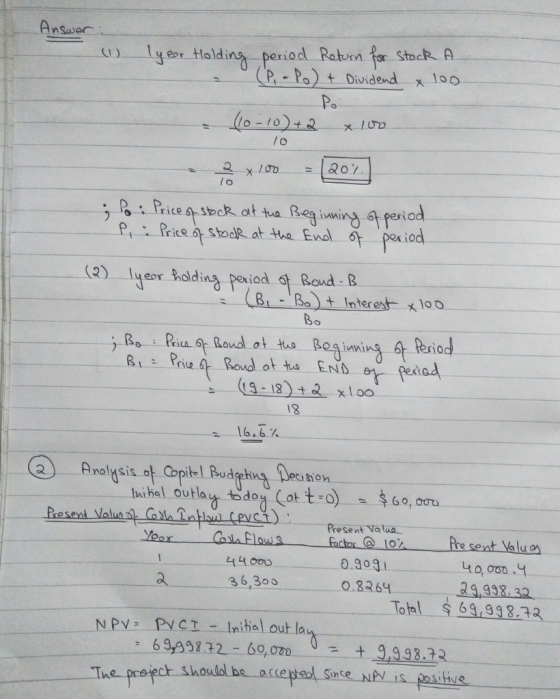
1.An investor bought Stock A and Bond B at the beginning of 2018, and sold them...
If an investor invested in Facebook stock and bought the shares on day of the IPO...
If an investor invested in Facebook stock and bought the shares on day of the IPO at the offer price - Estimate the investor’s first day return. Give your comments on the first day return. - Estimate the long-term performance of Facebook in the post-IPO period at the end of each financial year from the IPO date to 31 December 2014, that is, what is the investor’s holding period return since the day he/she bought the shares to the end...
Information about three securities appears next. Stock 1 Stock 2 Bond 1 Beginning-of- Year Price $43.20...
 Information about three securities appears next. Stock 1 Stock 2 Bond 1 Beginning-of- Year Price $43.20 $ 1.95 $1,090 End-of-Year Interest/Dividend Price Paid $47.45 $ 2.20 $ 2.09 $ 0 $1,118 $ 48.00 a. Assuming interest and dividends are paid annually, calculate the annual holding period return on each security. (Round your answers to 1 decimal place.) Annual Holding Period Return Stock 1 Stock 2 Bond 1
(Bond valuation) At the beginning of the year, you bought $1,000 per value corporate bond with an yed to maturity o...
 (Bond valuation) At the beginning of the year, you bought $1,000 per value corporate bond with an yed to maturity of 13 percent. Today the bond sols for $770 maturity date of 18 years. When you bought the bond, it had an expected What did you pay for the bond b. If you sold the bond at the end of the youwhat would be your one period rotum on the investments that you did not receive y orest payment during...
Homework 1. The investor (in Example 2) who bought this bond for 1,149 TL will obtain...
 Homework 1. The investor (in Example 2) who bought this bond for 1,149 TL will obtain 12% annual return on the average. Suppose that interest rate of the market will stay fixed to 12% next 8 years. What would be the price of the bond at the end of each year?
An investor purchases a nine-year, 7% annual coupon payment bond at a price equal to par...
An investor purchases a nine-year, 7% annual coupon payment bond at a price equal to par value. After the bond is purchased and before the first coupon is received, interest rates increase to 8%. The investor sells the bond after five years. Assume that interest rates remain unchanged at 8% over the five-year holding period. Assuming that all coupons are reinvested over the holding period, the investor's five-year horizon yield is closest to: 1. 5.66% 2. 6.62% 3. 7.12%
1 An investor bought 3 shares of stock A in 2010 aer ex-dividend dae activly traded...
 1 An investor bought 3 shares of stock A in 2010 aer ex-dividend dae activly traded a stock during 2010-2013 She purchased 2 more shares in 2011, sold 1 share in 2012 and then sold all her holding in The stock paid $2 dividend per shane at the end of each year 2013 ater exdiv date 3 1. Flin the the blanks cun shares entted to dividends CF for buying selling siock CF trom dvidends investors net cash ow new...
H Ch 5 HW Saved Information about three securities appears next. 10 points Stock 1 Stock...
 H Ch 5 HW Saved Information about three securities appears next. 10 points Stock 1 Stock 2 Bond 1 Beginning-of- Year Price $43.10 $ 1.85 $1,080 End-of-Year Interest/Dividend Price Paid $ 47.35 $ 2.10 $ 1.99 $ 0 $1,108 $ 47.00 8 02:04:10 a. Assuming interest and dividends are paid annually, calculate the annual holding period return on each security. (Round your answers to 1 decimal place.) eBook Annual Holding Period Return Stock 1 % Print Stock 2 Bond 1...
In all cases of common stock, the investor wishes to hold the common stock for various...
 In all cases of common stock, the investor wishes to hold the common stock for various holding periods. 1.Calculate the value of a 10-year, non-coupon bond, which has a par value of S 1,000, pays 9% interest, and the investor wants an 11% return. Explain the meaning of your result. 2. Calculate the value of a coupon bond that matures in 11 years, which has an even value of $ 1.000, pays 8% interest and the investor wants a 9%...
if an investor bought a 6% annual coupon bond for $1020 and sold it 2 years...
if an investor bought a 6% annual coupon bond for $1020 and sold it 2 years later for $1080, the annual rate of return on her 2-year investment will be a)10.65% b)17.65% c)11.76% d)8.47%
Do not use Excel please, show work Margined Long Position Name Date Suppose that an investor...
 Do not use Excel please, show work
Margined Long Position Name Date Suppose that an investor buys 300 shares on margin at $40 per share. The initial margin is 50% and the maintenance margin is 30%. After one year, the investor sells the shares for $38 and closes the long position. During the holding period, the shares paid a dividend of S1.30 per share. Interest on the margin loan is 7% annual. Show the calculations for the numbers you enter...
Do not use Excel please, show work
Margined Long Position Name Date Suppose that an investor buys 300 shares on margin at $40 per share. The initial margin is 50% and the maintenance margin is 30%. After one year, the investor sells the shares for $38 and closes the long position. During the holding period, the shares paid a dividend of S1.30 per share. Interest on the margin loan is 7% annual. Show the calculations for the numbers you enter...
 Information about three securities appears next. Stock 1 Stock 2 Bond 1 Beginning-of- Year Price $43.20 $ 1.95 $1,090 End-of-Year Interest/Dividend Price Paid $47.45 $ 2.20 $ 2.09 $ 0 $1,118 $ 48.00 a. Assuming interest and dividends are paid annually, calculate the annual holding period return on each security. (Round your answers to 1 decimal place.) Annual Holding Period Return Stock 1 Stock 2 Bond 1
 (Bond valuation) At the beginning of the year, you bought $1,000 per value corporate bond with an yed to maturity of 13 percent. Today the bond sols for $770 maturity date of 18 years. When you bought the bond, it had an expected What did you pay for the bond b. If you sold the bond at the end of the youwhat would be your one period rotum on the investments that you did not receive y orest payment during...
 Homework 1. The investor (in Example 2) who bought this bond for 1,149 TL will obtain 12% annual return on the average. Suppose that interest rate of the market will stay fixed to 12% next 8 years. What would be the price of the bond at the end of each year?
 1 An investor bought 3 shares of stock A in 2010 aer ex-dividend dae activly traded a stock during 2010-2013 She purchased 2 more shares in 2011, sold 1 share in 2012 and then sold all her holding in The stock paid $2 dividend per shane at the end of each year 2013 ater exdiv date 3 1. Flin the the blanks cun shares entted to dividends CF for buying selling siock CF trom dvidends investors net cash ow new...
 H Ch 5 HW Saved Information about three securities appears next. 10 points Stock 1 Stock 2 Bond 1 Beginning-of- Year Price $43.10 $ 1.85 $1,080 End-of-Year Interest/Dividend Price Paid $ 47.35 $ 2.10 $ 1.99 $ 0 $1,108 $ 47.00 8 02:04:10 a. Assuming interest and dividends are paid annually, calculate the annual holding period return on each security. (Round your answers to 1 decimal place.) eBook Annual Holding Period Return Stock 1 % Print Stock 2 Bond 1...
 In all cases of common stock, the investor wishes to hold the common stock for various holding periods. 1.Calculate the value of a 10-year, non-coupon bond, which has a par value of S 1,000, pays 9% interest, and the investor wants an 11% return. Explain the meaning of your result. 2. Calculate the value of a coupon bond that matures in 11 years, which has an even value of $ 1.000, pays 8% interest and the investor wants a 9%...
 Do not use Excel please, show work
Margined Long Position Name Date Suppose that an investor buys 300 shares on margin at $40 per share. The initial margin is 50% and the maintenance margin is 30%. After one year, the investor sells the shares for $38 and closes the long position. During the holding period, the shares paid a dividend of S1.30 per share. Interest on the margin loan is 7% annual. Show the calculations for the numbers you enter...
Do not use Excel please, show work
Margined Long Position Name Date Suppose that an investor buys 300 shares on margin at $40 per share. The initial margin is 50% and the maintenance margin is 30%. After one year, the investor sells the shares for $38 and closes the long position. During the holding period, the shares paid a dividend of S1.30 per share. Interest on the margin loan is 7% annual. Show the calculations for the numbers you enter...
Most questions answered within 3 hours.
-
Where is the error in this code sequence?
String s1 = "Hello";
String s2 = "ello";...
asked 11 months ago -
Financial data for Joel de Paris, Inc., for last year
follow:
Joel de Paris, Inc.
Balance...
asked 11 months ago -
Consider this reaction:
Al2(SO4)3 (aq)+ BaCl3
(aq) Al2Cl6 (aq)- +
3BaSO4(s) . What is the...
asked 11 months ago -
Suppose that Savneet is considering increasing her
recent random sample from 20 car rentals to 40...
asked 11 months ago -
Trucks arrive at an unloading terminal at an average rate of 120
per hour.
Trucks arrive...
asked 11 months ago -
Why are methanol and ethanol completely soluble in water while
octanol is not very little soluble....
asked 11 months ago -
A facilities manager at a university reads in a research report
that the mean amount of...
asked 11 months ago -
When the CuSO4 is rehydrated by adding water to the anhydrous
compound, is this an endothermic...
asked 11 months ago -
A ray of sunlight is passing from diamond into crown glass; the
angle of incidence is...
asked 11 months ago -
A block of mass 0.249 kg is placed on top of a light, vertical
spring of...
asked 11 months ago -
how do the kidneys compensate in the presences of acidosis
a) trigger hyperventilate
b) reserve acid...
asked 11 months ago -
Question 501 pts
The rental rate of capital to the firm increases. Which of the
following...
asked 11 months ago