
Homework Answers
Use the coulomb's law
F =k*q1*q2/(r^2)
For each point,
resolve force into x and y components.

Add Answer to:
Could you please draw a diagram as well. Have troubles
wrapping my head around it.
2....
72. M GO Three point charges have equal magnitudes, two being positive and one negative. These...
 72. M GO Three point charges have equal magnitudes, two being positive and one negative. These charges are fixed to the corners of an equilateral triangle, as the drawing shows. The magnitude of each of the charges is 5.0 uC, and the lengths of the sides of the triangle are 3.0 cm. Calculate the magnitude of the net force that each charge experiences. PROBLEM 72 A
Three point charges have equal magnitudes, two being positive and one negative. These charges are fixed...
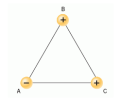 Three point charges have equal magnitudes, two being positive
and one negative. These charges are fixed to the corners of an
equilateral triangle, as the drawing shows. The magnitude of each
of the charges is 2.6 µC, and the lengths of the sides of the
triangle are 2.0cm. Calculate the magnitude of the net force that
each charge experiences.
FA = ?
FB = ?
FC = ?
***Units for all answers will be
Newtons*****
Three point charges have equal magnitudes, two being positive
and one negative. These charges are fixed to the corners of an
equilateral triangle, as the drawing shows. The magnitude of each
of the charges is 2.6 µC, and the lengths of the sides of the
triangle are 2.0cm. Calculate the magnitude of the net force that
each charge experiences.
FA = ?
FB = ?
FC = ?
***Units for all answers will be
Newtons*****
Three point charges have equal magnitudes, two being positive and one negative. These charges are fixed...
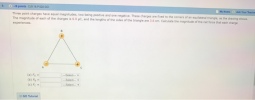 Three point charges have equal magnitudes, two being positive and one negative. These charges are fixed to the corners of an equilateral triangle, as the drawing shows. The magnitude of each of the charge is 6.0 mu C, and the lengths of the sides of the triangle are 3.6 cm. Calculate the magnitude of the net force that each charge experiences. F_A = F_B = F_C =
I only need the answer and explanation for charge A Three point charges have equal magnitudes,...
 I only need the answer and explanation for charge A
Three point charges have equal magnitudes, two being positive and one negative. These charges are fixed to the corners of an equilateral triangle, as the drawing shows. The magnitude of each of the charges is 3.0 C, and the lengths of the sides of the triangle are 1.5 cm. Calculate the magnitude of the net force that each charge experiences. (a) ta =
I only need the answer and explanation for charge A
Three point charges have equal magnitudes, two being positive and one negative. These charges are fixed to the corners of an equilateral triangle, as the drawing shows. The magnitude of each of the charges is 3.0 C, and the lengths of the sides of the triangle are 1.5 cm. Calculate the magnitude of the net force that each charge experiences. (a) ta =
(Revised on 2/4/19) 1. Two point charges, separated by 1.5 cn, have charge values of +2.0...
 (Revised on 2/4/19) 1. Two point charges, separated by 1.5 cn, have charge values of +2.0 and-4.0 pc, respectively. What is the value of the mutual force between them? (ke 8.99 x 10% Nm2/c2 (ANS:320 N) 2. Two point charges each have a value of 30.0 mC and are separated by a distance of 4.00 cm. What is the electric field midway between the two charges? (ANS: zero) 3. If О--16-nc..,. 3.0 n, and b-4.0 m, what is the magnitude...
Note: This test contains ten questions from chapter 19 to chapter 27. For full credit, you...
 Note: This test contains ten questions from chapter 19 to chapter 27. For full credit, you should show all the steps of your numerical answers. No credit would be earned for just circling the right answers. Chapter 19 - Electric Potential and Electric Potential Energy 1. Two point charges are of + 7 uC and - 4 C are held at the corners of a rectangle as shown. The lengths of the sides of rectangle are 0.15 m, and 0.05...
Hello, I need question 1 sections a,b,and c. Please make around a page long. CHAPTER 4...
 Hello, I need question 1 sections a,b,and c. Please make around
a page long.
CHAPTER 4 Techniques for Understanding Consumer Demand and Behavior 109 t effect. ed that managers be familiar with both approaches because each provides useful ues need to realize that marketing analysis builkds on the fundamental eco- of demand and elasticity. Marketers take these basie economie n Table 3.7 in goies and develop analyses of brand differentiation, market segmentation, and dct pricing, While some of the formal...
Hello, I need question 1 sections a,b,and c. Please make around
a page long.
CHAPTER 4 Techniques for Understanding Consumer Demand and Behavior 109 t effect. ed that managers be familiar with both approaches because each provides useful ues need to realize that marketing analysis builkds on the fundamental eco- of demand and elasticity. Marketers take these basie economie n Table 3.7 in goies and develop analyses of brand differentiation, market segmentation, and dct pricing, While some of the formal...
 72. M GO Three point charges have equal magnitudes, two being positive and one negative. These charges are fixed to the corners of an equilateral triangle, as the drawing shows. The magnitude of each of the charges is 5.0 uC, and the lengths of the sides of the triangle are 3.0 cm. Calculate the magnitude of the net force that each charge experiences. PROBLEM 72 A
 Three point charges have equal magnitudes, two being positive
and one negative. These charges are fixed to the corners of an
equilateral triangle, as the drawing shows. The magnitude of each
of the charges is 2.6 µC, and the lengths of the sides of the
triangle are 2.0cm. Calculate the magnitude of the net force that
each charge experiences.
FA = ?
FB = ?
FC = ?
***Units for all answers will be
Newtons*****
Three point charges have equal magnitudes, two being positive
and one negative. These charges are fixed to the corners of an
equilateral triangle, as the drawing shows. The magnitude of each
of the charges is 2.6 µC, and the lengths of the sides of the
triangle are 2.0cm. Calculate the magnitude of the net force that
each charge experiences.
FA = ?
FB = ?
FC = ?
***Units for all answers will be
Newtons*****
 Three point charges have equal magnitudes, two being positive and one negative. These charges are fixed to the corners of an equilateral triangle, as the drawing shows. The magnitude of each of the charge is 6.0 mu C, and the lengths of the sides of the triangle are 3.6 cm. Calculate the magnitude of the net force that each charge experiences. F_A = F_B = F_C =
 I only need the answer and explanation for charge A
Three point charges have equal magnitudes, two being positive and one negative. These charges are fixed to the corners of an equilateral triangle, as the drawing shows. The magnitude of each of the charges is 3.0 C, and the lengths of the sides of the triangle are 1.5 cm. Calculate the magnitude of the net force that each charge experiences. (a) ta =
I only need the answer and explanation for charge A
Three point charges have equal magnitudes, two being positive and one negative. These charges are fixed to the corners of an equilateral triangle, as the drawing shows. The magnitude of each of the charges is 3.0 C, and the lengths of the sides of the triangle are 1.5 cm. Calculate the magnitude of the net force that each charge experiences. (a) ta =
 (Revised on 2/4/19) 1. Two point charges, separated by 1.5 cn, have charge values of +2.0 and-4.0 pc, respectively. What is the value of the mutual force between them? (ke 8.99 x 10% Nm2/c2 (ANS:320 N) 2. Two point charges each have a value of 30.0 mC and are separated by a distance of 4.00 cm. What is the electric field midway between the two charges? (ANS: zero) 3. If О--16-nc..,. 3.0 n, and b-4.0 m, what is the magnitude...
 Note: This test contains ten questions from chapter 19 to chapter 27. For full credit, you should show all the steps of your numerical answers. No credit would be earned for just circling the right answers. Chapter 19 - Electric Potential and Electric Potential Energy 1. Two point charges are of + 7 uC and - 4 C are held at the corners of a rectangle as shown. The lengths of the sides of rectangle are 0.15 m, and 0.05...
 Hello, I need question 1 sections a,b,and c. Please make around
a page long.
CHAPTER 4 Techniques for Understanding Consumer Demand and Behavior 109 t effect. ed that managers be familiar with both approaches because each provides useful ues need to realize that marketing analysis builkds on the fundamental eco- of demand and elasticity. Marketers take these basie economie n Table 3.7 in goies and develop analyses of brand differentiation, market segmentation, and dct pricing, While some of the formal...
Hello, I need question 1 sections a,b,and c. Please make around
a page long.
CHAPTER 4 Techniques for Understanding Consumer Demand and Behavior 109 t effect. ed that managers be familiar with both approaches because each provides useful ues need to realize that marketing analysis builkds on the fundamental eco- of demand and elasticity. Marketers take these basie economie n Table 3.7 in goies and develop analyses of brand differentiation, market segmentation, and dct pricing, While some of the formal...
Most questions answered within 3 hours.
-
Where is the error in this code sequence?
String s1 = "Hello";
String s2 = "ello";...
asked 10 months ago -
Financial data for Joel de Paris, Inc., for last year
follow:
Joel de Paris, Inc.
Balance...
asked 10 months ago -
Consider this reaction:
Al2(SO4)3 (aq)+ BaCl3
(aq) Al2Cl6 (aq)- +
3BaSO4(s) . What is the...
asked 10 months ago -
Suppose that Savneet is considering increasing her
recent random sample from 20 car rentals to 40...
asked 10 months ago -
Trucks arrive at an unloading terminal at an average rate of 120
per hour.
Trucks arrive...
asked 10 months ago -
Why are methanol and ethanol completely soluble in water while
octanol is not very little soluble....
asked 10 months ago -
A facilities manager at a university reads in a research report
that the mean amount of...
asked 10 months ago -
When the CuSO4 is rehydrated by adding water to the anhydrous
compound, is this an endothermic...
asked 10 months ago -
A ray of sunlight is passing from diamond into crown glass; the
angle of incidence is...
asked 10 months ago -
A block of mass 0.249 kg is placed on top of a light, vertical
spring of...
asked 10 months ago -
how do the kidneys compensate in the presences of acidosis
a) trigger hyperventilate
b) reserve acid...
asked 10 months ago -
Question 501 pts
The rental rate of capital to the firm increases. Which of the
following...
asked 10 months ago