


Homework Answers
1.Slope of budegt line is the ratio of prices.
Answer-B
2.The Y axis is used to represent price.
Answer-B
3.Lower taxes reduce marginal cost of production and shift the supply curve to the right.
Answer-B
Add Answer to:
The slope of a budget constraint line is influenced by Select one: a. the cost of...
Help Which one of the following is not a non-price determinant of demand? Select one: a. The number of consumers b. Producer expectations of future prices c. Tastes and preferences d. Prices of r...
 Help Which one of the following is not a non-price determinant of demand? Select one: a. The number of consumers b. Producer expectations of future prices c. Tastes and preferences d. Prices of related goods and services e. Available assets
Help Which one of the following is not a non-price determinant of demand? Select one: a. The number of consumers b. Producer expectations of future prices c. Tastes and preferences d. Prices of related goods and services e. Available assets
Help Which one of the following is not a non-price determinant of demand? Select one: a. The number of consumers b. Producer expectations of future prices c. Tastes and preferences d. Prices of related goods and services e. Available assets
Economics Graphing Question (Please illustrate the graph) Which of the following is not one of the...
 Economics Graphing Question (Please illustrate the graph)
Which of the following is not one of the five major factors that shifts the demand curve when it changes? A The price of tho god ioet OB. Tastes and preferences. ○ C. The price of substitute goods. O D. The number of buyers. When one of the five major factors changes, causing an increase in demand, the demand curve shifts rightward The graph to the right illustrates the demand for smartphones in...
Economics Graphing Question (Please illustrate the graph)
Which of the following is not one of the five major factors that shifts the demand curve when it changes? A The price of tho god ioet OB. Tastes and preferences. ○ C. The price of substitute goods. O D. The number of buyers. When one of the five major factors changes, causing an increase in demand, the demand curve shifts rightward The graph to the right illustrates the demand for smartphones in...
The measure of variability that is influenced most by extreme values is Select one: Oa. the...
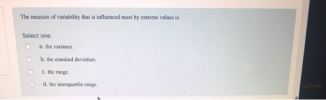 The measure of variability that is influenced most by extreme values is Select one: Oa. the variance. O O O b. the standard deviation. c. the range. d. the interquartile range.
Hi i need answer for this question blew. 2*. Assume that Bob has a budget constraint...
Hi i need answer for this question blew. 2*. Assume that Bob has a budget constraint p1x1 + p2x2 = m, and that his preferences are represented by the Cobb-Douglas utility function U(x1, x2) = x1 c x2 d , where c>0 and d>0. State Bob’s optimization (utility maximization) problem. A-Now assume that c=1/4 and d=3/4, m=160, p1=4 and p2=2. Calculate the income and substitution effects from an increase in price of x1 from p1=4 to p1=5. b) Illustrate these...
2*. Assume that Bob has a budget constraint p1x1 + p2x2 = m, and that his...
2*. Assume that Bob has a budget constraint p1x1 + p2x2 = m, and that his preferences are represented by the Cobb-Douglas utility function U(x1, x2) = x1 c x2 d , where c>0 and d>0. State Bob’s optimization (utility maximization) problem. a) Set up the Lagrangian function. b) Derive the necessary conditions (the first-order conditions) for an optimal interior solution. c) Show that the MRS (the slope of the indifference curve) is equal to the slope of the budget...
2*. Assume that Bob has a budget constraint p1x1 + p2x2 = m, and that his...
2*. Assume that Bob has a budget constraint p1x1 + p2x2 = m, and that his preferences are represented by the Cobb-Douglas utility function U(x1, x2) = x1 c x2 d , where c>0 and d>0. State Bob’s optimization (utility maximization) problem. a) Set up the Lagrangian function. b) Derive the necessary conditions (the first-order conditions) for an optimal interior solution. c) Show that the MRS (the slope of the indifference curve) is equal to the slope of the budget...
Mustapha’s utility function is as follows: U = 10x0.8 y0.6 Budget constraint: 100 = 6x +...
Mustapha’s utility function is as follows: U = 10x0.8 y0.6 Budget constraint: 100 = 6x + 4y a. Solve for the utility-maximizing bundle b. Find the equation of the indifference curve that contains the utility-maximizing bundle. c. Sketch the solution, labeling all relevant items, x on the horizontal axis and y on the vertical axis. d. At the utility-maximizing bundle, what is the increase in Mustapha’s utility from the last dollar spent on good X? What about for good Y?...
What is NOT implied when preferences display no wealth effect? Select one: a. A decision maker...
What is NOT implied when preferences display no wealth effect? Select one: a. A decision maker is willing to accept a different outcome of a transaction if he or she is compensated with a certain amount of money. b. The decision maker is able to pay any compensation that is necessary to come to a preferred outcome. c. The decision maker who has more money at his or her disposal is always able to achieve his most preferred outcome by...
4. An individual has preferences over two goods (x and y) that are represented by function...
 4. An individual has preferences over two goods (x and y) that are represented by function U = min{x,y}. The individual has income $60, the price of x is $4 and the price of good y is $2. (a) What kind of goods are these to the individual? (i.e. what "special case” is this?) (b) What is this individual's budget constraint? (c) What is this individual's optimal bundle of x and y? [HINT: You can't take the derivative of this...
(Ref. Ch. 14 Exercise on p. 393. Oakshott's book) Example 18.1 A particular linear programming problem...
 (Ref. Ch. 14 Exercise on p. 393. Oakshott's book) Example 18.1 A particular linear programming problem is formulated as follows: Min. Z 2500x + 3500y Subject to: 5x + by > 250 4x + 3y > 150 x + 2y 70 () Find the x- and y-intercepts (i.e., where the line crosses the axes) of the line that is for the constraint 5x + 6y > 250 Select one: a. (x,y) (0,41.67) and (x, y) = (50,0) o b.(x,y) (41.67,0)...
 Help Which one of the following is not a non-price determinant of demand? Select one: a. The number of consumers b. Producer expectations of future prices c. Tastes and preferences d. Prices of related goods and services e. Available assets
Help Which one of the following is not a non-price determinant of demand? Select one: a. The number of consumers b. Producer expectations of future prices c. Tastes and preferences d. Prices of related goods and services e. Available assets
Help Which one of the following is not a non-price determinant of demand? Select one: a. The number of consumers b. Producer expectations of future prices c. Tastes and preferences d. Prices of related goods and services e. Available assets
 Economics Graphing Question (Please illustrate the graph)
Which of the following is not one of the five major factors that shifts the demand curve when it changes? A The price of tho god ioet OB. Tastes and preferences. ○ C. The price of substitute goods. O D. The number of buyers. When one of the five major factors changes, causing an increase in demand, the demand curve shifts rightward The graph to the right illustrates the demand for smartphones in...
Economics Graphing Question (Please illustrate the graph)
Which of the following is not one of the five major factors that shifts the demand curve when it changes? A The price of tho god ioet OB. Tastes and preferences. ○ C. The price of substitute goods. O D. The number of buyers. When one of the five major factors changes, causing an increase in demand, the demand curve shifts rightward The graph to the right illustrates the demand for smartphones in...
 The measure of variability that is influenced most by extreme values is Select one: Oa. the variance. O O O b. the standard deviation. c. the range. d. the interquartile range.
 4. An individual has preferences over two goods (x and y) that are represented by function U = min{x,y}. The individual has income $60, the price of x is $4 and the price of good y is $2. (a) What kind of goods are these to the individual? (i.e. what "special case” is this?) (b) What is this individual's budget constraint? (c) What is this individual's optimal bundle of x and y? [HINT: You can't take the derivative of this...
 (Ref. Ch. 14 Exercise on p. 393. Oakshott's book) Example 18.1 A particular linear programming problem is formulated as follows: Min. Z 2500x + 3500y Subject to: 5x + by > 250 4x + 3y > 150 x + 2y 70 () Find the x- and y-intercepts (i.e., where the line crosses the axes) of the line that is for the constraint 5x + 6y > 250 Select one: a. (x,y) (0,41.67) and (x, y) = (50,0) o b.(x,y) (41.67,0)...
Most questions answered within 3 hours.
-
Where is the error in this code sequence?
String s1 = "Hello";
String s2 = "ello";...
asked 11 months ago -
Financial data for Joel de Paris, Inc., for last year
follow:
Joel de Paris, Inc.
Balance...
asked 11 months ago -
Consider this reaction:
Al2(SO4)3 (aq)+ BaCl3
(aq) Al2Cl6 (aq)- +
3BaSO4(s) . What is the...
asked 11 months ago -
Suppose that Savneet is considering increasing her
recent random sample from 20 car rentals to 40...
asked 11 months ago -
Trucks arrive at an unloading terminal at an average rate of 120
per hour.
Trucks arrive...
asked 11 months ago -
Why are methanol and ethanol completely soluble in water while
octanol is not very little soluble....
asked 11 months ago -
A facilities manager at a university reads in a research report
that the mean amount of...
asked 11 months ago -
When the CuSO4 is rehydrated by adding water to the anhydrous
compound, is this an endothermic...
asked 11 months ago -
A ray of sunlight is passing from diamond into crown glass; the
angle of incidence is...
asked 11 months ago -
A block of mass 0.249 kg is placed on top of a light, vertical
spring of...
asked 11 months ago -
how do the kidneys compensate in the presences of acidosis
a) trigger hyperventilate
b) reserve acid...
asked 11 months ago -
Question 501 pts
The rental rate of capital to the firm increases. Which of the
following...
asked 11 months ago