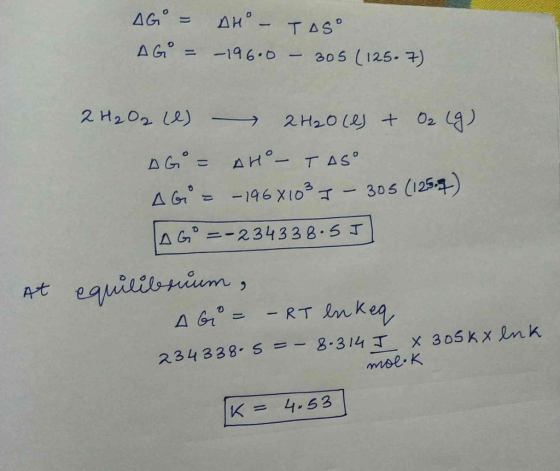
For the reaction 2H2O2(l)2H2O(l) + O2(g) H° = -196.0 kJ and S° = 125.7 J/K The...
For the reaction 2H2O2(l)2H2O(l) + O2(g) H° = -196.0 kJ and S° = 125.7 J/K The equilibrium constant for this reaction at 305.0 K is . Assume that H° and S° are independent of temperature.
AND
The equilibrium constant, Kp, for the following
reaction is 0.215 at 673 K.
NH4I(s)
NH3(g) + HI(g)
If ΔH° for this reaction is 182 kJ, what is the
value of Kp at 775 K?
Kp =
Homework Answers
Add Answer to:
For the reaction 2H2O2(l)2H2O(l) + O2(g) H° = -196.0 kJ and S° =
125.7 J/K The...
1. The equilibrium constant, Kp, for the following reaction is 0.497 at 500 K: PCl5(g) <---->...
1. The equilibrium constant, Kp, for the following reaction is 0.497 at 500 K: PCl5(g) <----> PCl3(g) + Cl2(g) Calculate the equilibrium partial pressures of all species when PCl5(g) is introduced into an evacuated flask at a pressure of 1.00 atm at 500 K. PPCl5 = atm PPCl3 = atm PCl2 = atm 2. The equilibrium constant, Kp, for the following reaction is 0.215 at 673 K: NH4I(s) <----> NH3(g) + HI(g) Calculate the equilibrium partial pressure of HI when...
(1). The equilibrium constant, Kp, for the following reaction is 1.80×10⁻² at 698K. 2HI(g) =H2(g) +...
(1). The equilibrium constant, Kp, for the following reaction is 1.80×10⁻² at 698K. 2HI(g) =H2(g) + I2(g) If an equilibrium mixture of the three gases in a 15.5 L container at 698K contains HI at a pressure of 0.399 atm and H2 at a pressure of 0.562 atm, the equilibrium partial pressure of I2 is atm. (2). Consider the following reaction: PCl5(g) =PCl3(g) + Cl2(g) If 1.17×10⁻³ moles of PCl5, 0.217 moles of PCl3, and 0.351 moles of Cl2 are at...
Hydrogen peroxide decomposes spontaneously to yield water and oxygen gas according to the reaction equation 2H2O2(aq)⟶2H2O(l)+O2(g)2H2O2(aq)⟶2H2O(l)+O2(g)...
Hydrogen peroxide decomposes spontaneously to yield water and oxygen gas according to the reaction equation 2H2O2(aq)⟶2H2O(l)+O2(g)2H2O2(aq)⟶2H2O(l)+O2(g) The activation energy for this reaction is 75 kJ⋅mol−1.75 kJ⋅mol−1. In the presence of a metal catalyst, the activation energy is lowered to 49 kJ⋅mol−1.49 kJ⋅mol−1. At what temperature would the non‑catalyzed reaction need to be run to have a rate equal to that of the metal‑catalyzed reaction at 25 ∘C? T= K
1. For the reaction H2S(g) + 2H2O(l)3H2(g) + SO2(g) H° = 295.4 kJ and S° =...
1. For the reaction H2S(g) + 2H2O(l)3H2(g) + SO2(g) H° = 295.4 kJ and S° = 294.7 J/K The equilibrium constant for this reaction at 345.0 K is _____ Assume that H° and S° are independent of temperature. 2. For the reaction H2+ C2H4 -> C2H6 H° = -137.0 kJ and S° = -120.7 J/K The equilibrium constant for this reaction at 264.0 K is ______. Assume that H° and S° are independent of temperature
A) For the reaction 4HCl(g) + O2(g)---->2H2O(g) + 2Cl2(g) Delta H° = -114.4 kJ and Delta...
A) For the reaction 4HCl(g) + O2(g)---->2H2O(g) + 2Cl2(g) Delta H° = -114.4 kJ and Delta S° = -128.9 J/K The equilibrium constant for this reaction at 306.0 K is _______? Assume that Delta H° and DeltaS° are independent of temperature. B) For the reaction N2(g) + 3H2(g)---->2NH3(g) Delta H° = -92.2 kJ and Delta S° = -198.7 J/K The equilibrium constant for this reaction at 333.0 K is ___? Assume that Delta H° and Delta S° are independent of...
The equilibrium constant, Kc, for the following reaction is 7.00×10⁻⁵ at 673 K. NH4I(s) <-->NH3(g) +...
The equilibrium constant, Kc, for the following reaction is 7.00×10⁻⁵ at 673 K. NH4I(s) <-->NH3(g) + HI(g) Calculate the equilibrium concentration of HI when 0.354 moles of NH4I(s) are introduced into a 1.00 L vessel at 673 K. [HI]= ____M
The equilibrium constant, K, for the following reaction is 7.00×10⁻⁵ at 673 K. NH4I(s)----> NH3(g) +...
The equilibrium constant, K, for the following reaction is 7.00×10⁻⁵ at 673 K. NH4I(s)----> NH3(g) + HI(g) An equilibrium mixture of the solid and the two gases in a 1.00 L flask at 673 K contains 0.388 mol NH4I, 8.37×10⁻³ M NH3 and 8.37×10⁻³ M HI. If the concentration of NH3(g) is suddenly increased to 1.46×10⁻² M, what will be the concentrations of the two gases once equilibrium has been reestablished? [NH3] = ______ M [HI] = _______ M
The equilibrium constant, K, for the following reaction is 7.00×10⁻⁵ at 673 K. NH4I(s) -->NH3(g) +...
The equilibrium constant, K, for the following reaction is 7.00×10⁻⁵ at 673 K. NH4I(s) -->NH3(g) + HI(g) An equilibrium mixture of the solid and the two gases in a 1.00 L flask at 673 K contains 0.335 mol NH4I, 8.37×10⁻³ M NH3 and 8.37×10⁻³ M HI. If the concentration of NH3(g) is suddenly increased to 1.28×10⁻² M, what will be the concentrations of the two gases once equilibrium has been reestablished?
For the reaction 4HCl(g) + O2(g)—>2H2O(g) + 2C12(g) AH = -114.4 kJ and AS°=-128.9 J/K The...
 For the reaction 4HCl(g) + O2(g)—>2H2O(g) + 2C12(g) AH = -114.4 kJ and AS°=-128.9 J/K The equilibrium constant for this reaction at 278.0 K is Assume that AH and ASº are independent of temperature.
For the reaction N2(g) + O2(g)2NO(g) H° = 180.6 kJ and S° = 24.9 J/K The...
For the reaction N2(g) + O2(g)2NO(g) H° = 180.6 kJ and S° = 24.9 J/K The equilibrium constant for this reaction at 259.0 K is . Assume that H° and S° are independent of temperature.
 For the reaction 4HCl(g) + O2(g)—>2H2O(g) + 2C12(g) AH = -114.4 kJ and AS°=-128.9 J/K The equilibrium constant for this reaction at 278.0 K is Assume that AH and ASº are independent of temperature.
Most questions answered within 3 hours.
-
Where is the error in this code sequence?
String s1 = "Hello";
String s2 = "ello";...
asked 11 months ago -
Financial data for Joel de Paris, Inc., for last year
follow:
Joel de Paris, Inc.
Balance...
asked 11 months ago -
Consider this reaction:
Al2(SO4)3 (aq)+ BaCl3
(aq) Al2Cl6 (aq)- +
3BaSO4(s) . What is the...
asked 11 months ago -
Suppose that Savneet is considering increasing her
recent random sample from 20 car rentals to 40...
asked 11 months ago -
Trucks arrive at an unloading terminal at an average rate of 120
per hour.
Trucks arrive...
asked 11 months ago -
Why are methanol and ethanol completely soluble in water while
octanol is not very little soluble....
asked 11 months ago -
A facilities manager at a university reads in a research report
that the mean amount of...
asked 11 months ago -
When the CuSO4 is rehydrated by adding water to the anhydrous
compound, is this an endothermic...
asked 11 months ago -
A ray of sunlight is passing from diamond into crown glass; the
angle of incidence is...
asked 11 months ago -
A block of mass 0.249 kg is placed on top of a light, vertical
spring of...
asked 11 months ago -
how do the kidneys compensate in the presences of acidosis
a) trigger hyperventilate
b) reserve acid...
asked 11 months ago -
Question 501 pts
The rental rate of capital to the firm increases. Which of the
following...
asked 11 months ago