 .
.Homework Answers
| Aspirin use (times per month) | |||||
| 0 | <1 | 1-15 | >16 | ||
| Men | Number of Deaths | 378 | 184 | 127 | 85 |
| Person-year at risk | 646,346 | 486,620 | 389,083 | 201,636 | |
| death per 100,000 | 58.48 | 37.81 | 32.64 | 42.16 | |
| death rate per 100,000 | 0.05848% | 0.03781% | 0.03264% | 0.04216% | |
| Women | Number of Deaths | 284 | 157 | 100 | 73 |
| Person-year at risk | 705,064 | 671,927 | 505,854 | 265,424 | |
| death per 100,000 | 40.28 | 23.37 | 19.77 | 27.5031 | |
| death rate per 100,000 | 0.04028% | 0.02337% | 0.01977% | 0.02750% | |
death rate per 1,00,000 is =
Add Answer to:
.
Case Study The following table shows the number of colon cancer deaths and person-years of...
Case Study The following table shows the number of colon cancer deaths and person-years of risk...
Case Study The following table shows the number of colon cancer deaths and person-years of risk by the frequency of aspirin for males and females. Table 1. Rates of death from colon cancer, according to frequency of aspirin use in the cohort before patients with illness at enrollment were excluded. Aspirin Use (times per month) 0 <1 1-15 >16 Men Number of Deaths 378 184 127 85 Person-years at risk 646,346 486,620 389,083 201,636 Death rate per 100,000 Rate ratio...
Lung Cancer & Smoking Case Study A causal relationship between cigarette smoking and lung cancer was...
 Lung Cancer & Smoking Case Study A causal relationship between cigarette smoking and lung cancer was first suspected in the 1920s on the basis of clinical observations. To test this apparent association, numerous epidemiologic studies were undertaken between 1930 and 1960. Two studies were conducted by Richard Doll and Austin Bradford Hill in Great Britain The first was a case-control study begun in 1947 comparing the smoking habits of lung cancer patients with the smoking habits of other patients. The...
Cigarette Smoking and Cancer Death Rates Deaths per year per 100,000 people Cigarettes Bladder per person...
 Cigarette Smoking and Cancer Death Rates Deaths per year per 100,000 people Cigarettes Bladder per person Massachusetts (a) Draw a scatter diagram of cigarettes smoked versus death rate from bladder cancer 5. (b) Find the estimated regression line. (c) Test the hypothesis, at the 5 percent level of significance that cigarette consumption does not affect the death rate from bladder cancer (d) Repeat part (c) at the 1 percent level of significance.
Recently, South African researchers conducted a study of the relationship between optimism and colon cancer survival....
Recently, South African researchers conducted a study of the relationship between optimism and colon cancer survival. Their hypothesis was that colon cancer patients who had a positive outlook on life would have a lower five-year cumulative incidence of mortality. The study included 100 recently diagnosed colon cancer patients who underwent psychological testing and were found to have an optimistic outlook on life and 100 recently diagnosed colon cancer patients who underwent the same psychological tests and were found to have...
The cohort study also provided mortality rates for cardiovascular disease among smokers and nqnsmokers. The following...
 The cohort study also provided mortality rates for cardiovascular disease among smokers and nqnsmokers. The following table presents lung cancer mortanty data an cardiovascular disease mortality data. ortality rates (per 1,000 person-years), rate ratios, and excess deaths from lung cancer an cardiovascular disease by smoking status, Doll and Hill physician cohort study, Great Britain, 1951-1961 Attributable risk percent among Mortality rate per 1000 person-years Non-smokers 0.07 7.32 Excess deaths per 1,000 Rate ratio ponears mokers 1.3 Lung cancer 1.37 0.99...
Deaths from all Causes Fill-in the tables below with the following information for each of the...
Deaths from all Causes Fill-in the tables below with the following information for each of the age groups: Number of deaths from all causes Number of deaths from accidents (unintentional injuries) Cause-specific death rate for accidents (unintentional injuries) Calculate the age-specific all cause death rates for each group and the proportionate mortality ratio (PMR) for accidents (unintentional injuries). TABLE A 2006 population Deaths in 2006 (All causes) Deaths from Accidents, 2006 Age-Specific All Cause Death Rate (per 100,000) Total 274,633,642...
An changessavednDrive Question 23: How many lung cancer deaths per 1,000 persons per year are attributable to smo...
 An changessavednDrive Question 23: How many lung cancer deaths per 1,000 persons per year are attributable to smoking among the entire population? How many cardiovascular discase deaths? What do these results tell you? The following table shows the relationship between smoking and lung cancer mortality in terms of the effects of stopping smoking Table 5. Number and rate (per 1,000 person-years) of lung cancer deaths for current smokers and smokers by years since quitting. Doll and Hill physician cobort study,...
The study also provided mortality rates for cardiovascular disease among smokers and non-smokers....
 The study also provided mortality rates for cardiovascular disease among smokers and non-smokers. The following table presents lung cancer mortality data and comparable cardiovascular disease mortality data. Table 2. Mortality rates (per 1,000 person-years), rate ratios, and excess deaths from lung cancer and cardiovascular disease by smoking status, Doll and Hill physician cohort study, Great Britain, 1951-1961. Mortality rate per 1,000 person-years Smokers Non-smokers All Rate ratio Excess deaths Attributable risk per 1,000 person-years smokers 1.23 2.19 percent among 1.30...
•2- Use Table (6-4) Titled: Selected Statistics for a Hypothetical Population, July 1st to July 30th...
 •2- Use Table (6-4) Titled: Selected Statistics for a
Hypothetical Population, July 1st to July 30th and calculate the
following mortality rates:
v Crude Mortality Rate or Crude death rate
vInfant Mortality
vNeonatal Mortality Rate
vPerinatal Mortality Rate
vFetal Death Rate (Stillbirth)
vCase fatality rate (Ratio)
vDeath – to – Case Ratio
vMaternal Mortality Rate
vAge – specific mortality rate for persons aged 55 years
or older.
vCause – specific mortality rate for those died from
heart disease.
vCause –...
•2- Use Table (6-4) Titled: Selected Statistics for a
Hypothetical Population, July 1st to July 30th and calculate the
following mortality rates:
v Crude Mortality Rate or Crude death rate
vInfant Mortality
vNeonatal Mortality Rate
vPerinatal Mortality Rate
vFetal Death Rate (Stillbirth)
vCase fatality rate (Ratio)
vDeath – to – Case Ratio
vMaternal Mortality Rate
vAge – specific mortality rate for persons aged 55 years
or older.
vCause – specific mortality rate for those died from
heart disease.
vCause –...
#7 The table to the right represents a random sample of the number of deaths per...
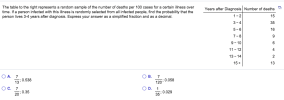 #7
The table to the right represents a random sample of the number of deaths per 100 cases for a certain illness over time. If a person infected with this illness is randomly selected from all infected people, find the probability that the person lives 3-4 years after diagnosis. Express your answer as a simplified fraction and as a decimal Years after Diagnosis Number of deaths 15 35 16 5-6 7-8 9-10 11 -12 13-14 15+ 4 13 OA. 7...
#7
The table to the right represents a random sample of the number of deaths per 100 cases for a certain illness over time. If a person infected with this illness is randomly selected from all infected people, find the probability that the person lives 3-4 years after diagnosis. Express your answer as a simplified fraction and as a decimal Years after Diagnosis Number of deaths 15 35 16 5-6 7-8 9-10 11 -12 13-14 15+ 4 13 OA. 7...
 Lung Cancer & Smoking Case Study A causal relationship between cigarette smoking and lung cancer was first suspected in the 1920s on the basis of clinical observations. To test this apparent association, numerous epidemiologic studies were undertaken between 1930 and 1960. Two studies were conducted by Richard Doll and Austin Bradford Hill in Great Britain The first was a case-control study begun in 1947 comparing the smoking habits of lung cancer patients with the smoking habits of other patients. The...
 Cigarette Smoking and Cancer Death Rates Deaths per year per 100,000 people Cigarettes Bladder per person Massachusetts (a) Draw a scatter diagram of cigarettes smoked versus death rate from bladder cancer 5. (b) Find the estimated regression line. (c) Test the hypothesis, at the 5 percent level of significance that cigarette consumption does not affect the death rate from bladder cancer (d) Repeat part (c) at the 1 percent level of significance.
 The cohort study also provided mortality rates for cardiovascular disease among smokers and nqnsmokers. The following table presents lung cancer mortanty data an cardiovascular disease mortality data. ortality rates (per 1,000 person-years), rate ratios, and excess deaths from lung cancer an cardiovascular disease by smoking status, Doll and Hill physician cohort study, Great Britain, 1951-1961 Attributable risk percent among Mortality rate per 1000 person-years Non-smokers 0.07 7.32 Excess deaths per 1,000 Rate ratio ponears mokers 1.3 Lung cancer 1.37 0.99...
 An changessavednDrive Question 23: How many lung cancer deaths per 1,000 persons per year are attributable to smoking among the entire population? How many cardiovascular discase deaths? What do these results tell you? The following table shows the relationship between smoking and lung cancer mortality in terms of the effects of stopping smoking Table 5. Number and rate (per 1,000 person-years) of lung cancer deaths for current smokers and smokers by years since quitting. Doll and Hill physician cobort study,...
 The study also provided mortality rates for cardiovascular disease among smokers and non-smokers. The following table presents lung cancer mortality data and comparable cardiovascular disease mortality data. Table 2. Mortality rates (per 1,000 person-years), rate ratios, and excess deaths from lung cancer and cardiovascular disease by smoking status, Doll and Hill physician cohort study, Great Britain, 1951-1961. Mortality rate per 1,000 person-years Smokers Non-smokers All Rate ratio Excess deaths Attributable risk per 1,000 person-years smokers 1.23 2.19 percent among 1.30...
 •2- Use Table (6-4) Titled: Selected Statistics for a
Hypothetical Population, July 1st to July 30th and calculate the
following mortality rates:
v Crude Mortality Rate or Crude death rate
vInfant Mortality
vNeonatal Mortality Rate
vPerinatal Mortality Rate
vFetal Death Rate (Stillbirth)
vCase fatality rate (Ratio)
vDeath – to – Case Ratio
vMaternal Mortality Rate
vAge – specific mortality rate for persons aged 55 years
or older.
vCause – specific mortality rate for those died from
heart disease.
vCause –...
•2- Use Table (6-4) Titled: Selected Statistics for a
Hypothetical Population, July 1st to July 30th and calculate the
following mortality rates:
v Crude Mortality Rate or Crude death rate
vInfant Mortality
vNeonatal Mortality Rate
vPerinatal Mortality Rate
vFetal Death Rate (Stillbirth)
vCase fatality rate (Ratio)
vDeath – to – Case Ratio
vMaternal Mortality Rate
vAge – specific mortality rate for persons aged 55 years
or older.
vCause – specific mortality rate for those died from
heart disease.
vCause –...
 #7
The table to the right represents a random sample of the number of deaths per 100 cases for a certain illness over time. If a person infected with this illness is randomly selected from all infected people, find the probability that the person lives 3-4 years after diagnosis. Express your answer as a simplified fraction and as a decimal Years after Diagnosis Number of deaths 15 35 16 5-6 7-8 9-10 11 -12 13-14 15+ 4 13 OA. 7...
#7
The table to the right represents a random sample of the number of deaths per 100 cases for a certain illness over time. If a person infected with this illness is randomly selected from all infected people, find the probability that the person lives 3-4 years after diagnosis. Express your answer as a simplified fraction and as a decimal Years after Diagnosis Number of deaths 15 35 16 5-6 7-8 9-10 11 -12 13-14 15+ 4 13 OA. 7...
Most questions answered within 3 hours.
-
Where is the error in this code sequence?
String s1 = "Hello";
String s2 = "ello";...
asked 10 months ago -
Financial data for Joel de Paris, Inc., for last year
follow:
Joel de Paris, Inc.
Balance...
asked 10 months ago -
Consider this reaction:
Al2(SO4)3 (aq)+ BaCl3
(aq) Al2Cl6 (aq)- +
3BaSO4(s) . What is the...
asked 10 months ago -
Suppose that Savneet is considering increasing her
recent random sample from 20 car rentals to 40...
asked 10 months ago -
Trucks arrive at an unloading terminal at an average rate of 120
per hour.
Trucks arrive...
asked 10 months ago -
Why are methanol and ethanol completely soluble in water while
octanol is not very little soluble....
asked 10 months ago -
A facilities manager at a university reads in a research report
that the mean amount of...
asked 10 months ago -
When the CuSO4 is rehydrated by adding water to the anhydrous
compound, is this an endothermic...
asked 10 months ago -
A ray of sunlight is passing from diamond into crown glass; the
angle of incidence is...
asked 10 months ago -
A block of mass 0.249 kg is placed on top of a light, vertical
spring of...
asked 10 months ago -
how do the kidneys compensate in the presences of acidosis
a) trigger hyperventilate
b) reserve acid...
asked 10 months ago -
Question 501 pts
The rental rate of capital to the firm increases. Which of the
following...
asked 10 months ago