
Homework Answers
Add Answer to:
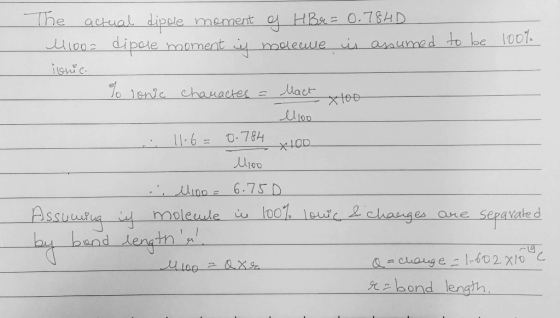
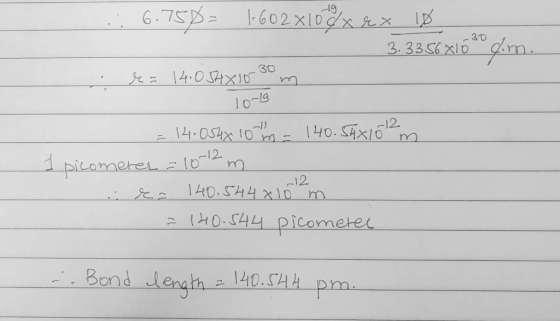
Part B The dipole moment (u) of HBr (a polar covalent molecule) is 0.784D (debye), and...
The dipole moment (μ) of HBr (a polar covalent molecule) is 0.784D (debye), and its percent...
The dipole moment (μ) of HBr (a polar covalent molecule) is 0.784D (debye), and its percent ionic character is 11.6 % . Estimate the bond length of the H−Br bond in picometers. Note that 1 D=3.34×10⁻³⁰ C⋅m and in a bond with 100% ionic character, Q=1.6×10⁻¹⁹ C.
why is this inncorrect? 8 of 21 > Constants Periodic Table Part A The dipole measured...
 why is this inncorrect?
8 of 21 > Constants Periodic Table Part A The dipole measured for HI is 0.380 D. The bond length is 161 pm. What is the percent ionic character of the HI bond? Express your answer as a percent to three significant figures. View Available Hint(s) t uÀ 5 - 0 ELA % ionic character = 4.92 ID : Submit Previous Answers X Incorrect; Try Again; 4 attempts remaining Enter your answer using units of percent....
why is this inncorrect?
8 of 21 > Constants Periodic Table Part A The dipole measured for HI is 0.380 D. The bond length is 161 pm. What is the percent ionic character of the HI bond? Express your answer as a percent to three significant figures. View Available Hint(s) t uÀ 5 - 0 ELA % ionic character = 4.92 ID : Submit Previous Answers X Incorrect; Try Again; 4 attempts remaining Enter your answer using units of percent....
Part A Review Constants Periodic Table Learning Goal: Consider the following element combinations. Classify the bonds...
 Part A Review Constants Periodic Table Learning Goal: Consider the following element combinations. Classify the bonds formed between each pair as ionic, polar covalent, or nonpolar covalent qualitatively based solely on each element's position on the periodic table. To use electronegativity or metal versus nonmetal classifications to distinguish covalent polar covalent, and ionic bonds. not conduct calculations. Drag the appropriate items to their respective bins. When two bonded atoms attract electrons with View Available Hint(s) equal strength, the result is...
21. How many of the following molecules are polar covalent compound? coco: o doc negative charge...
 21. How many of the following molecules are polar covalent compound? coco: o doc negative charge cor - H₂O a) Four b) Zeroc) One d) Two e) Three 22. Ir a solid line represents a covalent bond and a dotted line represents intermolecular atùraction, which of these choices shows a hydrogen bond? a) - N H -0. b) H-H c) O...H-C- d) CH-F- Question 23-26: Indicate the major types of attractive force --- a). ionic bond, b) dipole- dipole attraction,...
 why is this inncorrect?
8 of 21 > Constants Periodic Table Part A The dipole measured for HI is 0.380 D. The bond length is 161 pm. What is the percent ionic character of the HI bond? Express your answer as a percent to three significant figures. View Available Hint(s) t uÀ 5 - 0 ELA % ionic character = 4.92 ID : Submit Previous Answers X Incorrect; Try Again; 4 attempts remaining Enter your answer using units of percent....
why is this inncorrect?
8 of 21 > Constants Periodic Table Part A The dipole measured for HI is 0.380 D. The bond length is 161 pm. What is the percent ionic character of the HI bond? Express your answer as a percent to three significant figures. View Available Hint(s) t uÀ 5 - 0 ELA % ionic character = 4.92 ID : Submit Previous Answers X Incorrect; Try Again; 4 attempts remaining Enter your answer using units of percent....
 Part A Review Constants Periodic Table Learning Goal: Consider the following element combinations. Classify the bonds formed between each pair as ionic, polar covalent, or nonpolar covalent qualitatively based solely on each element's position on the periodic table. To use electronegativity or metal versus nonmetal classifications to distinguish covalent polar covalent, and ionic bonds. not conduct calculations. Drag the appropriate items to their respective bins. When two bonded atoms attract electrons with View Available Hint(s) equal strength, the result is...
 21. How many of the following molecules are polar covalent compound? coco: o doc negative charge cor - H₂O a) Four b) Zeroc) One d) Two e) Three 22. Ir a solid line represents a covalent bond and a dotted line represents intermolecular atùraction, which of these choices shows a hydrogen bond? a) - N H -0. b) H-H c) O...H-C- d) CH-F- Question 23-26: Indicate the major types of attractive force --- a). ionic bond, b) dipole- dipole attraction,...
Most questions answered within 3 hours.
-
Where is the error in this code sequence?
String s1 = "Hello";
String s2 = "ello";...
asked 11 months ago -
Financial data for Joel de Paris, Inc., for last year
follow:
Joel de Paris, Inc.
Balance...
asked 11 months ago -
Consider this reaction:
Al2(SO4)3 (aq)+ BaCl3
(aq) Al2Cl6 (aq)- +
3BaSO4(s) . What is the...
asked 11 months ago -
Suppose that Savneet is considering increasing her
recent random sample from 20 car rentals to 40...
asked 11 months ago -
Trucks arrive at an unloading terminal at an average rate of 120
per hour.
Trucks arrive...
asked 11 months ago -
Why are methanol and ethanol completely soluble in water while
octanol is not very little soluble....
asked 11 months ago -
A facilities manager at a university reads in a research report
that the mean amount of...
asked 11 months ago -
When the CuSO4 is rehydrated by adding water to the anhydrous
compound, is this an endothermic...
asked 11 months ago -
A ray of sunlight is passing from diamond into crown glass; the
angle of incidence is...
asked 11 months ago -
A block of mass 0.249 kg is placed on top of a light, vertical
spring of...
asked 11 months ago -
how do the kidneys compensate in the presences of acidosis
a) trigger hyperventilate
b) reserve acid...
asked 11 months ago -
Question 501 pts
The rental rate of capital to the firm increases. Which of the
following...
asked 11 months ago