
Homework Answers
The units are as follow:
1)Lenght:- Meter (m)
2.Mass:- Kilogram (kg)
3)Volume:-
Add Answer to:
1. In this experiment, what units are used: o Length? o Mass? o Volume? Density?
1 points 0/1 Subnissions Used Which combination of units expresses density? O mass/(time) 2 O mass/m...
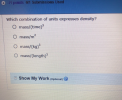 1 points 0/1 Subnissions Used Which combination of units expresses density? O mass/(time) 2 O mass/m O mass/(kg) mass/(length)3 Show My Work (Optional)
Why is volume more precise? Given your experience in mass determinations (Experiment 1) and with volumetric...
 Why is volume more precise?
Given your experience in mass determinations (Experiment 1) and with volumetric glassware (Experiment 2), which factor used in calculating the density- mass or volume-is likely to be measurable with greater precision? Explain. 6.
Why is volume more precise?
Given your experience in mass determinations (Experiment 1) and with volumetric glassware (Experiment 2), which factor used in calculating the density- mass or volume-is likely to be measurable with greater precision? Explain. 6.
1. An experiment is performed in the lab, where the mass and the volume of an...
1. An experiment is performed in the lab, where the mass and the volume of an object are measured to determine its density. Two completely different valid methods are used. Each experimental method to measure the density is performed, two considerable sets of data are taken on each and the results are compared. The results of the density measurement by each method should be ... a. dependent on the mass and the volume of the object b. completely different, because...
What volume of a 15% by mass NaOH, which its density is 1.116g/mL, should be used...
What volume of a 15% by mass NaOH, which its density is 1.116g/mL, should be used to make 5.40L of an NaOH solution with a pH of 10.2?
Analysis questions part 1 and part 2. Data and Calculations- Length, Mass, Volume, Density and Time...
 Analysis questions part 1 and part 2.
Data and Calculations- Length, Mass, Volume, Density and Time Part 1: Estimating Various Measurements Table 1 Estimated Actual % Difference 1.00 m 15 m 93.33% Length (m) Time (s) Mass (g) Part 2: Measurements Using Various Instruments Note: As always, be sure to record to the precision each device is capable of. Measurement of your hand span: 16 cm First Object Measured: eScience Lab Box Table 2 Length Width Height Volume 2.00 hands...
Analysis questions part 1 and part 2.
Data and Calculations- Length, Mass, Volume, Density and Time Part 1: Estimating Various Measurements Table 1 Estimated Actual % Difference 1.00 m 15 m 93.33% Length (m) Time (s) Mass (g) Part 2: Measurements Using Various Instruments Note: As always, be sure to record to the precision each device is capable of. Measurement of your hand span: 16 cm First Object Measured: eScience Lab Box Table 2 Length Width Height Volume 2.00 hands...
Density is equal to the mass of a substance divided by its volume: density = mass...
 Density is equal to the mass of a substance divided by its volume: density = mass of substance/volume of substance Water displacement can be used to find the volume of a solid by placing the object in a known volume of water. When the object is added to water, the measured total volume increases. This final volume is equal to the volume of the initial water plus the volume of the solid object added. To determine the volume of the...
The density experiment involves taking average mass and displaced volume measurements for multiple samples of metal....
 The density experiment involves taking average mass and displaced volume measurements for multiple samples of metal. A student ascertained that the identity of their unknown metal was zinc (d 7.14 g/mL). However, upon consulting their teaching assistant, they learned that the true identity of the metal was copper (d = 8.96 g/mL). What error could the student have made when performing the experiment that would have led to the student's original conclusion? 7.
Part A What volume of a 150% by mass NaOH solution, which has a density of...
 Part A What volume of a 150% by mass NaOH solution, which has a density of 1.116/mL should be used to make 465 L of an NaOH solution with a pH of 1027 Express your answer to one significant figure and include the appropriate units. Value Units Submit Previous Answers Request Answer X Incorrect: Try Again: 4 attempts remaining
The mass unit associated with density is usually grams. If the volume (in mL or cm3)...
The mass unit associated with density is usually grams. If the volume (in mL or cm3) is multiplied by the density (g/mL or g/cm3) the volume units will cancel out, leaving only the mass units. Keep in mind that the volume and density must use the same volume unit for the cancellation. If a large marshmallow has a volume of 2.00 in3 and density of 0.242 g/cm3, how much would it weigh in grams? 1 in3=16.39 cm3
The mass unit associated with density is usually grams. If the volume (in mL or cm3)...
The mass unit associated with density is usually grams. If the volume (in mL or cm3) is multiplied by the density (g/mL or g/cm3) the volume units will cancel out, leaving only the mass units. Keep in mind that the volume and density must use the same volume unit for the cancellation. If a large marshmallow has a volume of 2.00 in3 and density of 0.242 g/cm3, how much would it weigh in grams? 1 in3=16.39 cm3.
 1 points 0/1 Subnissions Used Which combination of units expresses density? O mass/(time) 2 O mass/m O mass/(kg) mass/(length)3 Show My Work (Optional)
 Why is volume more precise?
Given your experience in mass determinations (Experiment 1) and with volumetric glassware (Experiment 2), which factor used in calculating the density- mass or volume-is likely to be measurable with greater precision? Explain. 6.
Why is volume more precise?
Given your experience in mass determinations (Experiment 1) and with volumetric glassware (Experiment 2), which factor used in calculating the density- mass or volume-is likely to be measurable with greater precision? Explain. 6.
 Analysis questions part 1 and part 2.
Data and Calculations- Length, Mass, Volume, Density and Time Part 1: Estimating Various Measurements Table 1 Estimated Actual % Difference 1.00 m 15 m 93.33% Length (m) Time (s) Mass (g) Part 2: Measurements Using Various Instruments Note: As always, be sure to record to the precision each device is capable of. Measurement of your hand span: 16 cm First Object Measured: eScience Lab Box Table 2 Length Width Height Volume 2.00 hands...
Analysis questions part 1 and part 2.
Data and Calculations- Length, Mass, Volume, Density and Time Part 1: Estimating Various Measurements Table 1 Estimated Actual % Difference 1.00 m 15 m 93.33% Length (m) Time (s) Mass (g) Part 2: Measurements Using Various Instruments Note: As always, be sure to record to the precision each device is capable of. Measurement of your hand span: 16 cm First Object Measured: eScience Lab Box Table 2 Length Width Height Volume 2.00 hands...
 Density is equal to the mass of a substance divided by its volume: density = mass of substance/volume of substance Water displacement can be used to find the volume of a solid by placing the object in a known volume of water. When the object is added to water, the measured total volume increases. This final volume is equal to the volume of the initial water plus the volume of the solid object added. To determine the volume of the...
 The density experiment involves taking average mass and displaced volume measurements for multiple samples of metal. A student ascertained that the identity of their unknown metal was zinc (d 7.14 g/mL). However, upon consulting their teaching assistant, they learned that the true identity of the metal was copper (d = 8.96 g/mL). What error could the student have made when performing the experiment that would have led to the student's original conclusion? 7.
 Part A What volume of a 150% by mass NaOH solution, which has a density of 1.116/mL should be used to make 465 L of an NaOH solution with a pH of 1027 Express your answer to one significant figure and include the appropriate units. Value Units Submit Previous Answers Request Answer X Incorrect: Try Again: 4 attempts remaining
Most questions answered within 3 hours.
-
Where is the error in this code sequence?
String s1 = "Hello";
String s2 = "ello";...
asked 10 months ago -
Financial data for Joel de Paris, Inc., for last year
follow:
Joel de Paris, Inc.
Balance...
asked 10 months ago -
Consider this reaction:
Al2(SO4)3 (aq)+ BaCl3
(aq) Al2Cl6 (aq)- +
3BaSO4(s) . What is the...
asked 10 months ago -
Suppose that Savneet is considering increasing her
recent random sample from 20 car rentals to 40...
asked 10 months ago -
Trucks arrive at an unloading terminal at an average rate of 120
per hour.
Trucks arrive...
asked 10 months ago -
Why are methanol and ethanol completely soluble in water while
octanol is not very little soluble....
asked 10 months ago -
A facilities manager at a university reads in a research report
that the mean amount of...
asked 10 months ago -
When the CuSO4 is rehydrated by adding water to the anhydrous
compound, is this an endothermic...
asked 10 months ago -
A ray of sunlight is passing from diamond into crown glass; the
angle of incidence is...
asked 10 months ago -
A block of mass 0.249 kg is placed on top of a light, vertical
spring of...
asked 10 months ago -
how do the kidneys compensate in the presences of acidosis
a) trigger hyperventilate
b) reserve acid...
asked 10 months ago -
Question 501 pts
The rental rate of capital to the firm increases. Which of the
following...
asked 10 months ago