
Homework Answers
Add Answer to:
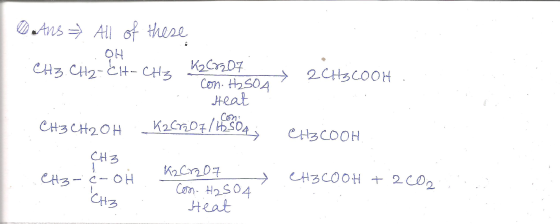
Which compound(s) can form a carboxylic acid if the proper
reagent and proper conditions are chosen?...
20. Which compound(s) can form a carboxylic acid if the proper reagent and proper conditions are...
 20. Which compound(s) can form a carboxylic acid if the proper reagent and proper conditions are chosen? 1. CH,CH,CH(OH)CH; II. CH3CH (OH) III. (CH3),COH O only O and ill only O ill only ll only O All of these Submit >
which will produce a carboxylic acid(3rd pic) Question 10 (1 point) Which is not a suitable...
 which
will produce a carboxylic acid(3rd pic)
Question 10 (1 point) Which is not a suitable method to prepare the following carboxylic acid? 1. Mg 2. CO2 3. H2O* 1. NaCN 2. H30*Heat 1.2L 2.CO2 Br 3. H,09 0 1 and 3 only O 1, 2, and 3 O2 only O1 only How many equivalents of the amine below are required for this reaction to go to completion: MeCOCl + EtNH – MeCONHE 01/2 Ol 00 COH 1. Mg 2....
which
will produce a carboxylic acid(3rd pic)
Question 10 (1 point) Which is not a suitable method to prepare the following carboxylic acid? 1. Mg 2. CO2 3. H2O* 1. NaCN 2. H30*Heat 1.2L 2.CO2 Br 3. H,09 0 1 and 3 only O 1, 2, and 3 O2 only O1 only How many equivalents of the amine below are required for this reaction to go to completion: MeCOCl + EtNH – MeCONHE 01/2 Ol 00 COH 1. Mg 2....
QUESTION 41 The reaction of an alcohol with a carboxylic acid under acidic conditions results in...
 QUESTION 41 The reaction of an alcohol with a carboxylic acid under acidic conditions results in an ester. How many nelementary mechanic steps are reasonable for this transformation? 3 7 QUESTION 42 Which of the following compounds would have a quartet in the NMR spectrum near 4.1? COH CHO Y Śs II III IV 0 0 0 0 111 IV TION 2 Which of the following are romane QUESTION QUESTION 4 Which structure has the correct formal charge? F* CI...
pppppplllleeeaaassseee help 1. a. Compound 1 reacts with A under acid conditions to form an imine. What could Z be in this reaction? b. Compound 2 reacts with A (same A as previous reaction) unde...
 pppppplllleeeaaassseee help
1. a. Compound 1 reacts with A under acid conditions to form an imine. What could Z be in this reaction? b. Compound 2 reacts with A (same A as previous reaction) under acid conditions to form an amide. What is Z in this reaction? Draw the structure of A Use curved arrows to show how Compound 2 forms the amide. c. Both reactions involve a leaving group. What is the leaving group in each reaction? O A...
pppppplllleeeaaassseee help
1. a. Compound 1 reacts with A under acid conditions to form an imine. What could Z be in this reaction? b. Compound 2 reacts with A (same A as previous reaction) under acid conditions to form an amide. What is Z in this reaction? Draw the structure of A Use curved arrows to show how Compound 2 forms the amide. c. Both reactions involve a leaving group. What is the leaving group in each reaction? O A...
practice complely the follow, + NaOH following (Fill in the Blanks (ose wnds carboxylic Acid +...
 practice
complely the follow, + NaOH following (Fill in the Blanks (ose wnds carboxylic Acid + Amine water carboxylic Aad & Alcohol Carboxylic Acid water Esten + H₂O + tre hydrolysis? Amide + H₂O titre hydedlysis Show the reagent / reagents needed to make the following molecolar conversions. Show reagent (s) to the right. Seach=40 HC=CH₂ HC-CH₃ 4 ة= SH please note: the is an aromated ring. It does not atlect the chemistry Hocao 0 ÖzçēH (oxidation? bacco in there...
practice
complely the follow, + NaOH following (Fill in the Blanks (ose wnds carboxylic Acid + Amine water carboxylic Aad & Alcohol Carboxylic Acid water Esten + H₂O + tre hydrolysis? Amide + H₂O titre hydedlysis Show the reagent / reagents needed to make the following molecolar conversions. Show reagent (s) to the right. Seach=40 HC=CH₂ HC-CH₃ 4 ة= SH please note: the is an aromated ring. It does not atlect the chemistry Hocao 0 ÖzçēH (oxidation? bacco in there...
PLEASE ANSWER THIS IMMEDIATELY! a point Dorius will be awardea COOH COON *1. Which compound is...
 PLEASE ANSWER THIS IMMEDIATELY!
a point Dorius will be awardea COOH COON *1. Which compound is the strongest acid? COOH COONa. (B) | HOOC COOH . HOOC COOH 2. Which compound is most likely to form an enolate upon addition of lithium diisopropylamide (LDA) 1) C O COON COON 3. Which route will produce Target starting with ethyl acetoacetate. (The IUPAC name for styrene oxide is 2-phenyloxirane) 1. NaOEt (2 eq) 1. LDA (2 eq) 1. LDA (2 ) 1....
PLEASE ANSWER THIS IMMEDIATELY!
a point Dorius will be awardea COOH COON *1. Which compound is the strongest acid? COOH COONa. (B) | HOOC COOH . HOOC COOH 2. Which compound is most likely to form an enolate upon addition of lithium diisopropylamide (LDA) 1) C O COON COON 3. Which route will produce Target starting with ethyl acetoacetate. (The IUPAC name for styrene oxide is 2-phenyloxirane) 1. NaOEt (2 eq) 1. LDA (2 eq) 1. LDA (2 ) 1....
Can you help me identify reagent (i), Compound 8 and Compound 12 in the reaction scheme?...
 Can you help me identify reagent (i), Compound 8 and
Compound 12 in the reaction scheme?
You have laboratory data on all the compounds in the
synthesis, however the amount of data available to you varies. Some
have the entirety of the spectral data, others have as little as
the elemental analysis. Use the laboratory data to help you
discover which reaction has been performed.
The lab data for Compound 8 and 12 is as
follows:
You can use any...
Can you help me identify reagent (i), Compound 8 and
Compound 12 in the reaction scheme?
You have laboratory data on all the compounds in the
synthesis, however the amount of data available to you varies. Some
have the entirety of the spectral data, others have as little as
the elemental analysis. Use the laboratory data to help you
discover which reaction has been performed.
The lab data for Compound 8 and 12 is as
follows:
You can use any...
Grignard Reaction 1. Draw your complete reaction, including the formation of the Grignard reagent and the...
 Grignard Reaction 1. Draw your complete reaction, including the formation of the Grignard reagent and the reaction with your carbonyl compound. Below each reagent, write its molecular weight and density (if a liquid). Also write how much of each material you will use in ml (if liquid), grams, and moles. Also include the molecular weight and melting point of your final product. 2. How many moles of Grignard reagent are you synthesizing? What mass of water could fully react with...
18. Which of the following compound(s) would undergo mutarotation in aqueous solution? 19. Draw the chair...
 18.
Which of the following compound(s) would undergo mutarotation in
aqueous solution?
19. Draw the chair conformation of a-D-galactopyranose.
20. Which of the following compound(s) is a glycoside?
21. Provide the reagents neccesary to carry out the following
conversion.
22. Predict the product(s) for the following reaction.
23. D-glucose & D-galactose are ______epimers of each
other.
24. Predict the product(s) for the following reaction.
25. Which of the following compound(s) would produce D-glucose
and D-mannose when treated with HCN followed...
18.
Which of the following compound(s) would undergo mutarotation in
aqueous solution?
19. Draw the chair conformation of a-D-galactopyranose.
20. Which of the following compound(s) is a glycoside?
21. Provide the reagents neccesary to carry out the following
conversion.
22. Predict the product(s) for the following reaction.
23. D-glucose & D-galactose are ______epimers of each
other.
24. Predict the product(s) for the following reaction.
25. Which of the following compound(s) would produce D-glucose
and D-mannose when treated with HCN followed...
Grignard reagent THE GRIGNARD REAGENT-PREPARATION AND REACTION In this experiment, you will prepa...
 i need help with the prelab questions please
Grignard reagent THE GRIGNARD REAGENT-PREPARATION AND REACTION In this experiment, you will prepare a Grignard reagent, phenyl magnesium bromide, from bromobenzene and magnesium metal. The Grignard reagent will then react with methyl benzoate to form triphenylmethanol. Introduction Grignard reagents, such as organomagnesium halides, were discovered in 1910 by French chemist Victor Grignard. The Grignard reaction is one of the most general methods for carbon- carbon bond formation in all of organic chemistry....
i need help with the prelab questions please
Grignard reagent THE GRIGNARD REAGENT-PREPARATION AND REACTION In this experiment, you will prepare a Grignard reagent, phenyl magnesium bromide, from bromobenzene and magnesium metal. The Grignard reagent will then react with methyl benzoate to form triphenylmethanol. Introduction Grignard reagents, such as organomagnesium halides, were discovered in 1910 by French chemist Victor Grignard. The Grignard reaction is one of the most general methods for carbon- carbon bond formation in all of organic chemistry....
 20. Which compound(s) can form a carboxylic acid if the proper reagent and proper conditions are chosen? 1. CH,CH,CH(OH)CH; II. CH3CH (OH) III. (CH3),COH O only O and ill only O ill only ll only O All of these Submit >
 which
will produce a carboxylic acid(3rd pic)
Question 10 (1 point) Which is not a suitable method to prepare the following carboxylic acid? 1. Mg 2. CO2 3. H2O* 1. NaCN 2. H30*Heat 1.2L 2.CO2 Br 3. H,09 0 1 and 3 only O 1, 2, and 3 O2 only O1 only How many equivalents of the amine below are required for this reaction to go to completion: MeCOCl + EtNH – MeCONHE 01/2 Ol 00 COH 1. Mg 2....
which
will produce a carboxylic acid(3rd pic)
Question 10 (1 point) Which is not a suitable method to prepare the following carboxylic acid? 1. Mg 2. CO2 3. H2O* 1. NaCN 2. H30*Heat 1.2L 2.CO2 Br 3. H,09 0 1 and 3 only O 1, 2, and 3 O2 only O1 only How many equivalents of the amine below are required for this reaction to go to completion: MeCOCl + EtNH – MeCONHE 01/2 Ol 00 COH 1. Mg 2....
 QUESTION 41 The reaction of an alcohol with a carboxylic acid under acidic conditions results in an ester. How many nelementary mechanic steps are reasonable for this transformation? 3 7 QUESTION 42 Which of the following compounds would have a quartet in the NMR spectrum near 4.1? COH CHO Y Śs II III IV 0 0 0 0 111 IV TION 2 Which of the following are romane QUESTION QUESTION 4 Which structure has the correct formal charge? F* CI...
 pppppplllleeeaaassseee help
1. a. Compound 1 reacts with A under acid conditions to form an imine. What could Z be in this reaction? b. Compound 2 reacts with A (same A as previous reaction) under acid conditions to form an amide. What is Z in this reaction? Draw the structure of A Use curved arrows to show how Compound 2 forms the amide. c. Both reactions involve a leaving group. What is the leaving group in each reaction? O A...
pppppplllleeeaaassseee help
1. a. Compound 1 reacts with A under acid conditions to form an imine. What could Z be in this reaction? b. Compound 2 reacts with A (same A as previous reaction) under acid conditions to form an amide. What is Z in this reaction? Draw the structure of A Use curved arrows to show how Compound 2 forms the amide. c. Both reactions involve a leaving group. What is the leaving group in each reaction? O A...
 practice
complely the follow, + NaOH following (Fill in the Blanks (ose wnds carboxylic Acid + Amine water carboxylic Aad & Alcohol Carboxylic Acid water Esten + H₂O + tre hydrolysis? Amide + H₂O titre hydedlysis Show the reagent / reagents needed to make the following molecolar conversions. Show reagent (s) to the right. Seach=40 HC=CH₂ HC-CH₃ 4 ة= SH please note: the is an aromated ring. It does not atlect the chemistry Hocao 0 ÖzçēH (oxidation? bacco in there...
practice
complely the follow, + NaOH following (Fill in the Blanks (ose wnds carboxylic Acid + Amine water carboxylic Aad & Alcohol Carboxylic Acid water Esten + H₂O + tre hydrolysis? Amide + H₂O titre hydedlysis Show the reagent / reagents needed to make the following molecolar conversions. Show reagent (s) to the right. Seach=40 HC=CH₂ HC-CH₃ 4 ة= SH please note: the is an aromated ring. It does not atlect the chemistry Hocao 0 ÖzçēH (oxidation? bacco in there...
 PLEASE ANSWER THIS IMMEDIATELY!
a point Dorius will be awardea COOH COON *1. Which compound is the strongest acid? COOH COONa. (B) | HOOC COOH . HOOC COOH 2. Which compound is most likely to form an enolate upon addition of lithium diisopropylamide (LDA) 1) C O COON COON 3. Which route will produce Target starting with ethyl acetoacetate. (The IUPAC name for styrene oxide is 2-phenyloxirane) 1. NaOEt (2 eq) 1. LDA (2 eq) 1. LDA (2 ) 1....
PLEASE ANSWER THIS IMMEDIATELY!
a point Dorius will be awardea COOH COON *1. Which compound is the strongest acid? COOH COONa. (B) | HOOC COOH . HOOC COOH 2. Which compound is most likely to form an enolate upon addition of lithium diisopropylamide (LDA) 1) C O COON COON 3. Which route will produce Target starting with ethyl acetoacetate. (The IUPAC name for styrene oxide is 2-phenyloxirane) 1. NaOEt (2 eq) 1. LDA (2 eq) 1. LDA (2 ) 1....
 Can you help me identify reagent (i), Compound 8 and
Compound 12 in the reaction scheme?
You have laboratory data on all the compounds in the
synthesis, however the amount of data available to you varies. Some
have the entirety of the spectral data, others have as little as
the elemental analysis. Use the laboratory data to help you
discover which reaction has been performed.
The lab data for Compound 8 and 12 is as
follows:
You can use any...
Can you help me identify reagent (i), Compound 8 and
Compound 12 in the reaction scheme?
You have laboratory data on all the compounds in the
synthesis, however the amount of data available to you varies. Some
have the entirety of the spectral data, others have as little as
the elemental analysis. Use the laboratory data to help you
discover which reaction has been performed.
The lab data for Compound 8 and 12 is as
follows:
You can use any...
 Grignard Reaction 1. Draw your complete reaction, including the formation of the Grignard reagent and the reaction with your carbonyl compound. Below each reagent, write its molecular weight and density (if a liquid). Also write how much of each material you will use in ml (if liquid), grams, and moles. Also include the molecular weight and melting point of your final product. 2. How many moles of Grignard reagent are you synthesizing? What mass of water could fully react with...
 18.
Which of the following compound(s) would undergo mutarotation in
aqueous solution?
19. Draw the chair conformation of a-D-galactopyranose.
20. Which of the following compound(s) is a glycoside?
21. Provide the reagents neccesary to carry out the following
conversion.
22. Predict the product(s) for the following reaction.
23. D-glucose & D-galactose are ______epimers of each
other.
24. Predict the product(s) for the following reaction.
25. Which of the following compound(s) would produce D-glucose
and D-mannose when treated with HCN followed...
18.
Which of the following compound(s) would undergo mutarotation in
aqueous solution?
19. Draw the chair conformation of a-D-galactopyranose.
20. Which of the following compound(s) is a glycoside?
21. Provide the reagents neccesary to carry out the following
conversion.
22. Predict the product(s) for the following reaction.
23. D-glucose & D-galactose are ______epimers of each
other.
24. Predict the product(s) for the following reaction.
25. Which of the following compound(s) would produce D-glucose
and D-mannose when treated with HCN followed...
 i need help with the prelab questions please
Grignard reagent THE GRIGNARD REAGENT-PREPARATION AND REACTION In this experiment, you will prepare a Grignard reagent, phenyl magnesium bromide, from bromobenzene and magnesium metal. The Grignard reagent will then react with methyl benzoate to form triphenylmethanol. Introduction Grignard reagents, such as organomagnesium halides, were discovered in 1910 by French chemist Victor Grignard. The Grignard reaction is one of the most general methods for carbon- carbon bond formation in all of organic chemistry....
i need help with the prelab questions please
Grignard reagent THE GRIGNARD REAGENT-PREPARATION AND REACTION In this experiment, you will prepare a Grignard reagent, phenyl magnesium bromide, from bromobenzene and magnesium metal. The Grignard reagent will then react with methyl benzoate to form triphenylmethanol. Introduction Grignard reagents, such as organomagnesium halides, were discovered in 1910 by French chemist Victor Grignard. The Grignard reaction is one of the most general methods for carbon- carbon bond formation in all of organic chemistry....
Most questions answered within 3 hours.
-
Where is the error in this code sequence?
String s1 = "Hello";
String s2 = "ello";...
asked 10 months ago -
Financial data for Joel de Paris, Inc., for last year
follow:
Joel de Paris, Inc.
Balance...
asked 10 months ago -
Consider this reaction:
Al2(SO4)3 (aq)+ BaCl3
(aq) Al2Cl6 (aq)- +
3BaSO4(s) . What is the...
asked 10 months ago -
Suppose that Savneet is considering increasing her
recent random sample from 20 car rentals to 40...
asked 10 months ago -
Trucks arrive at an unloading terminal at an average rate of 120
per hour.
Trucks arrive...
asked 10 months ago -
Why are methanol and ethanol completely soluble in water while
octanol is not very little soluble....
asked 10 months ago -
A facilities manager at a university reads in a research report
that the mean amount of...
asked 10 months ago -
When the CuSO4 is rehydrated by adding water to the anhydrous
compound, is this an endothermic...
asked 10 months ago -
A ray of sunlight is passing from diamond into crown glass; the
angle of incidence is...
asked 10 months ago -
A block of mass 0.249 kg is placed on top of a light, vertical
spring of...
asked 10 months ago -
how do the kidneys compensate in the presences of acidosis
a) trigger hyperventilate
b) reserve acid...
asked 10 months ago -
Question 501 pts
The rental rate of capital to the firm increases. Which of the
following...
asked 10 months ago