A 2.8 ?? block attached to a massless spring and is displaced 35 ?? by a...
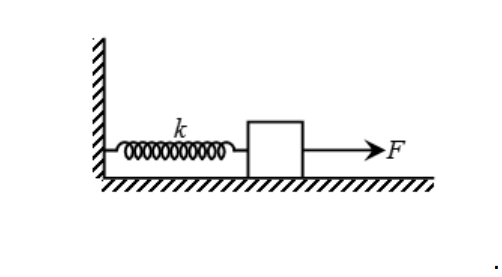
A 2.8 ?? block attached to a massless spring and is displaced 35 ?? by a force of 927.5 ? across a smooth floor. The box is then let go and undergoes simple harmonic motion. Determine, a. The maximum acceleration of the block. b. The period of oscillation. c. The angular frequency. d. The speed at equilibrium. e. The velocity at ? = 16.2 ?�
Homework Answers
here
mass , m = 2.8 kg
amplitude of motion , A = 35 cm
A = 0.35 m
force applied ,F = 927.5 N
let the spring constant be K
F = K * x
927.5 = K * 0.35
K = 2650 N/m
a)
The maximum acceleration of the block , a = F /m
a = 927.5 /2.8 m/s^2 = 331.25 m/s^2
b)
the period of oscillation , T = 2*pi * sqrt(m/K)
T = 2*pi * sqrt(2.8 /2650) s
T = 0.204 s
c)
the angular frequency , w= sqrt(K/m)
w = sqrt(2650 /2.8) = 30.8 rad/s
d)
the speed at equilibrium , vm = A * w
vm = 0.35 * 30.8 m/s = 10.77 m/s
e)
let the velocity be v1 when x1 = 16.2 cm = 0.162 m
using conservation of energy
0.5 * m * vm^2 = 0.5 * m * v1^2 + 0.5 * K * x1^2
2.8 * 10.77^2 = 2.8 * v1^2 + 2650 * 0.162^2
solving for v1
v1 = 9.54 m/s
the velocity is 9.54 m/s
Add Answer to:
A 2.8 ?? block attached to a massless spring and is displaced 35
?? by a...
A block of mass 1.6 ?? is moving across a smooth floor at 13.8 ?/? and...
 A block of mass 1.6 ?? is moving across a smooth floor at 13.8
?/? and encounters a second block (initially at rest) of mass 3.4
?? in a fully elastic collision. The second block is attached to a
spring of ? = 1250 ?/?. Assume the spring to be massless and does
not interfere with the collision. After the collision, the second
block is under simple harmonic motion. Determine, a. The amplitude
of oscillation. b. The frequency of oscillation....
A block of mass 1.6 ?? is moving across a smooth floor at 13.8
?/? and encounters a second block (initially at rest) of mass 3.4
?? in a fully elastic collision. The second block is attached to a
spring of ? = 1250 ?/?. Assume the spring to be massless and does
not interfere with the collision. After the collision, the second
block is under simple harmonic motion. Determine, a. The amplitude
of oscillation. b. The frequency of oscillation....
7. A block of mass 1.6 kg is moving across a smooth floor at 13.8 m/s...
 7. A block of mass 1.6 kg is moving across a smooth floor at 13.8 m/s and encounters a second block (initially at rest) of mass 3.4 kg in a fully elastic collision. The second block is attached to a spring of k = 1250 N/m. Assume the spring to be massless and does not interfere with the collision. After the collision, the second block is under simple harmonic motion. Determine, a. The amplitude of oscillation b. The frequency of...
Consider a spring hung vertically from the ceiling. (a) When a 0.25kg block is attached to...
Consider a spring hung vertically from the ceiling. (a) When a 0.25kg block is attached to the spring, the spring is stretched 0.05m. What is the force constant of the spring? (b) What is the angular frequency for the simple harmonic motion of the block if you pull it down 5cm and release it? How does this compare to the angular frequency if you pull it down 10cm? (c) Taking upward to be positive, and the equilibrium position to be...
Problem3 A (2+0.1y) kg block attached to a spring undergoes simple harmonic motion described by x...
 Can you please answer both questions, Y=0
Problem3 A (2+0.1y) kg block attached to a spring undergoes simple harmonic motion described by x (30 cm) cos[(6.28 rad/s)t + /4) Determine (a) the amplitude, (b) the spring constant, (c) the frequency, (d) the maximum speed (e) maximum acceleration of the block, and (e) the total energy of the spring-block. of the block Problem 4 A block attached to a spring, undergoes simple harmonic motion with a period of 1.5 + y)...
Can you please answer both questions, Y=0
Problem3 A (2+0.1y) kg block attached to a spring undergoes simple harmonic motion described by x (30 cm) cos[(6.28 rad/s)t + /4) Determine (a) the amplitude, (b) the spring constant, (c) the frequency, (d) the maximum speed (e) maximum acceleration of the block, and (e) the total energy of the spring-block. of the block Problem 4 A block attached to a spring, undergoes simple harmonic motion with a period of 1.5 + y)...
z waqod A 2- kg block attached to a spring undergoes simple harmonic motion described by...
 z waqod A 2- kg block attached to a spring undergoes simple harmonic motion described by = (30 cm) cos[(6.28 rad/s)t + /4]. Determine (a) the amplitude, (b) the spring constant, (c) the frequency, (d) the maximum speed of the block, (e) maximum acceleration of the block, and (e) the total energy of the spring-block. Problem 3 A block attached to a spring, undergoes simple harmonic motion with a period of 1.5 s, and amplitude of 20 cm. The mechanical...
A block of unknown mass is attached to a spring with a spring constant of 5.00...
A block of unknown mass is attached to a spring with a spring constant of 5.00 N/m and undergoes simple harmonic motion with an amplitude of 10.0 cm. When the block is halfway between its equilibrium position and the end point, its speed is measured to be 27.0 cm/s. (a) Calculate the mass of the block. (b) Calculate the period of the motion. (c) Calculate the maximum acceleration of the block. (m/s2
2. A block of unknown mass is attached to a spring with a spring constant of...
 2.
A block of unknown mass is attached to a spring with a spring constant of 5.00 N/m and undergoes simple harmonic motion with an amplitude of 10.0 cm. When the block is halfway between its equilibrium position and the end point, its speed is measured to be 32.0 cm/s (a) Calculate the mass of the block (b) Calculate the period of the motion (c) Calculate the maximum acceleration of the block. kg m/s
2.
A block of unknown mass is attached to a spring with a spring constant of 5.00 N/m and undergoes simple harmonic motion with an amplitude of 10.0 cm. When the block is halfway between its equilibrium position and the end point, its speed is measured to be 32.0 cm/s (a) Calculate the mass of the block (b) Calculate the period of the motion (c) Calculate the maximum acceleration of the block. kg m/s
A block of mass M is attached to a wall by a massless spring with spring constant k. The block is allowed to oscillate on a frictionless surface.
A block of mass M is attached to a wall by a massless spring with spring constant k. The block is allowed to oscillate on a frictionless surface. A second block of mass m is placed on top of the first block. The coefficient of static friction between the two blocks is his. What is the angular frequency of oscillation, and what is the maximum possible amplitude of oscillation such that the second block will not fly off?
A 1,28-kg block on a horizontal frictionless surface is attached to an ideal massless spring whose...
A 1,28-kg block on a horizontal frictionless surface is attached to an ideal massless spring whose spring constant is 133,84 N/m. The block is pulled from its equilibrium position at x = 0.00 m to a displacement x = +0,03 m and is released from rest. The block then executes simple harmonic motion along the horizontal x-axis. What is the velocity of the block at time t = 0,34 s? Answer in two decimal places.
A 1,11-kg block on a horizontal frictionless surface is attached to an ideal massless spring whose...
A 1,11-kg block on a horizontal frictionless surface is attached to an ideal massless spring whose spring constant is 100,28 N/m. The block is pulled from its equilibrium position at x = 0.00 m to a displacement x = +0,04 m and is released from rest. The block then executes simple harmonic motion along the horizontal x-axis. What is the velocity of the block at time t = 0,23 s? Answer in two decimal places.
 A block of mass 1.6 ?? is moving across a smooth floor at 13.8
?/? and encounters a second block (initially at rest) of mass 3.4
?? in a fully elastic collision. The second block is attached to a
spring of ? = 1250 ?/?. Assume the spring to be massless and does
not interfere with the collision. After the collision, the second
block is under simple harmonic motion. Determine, a. The amplitude
of oscillation. b. The frequency of oscillation....
A block of mass 1.6 ?? is moving across a smooth floor at 13.8
?/? and encounters a second block (initially at rest) of mass 3.4
?? in a fully elastic collision. The second block is attached to a
spring of ? = 1250 ?/?. Assume the spring to be massless and does
not interfere with the collision. After the collision, the second
block is under simple harmonic motion. Determine, a. The amplitude
of oscillation. b. The frequency of oscillation....
 7. A block of mass 1.6 kg is moving across a smooth floor at 13.8 m/s and encounters a second block (initially at rest) of mass 3.4 kg in a fully elastic collision. The second block is attached to a spring of k = 1250 N/m. Assume the spring to be massless and does not interfere with the collision. After the collision, the second block is under simple harmonic motion. Determine, a. The amplitude of oscillation b. The frequency of...
 Can you please answer both questions, Y=0
Problem3 A (2+0.1y) kg block attached to a spring undergoes simple harmonic motion described by x (30 cm) cos[(6.28 rad/s)t + /4) Determine (a) the amplitude, (b) the spring constant, (c) the frequency, (d) the maximum speed (e) maximum acceleration of the block, and (e) the total energy of the spring-block. of the block Problem 4 A block attached to a spring, undergoes simple harmonic motion with a period of 1.5 + y)...
Can you please answer both questions, Y=0
Problem3 A (2+0.1y) kg block attached to a spring undergoes simple harmonic motion described by x (30 cm) cos[(6.28 rad/s)t + /4) Determine (a) the amplitude, (b) the spring constant, (c) the frequency, (d) the maximum speed (e) maximum acceleration of the block, and (e) the total energy of the spring-block. of the block Problem 4 A block attached to a spring, undergoes simple harmonic motion with a period of 1.5 + y)...
 z waqod A 2- kg block attached to a spring undergoes simple harmonic motion described by = (30 cm) cos[(6.28 rad/s)t + /4]. Determine (a) the amplitude, (b) the spring constant, (c) the frequency, (d) the maximum speed of the block, (e) maximum acceleration of the block, and (e) the total energy of the spring-block. Problem 3 A block attached to a spring, undergoes simple harmonic motion with a period of 1.5 s, and amplitude of 20 cm. The mechanical...
 2.
A block of unknown mass is attached to a spring with a spring constant of 5.00 N/m and undergoes simple harmonic motion with an amplitude of 10.0 cm. When the block is halfway between its equilibrium position and the end point, its speed is measured to be 32.0 cm/s (a) Calculate the mass of the block (b) Calculate the period of the motion (c) Calculate the maximum acceleration of the block. kg m/s
2.
A block of unknown mass is attached to a spring with a spring constant of 5.00 N/m and undergoes simple harmonic motion with an amplitude of 10.0 cm. When the block is halfway between its equilibrium position and the end point, its speed is measured to be 32.0 cm/s (a) Calculate the mass of the block (b) Calculate the period of the motion (c) Calculate the maximum acceleration of the block. kg m/s
Most questions answered within 3 hours.
-
Where is the error in this code sequence?
String s1 = "Hello";
String s2 = "ello";...
asked 10 months ago -
Financial data for Joel de Paris, Inc., for last year
follow:
Joel de Paris, Inc.
Balance...
asked 10 months ago -
Consider this reaction:
Al2(SO4)3 (aq)+ BaCl3
(aq) Al2Cl6 (aq)- +
3BaSO4(s) . What is the...
asked 10 months ago -
Suppose that Savneet is considering increasing her
recent random sample from 20 car rentals to 40...
asked 10 months ago -
Trucks arrive at an unloading terminal at an average rate of 120
per hour.
Trucks arrive...
asked 10 months ago -
Why are methanol and ethanol completely soluble in water while
octanol is not very little soluble....
asked 10 months ago -
A facilities manager at a university reads in a research report
that the mean amount of...
asked 10 months ago -
When the CuSO4 is rehydrated by adding water to the anhydrous
compound, is this an endothermic...
asked 10 months ago -
A ray of sunlight is passing from diamond into crown glass; the
angle of incidence is...
asked 10 months ago -
A block of mass 0.249 kg is placed on top of a light, vertical
spring of...
asked 10 months ago -
how do the kidneys compensate in the presences of acidosis
a) trigger hyperventilate
b) reserve acid...
asked 10 months ago -
Question 501 pts
The rental rate of capital to the firm increases. Which of the
following...
asked 10 months ago