An electrical heater is used to supply 85.0 J of energy to a 10.0 g sample...
An electrical heater is used to supply 85.0 J of energy to a 10.0 g sample of aluminum, originally at 295.0 K. Determine the final temperature in degrees Kelvin. (the specific heat capacity for aluminum is 24.35 Jmol-1K-1)
Homework Answers
Molar mass of Al = 26.98 g/mol
mass(Al)= 10.0 g
use:
number of mol of Al,
n = mass of Al/molar mass of Al
=(10 g)/(26.98 g/mol)
= 0.3706 mol
Use:
Q = n*C*(Tf-Ti)
85.0 J = 0.3706 mol * 24.35 J/mol.K * (Tf - 295.0) K
Tf - 295.0 = 9.42
Tf = 304 K
Answer: 304 K
Add Answer to:
An electrical heater is used to supply 85.0 J of energy to a
10.0 g sample...
An electric heater is used to supply 52.0 J of energy to a 20.0-g graphite block...
An electric heater is used to supply 52.0 J of energy to a 20.0-g graphite block with an initial temperature of 15.0 ºC. Determine the final temperature of the graphite. (Specific heat of graphite = 0.72 J/g ºC.)
1. A sample of solid chromium is heated with an electrical coil. If 85.0 Joules of energy are added to a 11.3 gram sampl...
1. A sample of solid chromium is heated with an electrical coil. If 85.0 Joules of energy are added to a 11.3 gram sample and the final temperature is 39.2 °C, what is the initial temperature of the chromium? 2. She heats 18.6 grams of copper to 97.81 °C and then drops it into an insulated cup containing 80.2 grams of water at 24.17 °C. When thermal equilibrium is reached, she measures the final temperature to be 25.67 °C. Assuming...
9 A student in a laboratory uses the apparatus shown in the figure to determine the...
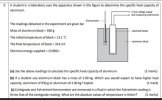 9 A student in a laboratory uses the apparatus shown in the figure to determine the specific heat capacity of aluminum to low voltage supply and measuring instruments thermometer electrical heater The readings obtained in the experiment are given be Mass of aluminum block = 930 g The initial temperature of block = 13.1 °C The final temperature of block = 314.3 K Electrical energy supplied = 23 800) aluminium block (a) Use the above readings to calculate the specific...
An electric heater supplies 41.9 joules of energy to 11.7-g sample of Ar gas originally at...
An electric heater supplies 41.9 joules of energy to 11.7-g sample of Ar gas originally at 9.13 °C. Compute the final temperature (in °C). (Don't have specific heat that is why I need help!)
A 7.00-g sample of aluminum pellets (specific heat capacity = 0.89 J/°C·g) and a 14.00-g sample...
A 7.00-g sample of aluminum pellets (specific heat capacity = 0.89 J/°C·g) and a 14.00-g sample of iron pellets (specific heat capacity = 0.45 J/°C·g) are heated to 100.0 °C. The mixture of hot iron and aluminum is then dropped into 71.3 g water at 22.0 °C. Calculate the final temperature of the metal and water mixture, assuming no heat loss to the surroundings.
Exactly 1000 J of energy as heat are added to an 8.50 g sample of helium...
Exactly 1000 J of energy as heat are added to an 8.50 g sample of helium at 20.0 °C under constant-pressure. The specific heat capacity at constant-pressure for helium is 5.1926 kJ kg-1 K-1. What is the final temperature of the helium sample? 316 K 22.7 K 273 K 89.6 K 363 K
A 3.00-g sample of aluminum pellets (specific heat capacity = 0.89 J/°C·g) and a 11.00-g sample...
A 3.00-g sample of aluminum pellets (specific heat capacity = 0.89 J/°C·g) and a 11.00-g sample of iron pellets (specific heat capacity = 0.45 J/°C·g) are heated to 100.0 °C. The mixture of hot iron and aluminum is then dropped into 73.8 g water at 22.0 °C. Calculate the final temperature of the metal and water mixture, assuming no heat loss to the surroundings. Please be super specific on how you get to each step!
A small electric immersion heater is used to heat 57 g of water for a cup...
 A small electric immersion heater is used to heat 57 g of water for a cup of instant coffee. The heater is labeled "140 watts" (it converts electrical energy to thermal energy at this rate). Calculate the time required to bring all this water from 22°C to 100°C, ignoring any heat losses. (The specific heat of water is 4186 J/kg-K.) Number Units the tolerance is +/-2%
A 3.00-g sample of aluminum pellets (specific heat capacity=0.89 J/°C g) and a 18.50-g sample of...
 A 3.00-g sample of aluminum pellets (specific heat capacity=0.89 J/°C g) and a 18.50-g sample of iron pellets (specific heat capacity = 0.45 J/°C-g) are heated to 100.0 °C. The mixture of hot iron and aluminum is then dropped into 77.4 g water at 22.0 °C. Calculate the final temperature of the metal and water mixture, assuming no heat loss to the surroundings. Final temperature = 20.23 °C An error has been detected in your answer. Check for typos. miscalculations...
When 702.5 J of heat energy is added to a 53.0 g sample of solid copper,...
When 702.5 J of heat energy is added to a 53.0 g sample of solid copper, the temperature increases to 87.6°C. What was the original temperature of the solid in °C? The specific heat capacity of solid copper is 0.385 J/g • K.
 9 A student in a laboratory uses the apparatus shown in the figure to determine the specific heat capacity of aluminum to low voltage supply and measuring instruments thermometer electrical heater The readings obtained in the experiment are given be Mass of aluminum block = 930 g The initial temperature of block = 13.1 °C The final temperature of block = 314.3 K Electrical energy supplied = 23 800) aluminium block (a) Use the above readings to calculate the specific...
 A small electric immersion heater is used to heat 57 g of water for a cup of instant coffee. The heater is labeled "140 watts" (it converts electrical energy to thermal energy at this rate). Calculate the time required to bring all this water from 22°C to 100°C, ignoring any heat losses. (The specific heat of water is 4186 J/kg-K.) Number Units the tolerance is +/-2%
 A 3.00-g sample of aluminum pellets (specific heat capacity=0.89 J/°C g) and a 18.50-g sample of iron pellets (specific heat capacity = 0.45 J/°C-g) are heated to 100.0 °C. The mixture of hot iron and aluminum is then dropped into 77.4 g water at 22.0 °C. Calculate the final temperature of the metal and water mixture, assuming no heat loss to the surroundings. Final temperature = 20.23 °C An error has been detected in your answer. Check for typos. miscalculations...
Most questions answered within 3 hours.
-
Where is the error in this code sequence?
String s1 = "Hello";
String s2 = "ello";...
asked 11 months ago -
Financial data for Joel de Paris, Inc., for last year
follow:
Joel de Paris, Inc.
Balance...
asked 11 months ago -
Consider this reaction:
Al2(SO4)3 (aq)+ BaCl3
(aq) Al2Cl6 (aq)- +
3BaSO4(s) . What is the...
asked 11 months ago -
Suppose that Savneet is considering increasing her
recent random sample from 20 car rentals to 40...
asked 11 months ago -
Trucks arrive at an unloading terminal at an average rate of 120
per hour.
Trucks arrive...
asked 11 months ago -
Why are methanol and ethanol completely soluble in water while
octanol is not very little soluble....
asked 11 months ago -
A facilities manager at a university reads in a research report
that the mean amount of...
asked 11 months ago -
When the CuSO4 is rehydrated by adding water to the anhydrous
compound, is this an endothermic...
asked 11 months ago -
A ray of sunlight is passing from diamond into crown glass; the
angle of incidence is...
asked 11 months ago -
A block of mass 0.249 kg is placed on top of a light, vertical
spring of...
asked 11 months ago -
how do the kidneys compensate in the presences of acidosis
a) trigger hyperventilate
b) reserve acid...
asked 11 months ago -
Question 501 pts
The rental rate of capital to the firm increases. Which of the
following...
asked 11 months ago