

Homework Answers

Add Answer to:
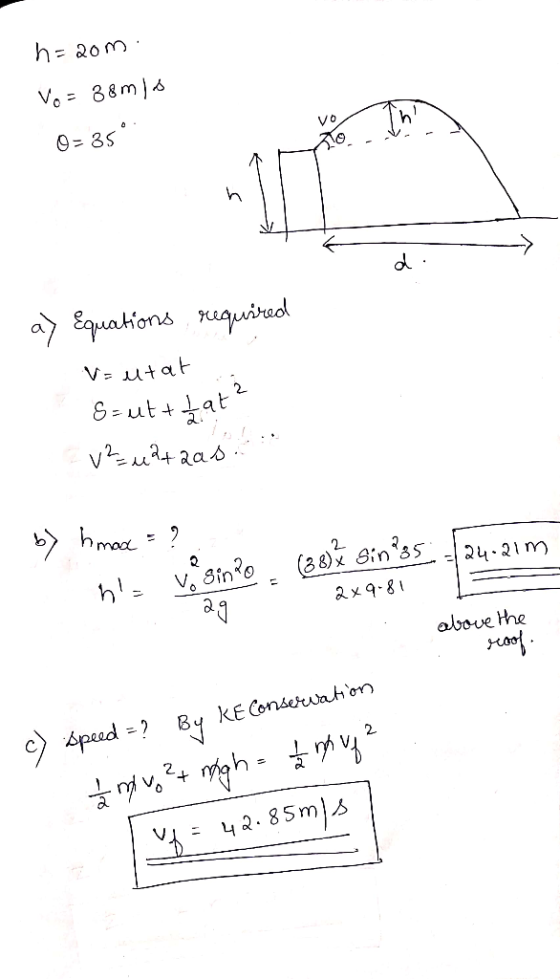
Problemi 2: A man stands on the roof of a 20.0 m tall building and throws...
A man stands on the roof of a building of height 17.0 m and throws a...
A man stands on the roof of a building of height 17.0 m and throws a rock with a velocity of magnitude 29.2 m/s at an angle of 33.3 ∘ above the horizontal. You can ignore air resistance. a. Calculate the maximum height above the roof reached by the rock. b. Calculate the magnitude of the velocity of the rock just before it strikes the ground. c. Calculate the horizontal distance from the base of the building to the point...
A man stands on the roof of a building of height 16.3 m and throws a...
A man stands on the roof of a building of height 16.3 m and throws a rock with a velocity of magnitude 25.8 m/s at an angle of 27.6 ∘ above the horizontal. You can ignore air resistance. Calculate the magnitude of the velocity of the rock just before it strikes the ground. Calculate the horizontal distance from the base of the building to the point where the rock strikes the ground.
A man stands on the roof of a building of height 15.1 m and throws a rock with...
A man stands on the roof of a building of height 15.1 m and throws a rock with a velocity of magnitude 31.4 m/s at an angle of 31.4 ∘ above the horizontal. You can ignore air resistance. Calculate the horizontal distance from the base of the building to the point where the rock strikes the ground.
A man stands on the roof of a building of height 16.7m and throws a rock...
A man stands on the roof of a building of height 16.7m and throws a rock with a velocity of magnitude 28.9m/s at an angle of 26.0❝ above the horizontal. You can ignore air resistance. Part A Calculate the maximum height above the roof reached by the rock. Part B Calculate the magnitude of the velocity of the rock just before it strikes the ground. Part C Calculate the horizontal distance from the base of the building to the point...
A man stands on the roof of a building of height 13.0 mm and throws a...
A man stands on the roof of a building of height 13.0 mm and throws a rock with a velocity of magnitude 27.0 m/sm/s at an angle of 33.0 ∘∘ above the horizontal. You can ignore air resistance Part A Calculate the maximum height above the roof reached by the rock. Express your answer in meters. Part B Calculate the magnitude of the velocity of the rock just before it strikes the ground. Express your answer in meters per second....
please answer all questions !! Constants Part A A man stands on the roof of a...
 please answer all questions !!
Constants Part A A man stands on the roof of a building of height 14.3 m and throws a rock with a velocity of magnitude 31.1 m/s at an angle of 33.6 above the horizontal. You can ignore air resistance Calculate the maximum height above the roof reached by the rock. A2op SubmitP Previous Answers Request Answer X Incorrect; Try Again; 2 attempts remaining Part B Calculate the magnitude of the velocity of the rock...
please answer all questions !!
Constants Part A A man stands on the roof of a building of height 14.3 m and throws a rock with a velocity of magnitude 31.1 m/s at an angle of 33.6 above the horizontal. You can ignore air resistance Calculate the maximum height above the roof reached by the rock. A2op SubmitP Previous Answers Request Answer X Incorrect; Try Again; 2 attempts remaining Part B Calculate the magnitude of the velocity of the rock...
1)A fairground ride spins its occupants inside a flying saucer-shaped container. If the horizontal circular path...
1)A fairground ride spins its occupants inside a flying saucer-shaped container. If the horizontal circular path the riders follow has an 8.00-m radius, at how many revolutions per minute are the riders subjected to a centripetal acceleration equal to that of gravity? 2)A man stands on the roof of a 15.0-m-tall building and throws a rock with a speed of 30.0 m/s at and an angle of 33.0above the horizontal. You can ignore air resistance. Calculate (a) the maximum height...
The robot uprising begins tomorrow! A robot stands on the roof of Boston Dynamics (20.0m tall...
The robot uprising begins tomorrow! A robot stands on the roof of Boston Dynamics (20.0m tall building). The robot practices for the big day by throwing a mannequin with a velocity of magnitude 25.0m/s at an angle of 37.0 degrees above the horizontal. You can ignore air resistance, but you can’t ignore the cold, passionless logic of our soon-to-be new overlords. Calculate: (a) The maximum height above the roof reached by the mannequin. (b) The magnitude of the velocity of...
A baseball is thrown from the roof of 20.6 m -tall building with an initial velocity...
A baseball is thrown from the roof of 20.6 m -tall building with an initial velocity of magnitude 12.4 m/s and directed at an angle of 55.6 ∘ above the horizontal. a) What is the speed of the ball just before it strikes the ground? Use energy methods and ignore air resistance. b) What is the answer for part (A) if the initial velocity is at an angle of 55.6 ∘ below the horizontal? c) If the effects of air...
A baseball is thrown from the roof of 22.8 m -tall building with an initial velocity...
A baseball is thrown from the roof of 22.8 m -tall building with an initial velocity of magnitude 10.3 m/s and directed at an angle of 56.8 ∘ above the horizontal. A)What is the speed of the ball just before it strikes the ground? Use energy methods and ignore air resistance. B) What is the answer for part (A) if the initial velocity is at an angle of 56.8 ∘ below the horizontal? c)If the effects of air resistance are...
 please answer all questions !!
Constants Part A A man stands on the roof of a building of height 14.3 m and throws a rock with a velocity of magnitude 31.1 m/s at an angle of 33.6 above the horizontal. You can ignore air resistance Calculate the maximum height above the roof reached by the rock. A2op SubmitP Previous Answers Request Answer X Incorrect; Try Again; 2 attempts remaining Part B Calculate the magnitude of the velocity of the rock...
please answer all questions !!
Constants Part A A man stands on the roof of a building of height 14.3 m and throws a rock with a velocity of magnitude 31.1 m/s at an angle of 33.6 above the horizontal. You can ignore air resistance Calculate the maximum height above the roof reached by the rock. A2op SubmitP Previous Answers Request Answer X Incorrect; Try Again; 2 attempts remaining Part B Calculate the magnitude of the velocity of the rock...
Most questions answered within 3 hours.
-
Where is the error in this code sequence?
String s1 = "Hello";
String s2 = "ello";...
asked 11 months ago -
Financial data for Joel de Paris, Inc., for last year
follow:
Joel de Paris, Inc.
Balance...
asked 11 months ago -
Consider this reaction:
Al2(SO4)3 (aq)+ BaCl3
(aq) Al2Cl6 (aq)- +
3BaSO4(s) . What is the...
asked 11 months ago -
Suppose that Savneet is considering increasing her
recent random sample from 20 car rentals to 40...
asked 11 months ago -
Trucks arrive at an unloading terminal at an average rate of 120
per hour.
Trucks arrive...
asked 11 months ago -
Why are methanol and ethanol completely soluble in water while
octanol is not very little soluble....
asked 11 months ago -
A facilities manager at a university reads in a research report
that the mean amount of...
asked 11 months ago -
When the CuSO4 is rehydrated by adding water to the anhydrous
compound, is this an endothermic...
asked 11 months ago -
A ray of sunlight is passing from diamond into crown glass; the
angle of incidence is...
asked 11 months ago -
A block of mass 0.249 kg is placed on top of a light, vertical
spring of...
asked 11 months ago -
how do the kidneys compensate in the presences of acidosis
a) trigger hyperventilate
b) reserve acid...
asked 11 months ago -
Question 501 pts
The rental rate of capital to the firm increases. Which of the
following...
asked 11 months ago