A) Starting from rest, you accelerate at 6.0 m/s/s for 5 seconds. You then travel at...
A) Starting from rest, you accelerate at 6.0 m/s/s for 5 seconds. You then travel at constant speed for 10 seconds. What is the constant velocity you are moving at after 5 seconds?
B) Starting from rest, you accelerate at 6.0 m/s/s for 5 seconds. You then travel at constant speed for 10 seconds. How far did you travel over the 15 seconds?
Homework Answers

Add Answer to:
A) Starting from rest, you accelerate at 6.0 m/s/s for 5
seconds. You then travel at...
A bus travels at a constant speed of 32m/s for 5 seconds. It begins to accelerate at a rate of 3m/s^2 for 7 seconds and then maintains that speed for another 18 seconds. Finally, it slows down to rest in 22 seconds. How far did the bus travel during the c
A bus travels at a constant speed of 32m/s for 5 seconds. It begins to accelerate at a rate of 3m/s^2 for 7 seconds and then maintains that speed for another 18 seconds. Finally, it slows down to rest in 22 seconds. How far did the bus travel during the course of this entire problem?
(20 points) A car starting from rest travels 220 m in 9.4 seconds with a constant acceleration. It then travels at a con...
(20 points) A car starting from rest travels 220 m in 9.4 seconds with a constant acceleration. It then travels at a constant speed for another 12 seconds. After that, the brakes are applied and the car comes to rest an acceleration of 6.5 m/s2. A) Draw the motion diagram for the entire trip. B) What direction is the acceleration when the car is coming to rest? C) List all known variables with their values. D) What is the acceleration...
A car accelerates from rest with a constant acceleration of 1.5m/s^2 for 14 seconds . the...
A car accelerates from rest with a constant acceleration of 1.5m/s^2 for 14 seconds . the car then continues traveling at the constant velocity with the speed it achieved after the 14 seconds of acceleration . it travels at this constant velocity for an additional 25 seconds. how far did the car travel during this whole motion?
7 and 10? 7. If you accelerate from rest 1 m/s each second for an hour,...
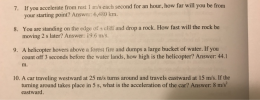 7 and 10?
7. If you accelerate from rest 1 m/s each second for an hour, how far will you be from 8. You are standing on the edge of a cliff and drop a rock. How fast will the rock be 9. A helicopter hovers above a forest fire and dumps a large bucket of water. If you your starting point? Answer: 6,480 km. moving 2 s later? Answer: 19.6 m/s. count off 3 seconds before the water lands,...
7 and 10?
7. If you accelerate from rest 1 m/s each second for an hour, how far will you be from 8. You are standing on the edge of a cliff and drop a rock. How fast will the rock be 9. A helicopter hovers above a forest fire and dumps a large bucket of water. If you your starting point? Answer: 6,480 km. moving 2 s later? Answer: 19.6 m/s. count off 3 seconds before the water lands,...
5. Starting from rest, a particle confined to move along a straight line is accelerated at...
 5. Starting from rest, a particle confined to move along a straight line is accelerated at a rate of 5.0 m/s Which one of the following statements accurately describes the motion of this particle? A) The particle travels 5.0 m during each second. B) The particle travels 5.0 m only during the first second. C) The speed of the particle increases by 5.0 m/s during each second. D) The acceleration of the particle increases by 5.0 m/s during each second....
So I know there is 4 different equationsfor kinematics. Can you pick the problems that use...
 So
I know there is 4 different equationsfor kinematics. Can you pick
the problems that use each one and write out how you do it?
Especially 6 and 10 because those seem very hard.
1-D Kinematics Practice PHYS&114 Name: 1. A car starting from rest travels 231 m with a constant acceleration of 1.05 3. What is its 2. How far does a train travel while its velocity changes from +102 to +45.0 등 in 22.0 seconds? 3. You sprint...
So
I know there is 4 different equationsfor kinematics. Can you pick
the problems that use each one and write out how you do it?
Especially 6 and 10 because those seem very hard.
1-D Kinematics Practice PHYS&114 Name: 1. A car starting from rest travels 231 m with a constant acceleration of 1.05 3. What is its 2. How far does a train travel while its velocity changes from +102 to +45.0 등 in 22.0 seconds? 3. You sprint...
An automobile accelerates for 2.60 seconds, starting from rest and uniformly accelerating to 32.0 m/s. How...
An automobile accelerates for 2.60 seconds, starting from rest and uniformly accelerating to 32.0 m/s. How far does the vehicle travel during the period of uniform acceleration?
A car accelerates from rest at S m/s for 5 seconds. It moves with a constant...
 A car accelerates from rest at S m/s for 5 seconds. It moves with a constant velocity for 15 seconds, and then decelerates at 5 m/s to come to rest in 5 seconds. The entire journey takes 25 seconds. Plot the velocity-time graph of the motion AND determine the total distance the car travelled. (10 pts.) 4.
9) An object could accelerate continuously at 10.0 m/s, how far would it travel and how...
 9) An object could accelerate continuously at 10.0 m/s, how far would it travel and how long would it take to reach: (a) the speed of sound, 334 m's. (b) the escape speed of a rocket from the earth, 1 1 .2 km/s; (c) 10% of the speed of light? Assume it starts from rest.
Can you show me how to do this problem step by step and draw the graph...
 Can
you show me how to do this problem step by step and draw the graph
liysics ihematics ine Dimension Distance, Acceleration and Velocity Practice Problems A van travels at a constant speed of 18 m/s for 4.3 seconds. It begins to accelerate at a rate of 3.4 m/s2 for 5.1 seconds and then maintains that speed for another 15 seconds. Finally, it slows down to rest in 14.8 seconds. How far did the van travel during this time.
Can
you show me how to do this problem step by step and draw the graph
liysics ihematics ine Dimension Distance, Acceleration and Velocity Practice Problems A van travels at a constant speed of 18 m/s for 4.3 seconds. It begins to accelerate at a rate of 3.4 m/s2 for 5.1 seconds and then maintains that speed for another 15 seconds. Finally, it slows down to rest in 14.8 seconds. How far did the van travel during this time.
 7 and 10?
7. If you accelerate from rest 1 m/s each second for an hour, how far will you be from 8. You are standing on the edge of a cliff and drop a rock. How fast will the rock be 9. A helicopter hovers above a forest fire and dumps a large bucket of water. If you your starting point? Answer: 6,480 km. moving 2 s later? Answer: 19.6 m/s. count off 3 seconds before the water lands,...
7 and 10?
7. If you accelerate from rest 1 m/s each second for an hour, how far will you be from 8. You are standing on the edge of a cliff and drop a rock. How fast will the rock be 9. A helicopter hovers above a forest fire and dumps a large bucket of water. If you your starting point? Answer: 6,480 km. moving 2 s later? Answer: 19.6 m/s. count off 3 seconds before the water lands,...
 5. Starting from rest, a particle confined to move along a straight line is accelerated at a rate of 5.0 m/s Which one of the following statements accurately describes the motion of this particle? A) The particle travels 5.0 m during each second. B) The particle travels 5.0 m only during the first second. C) The speed of the particle increases by 5.0 m/s during each second. D) The acceleration of the particle increases by 5.0 m/s during each second....
 So
I know there is 4 different equationsfor kinematics. Can you pick
the problems that use each one and write out how you do it?
Especially 6 and 10 because those seem very hard.
1-D Kinematics Practice PHYS&114 Name: 1. A car starting from rest travels 231 m with a constant acceleration of 1.05 3. What is its 2. How far does a train travel while its velocity changes from +102 to +45.0 등 in 22.0 seconds? 3. You sprint...
So
I know there is 4 different equationsfor kinematics. Can you pick
the problems that use each one and write out how you do it?
Especially 6 and 10 because those seem very hard.
1-D Kinematics Practice PHYS&114 Name: 1. A car starting from rest travels 231 m with a constant acceleration of 1.05 3. What is its 2. How far does a train travel while its velocity changes from +102 to +45.0 등 in 22.0 seconds? 3. You sprint...
 A car accelerates from rest at S m/s for 5 seconds. It moves with a constant velocity for 15 seconds, and then decelerates at 5 m/s to come to rest in 5 seconds. The entire journey takes 25 seconds. Plot the velocity-time graph of the motion AND determine the total distance the car travelled. (10 pts.) 4.
 9) An object could accelerate continuously at 10.0 m/s, how far would it travel and how long would it take to reach: (a) the speed of sound, 334 m's. (b) the escape speed of a rocket from the earth, 1 1 .2 km/s; (c) 10% of the speed of light? Assume it starts from rest.
 Can
you show me how to do this problem step by step and draw the graph
liysics ihematics ine Dimension Distance, Acceleration and Velocity Practice Problems A van travels at a constant speed of 18 m/s for 4.3 seconds. It begins to accelerate at a rate of 3.4 m/s2 for 5.1 seconds and then maintains that speed for another 15 seconds. Finally, it slows down to rest in 14.8 seconds. How far did the van travel during this time.
Can
you show me how to do this problem step by step and draw the graph
liysics ihematics ine Dimension Distance, Acceleration and Velocity Practice Problems A van travels at a constant speed of 18 m/s for 4.3 seconds. It begins to accelerate at a rate of 3.4 m/s2 for 5.1 seconds and then maintains that speed for another 15 seconds. Finally, it slows down to rest in 14.8 seconds. How far did the van travel during this time.
Most questions answered within 3 hours.
-
Where is the error in this code sequence?
String s1 = "Hello";
String s2 = "ello";...
asked 10 months ago -
Financial data for Joel de Paris, Inc., for last year
follow:
Joel de Paris, Inc.
Balance...
asked 10 months ago -
Consider this reaction:
Al2(SO4)3 (aq)+ BaCl3
(aq) Al2Cl6 (aq)- +
3BaSO4(s) . What is the...
asked 10 months ago -
Suppose that Savneet is considering increasing her
recent random sample from 20 car rentals to 40...
asked 10 months ago -
Trucks arrive at an unloading terminal at an average rate of 120
per hour.
Trucks arrive...
asked 10 months ago -
Why are methanol and ethanol completely soluble in water while
octanol is not very little soluble....
asked 10 months ago -
A facilities manager at a university reads in a research report
that the mean amount of...
asked 10 months ago -
When the CuSO4 is rehydrated by adding water to the anhydrous
compound, is this an endothermic...
asked 10 months ago -
A ray of sunlight is passing from diamond into crown glass; the
angle of incidence is...
asked 10 months ago -
A block of mass 0.249 kg is placed on top of a light, vertical
spring of...
asked 10 months ago -
how do the kidneys compensate in the presences of acidosis
a) trigger hyperventilate
b) reserve acid...
asked 10 months ago -
Question 501 pts
The rental rate of capital to the firm increases. Which of the
following...
asked 10 months ago