
Homework Answers
CI = mean +/- z*sigma/sqrt(n)
If we increase the sample size i.e. n in the above equation by factor of 100, this will decrease the CI by 10 due to square root effect.
Hence decreases by factor of 10
Option D
Add Answer to:
ect Question 3 0/20 pts Suppose we have an existing confidence interval for a population mean....
Suppose we have an existing confidence interval for a population mean. If we increase the sample...
Suppose we have an existing confidence interval for a population mean. If we increase the sample size by a factor of 100, what happens to the width of the confidence interval? a) It remains the same. b) It decreases by a factor of 100. c) It increases by a factor of 10. d) It decreases by a factor of 10.
Suppose you wish to estimate the mean of a normal population using a 95% confidence interval, and...
Suppose you wish to estimate the mean of a normal population using a 95% confidence interval, and you know from prior information that σ2 ≈ 1. a. To see the effect of the sample size on the width of the confidence interval, calculate the width of the confidence interval for n = 16, 25, 49, 100, and 400. b. Plot the width as a function of sample size n on graph paper. Connect the points by a smooth curve and...
If you are constructing a confidence interval for a population mean, for the same confidence level,...
If you are constructing a confidence interval for a population mean, for the same confidence level, the width of the confidence interval will __________ as the sample size increases. Decrease Increase Stay the same Depends on the sample size
Which of the following correctly describes how the width of a confidence interval for a population...
Which of the following correctly describes how the width of a confidence interval for a population mean changes when the population standard deviation is known? There is no change if just the sample size increases. The interval widens if the sample size stays the same and confidence level decreases. The interval narrows if the sample size increases and confidence level stays the same. The interval narrows if the sample size decreases and confidence level stays the same. The interval widens...
QUESTION 1 Suppose we have a sample size of 100 and calculate a confidence interval. What will happen to that interval...
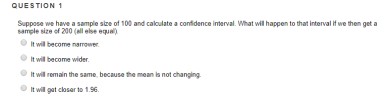 QUESTION 1 Suppose we have a sample size of 100 and calculate a confidence interval. What will happen to that interval if we then get a sample size of 200 (all else equal). It will become narrower It will become wider. It will remain the same, because the mean is not changing It will get closer to 1.96.
QUESTION 1 Suppose we have a sample size of 100 and calculate a confidence interval. What will happen to that interval if...
QUESTION 1 Suppose we have a sample size of 100 and calculate a confidence interval. What will happen to that interval if we then get a sample size of 200 (all else equal). It will become narrower It will become wider. It will remain the same, because the mean is not changing It will get closer to 1.96.
QUESTION 1 Suppose we have a sample size of 100 and calculate a confidence interval. What will happen to that interval if...
10. Properties of a confidence interval Suppose the mean of a population is 22. A researcher...
 10. Properties of a confidence interval Suppose the mean of a population is 22. A researcher (who does not know that p Then she constructs a 95% confidence interval of the population mean. 22) selects a random sample of size n from this population. The true population mean and the researcher's 95% confidence interval of the population mean are shown in the following graph. Use the graph to answer the questions that follow Sample Mean 95% Confidence interval of the...
Consider the formula for estimating a population mean using a confidence interval. If the sample standard...
Consider the formula for estimating a population mean using a confidence interval. If the sample standard deviation increases when all other factors remain the same, then the width of the confidence interval a) increases b) decreases c) stays the same
QUESTION 21 If we change a 90% confidence interval estimate to a 99% confidence interval estimate...
QUESTION 21 If we change a 90% confidence interval estimate to a 99% confidence interval estimate while holding sample size constant, we can expect a. the width of the confidence interval to increase. b. the width of the confidence interval to decrease. c. the width of the confidence interval to remain the same. d. the sample size to increase. QUESTION 22 Which one of the following is a correct statement about the probability distribution of a t random variable? a....
Which of the following does NOT correctly describe how the width of a confidence interval for...
Which of the following does NOT correctly describe how the width of a confidence interval for a population mean changes when the population standard deviation is known? The interval changes if the sample size decreases. The interval changes if the sample size increases. The interval narrows if the sample size increases and confidence level stays the same. The interval widens if the sample size decreases and the confidence level stays the same. The interval widens if the sample size stays...
Describe how the width of a 95% confidence interval for a mean changes as the sample...
Describe how the width of a 95% confidence interval for a mean changes as the sample size (n) increases, assuming the standard deviation remains the same. As the sample size increases, the width of a 95% confidence interval for a mean gets , assuming the standard deviation remains the same. Choices are larger, gets smaller, gets larger, stays the same
 QUESTION 1 Suppose we have a sample size of 100 and calculate a confidence interval. What will happen to that interval if we then get a sample size of 200 (all else equal). It will become narrower It will become wider. It will remain the same, because the mean is not changing It will get closer to 1.96.
QUESTION 1 Suppose we have a sample size of 100 and calculate a confidence interval. What will happen to that interval if...
QUESTION 1 Suppose we have a sample size of 100 and calculate a confidence interval. What will happen to that interval if we then get a sample size of 200 (all else equal). It will become narrower It will become wider. It will remain the same, because the mean is not changing It will get closer to 1.96.
QUESTION 1 Suppose we have a sample size of 100 and calculate a confidence interval. What will happen to that interval if...
 10. Properties of a confidence interval Suppose the mean of a population is 22. A researcher (who does not know that p Then she constructs a 95% confidence interval of the population mean. 22) selects a random sample of size n from this population. The true population mean and the researcher's 95% confidence interval of the population mean are shown in the following graph. Use the graph to answer the questions that follow Sample Mean 95% Confidence interval of the...
Most questions answered within 3 hours.
-
Where is the error in this code sequence?
String s1 = "Hello";
String s2 = "ello";...
asked 10 months ago -
Financial data for Joel de Paris, Inc., for last year
follow:
Joel de Paris, Inc.
Balance...
asked 10 months ago -
Consider this reaction:
Al2(SO4)3 (aq)+ BaCl3
(aq) Al2Cl6 (aq)- +
3BaSO4(s) . What is the...
asked 10 months ago -
Suppose that Savneet is considering increasing her
recent random sample from 20 car rentals to 40...
asked 10 months ago -
Trucks arrive at an unloading terminal at an average rate of 120
per hour.
Trucks arrive...
asked 10 months ago -
Why are methanol and ethanol completely soluble in water while
octanol is not very little soluble....
asked 10 months ago -
A facilities manager at a university reads in a research report
that the mean amount of...
asked 10 months ago -
When the CuSO4 is rehydrated by adding water to the anhydrous
compound, is this an endothermic...
asked 10 months ago -
A ray of sunlight is passing from diamond into crown glass; the
angle of incidence is...
asked 10 months ago -
A block of mass 0.249 kg is placed on top of a light, vertical
spring of...
asked 10 months ago -
how do the kidneys compensate in the presences of acidosis
a) trigger hyperventilate
b) reserve acid...
asked 10 months ago -
Question 501 pts
The rental rate of capital to the firm increases. Which of the
following...
asked 10 months ago