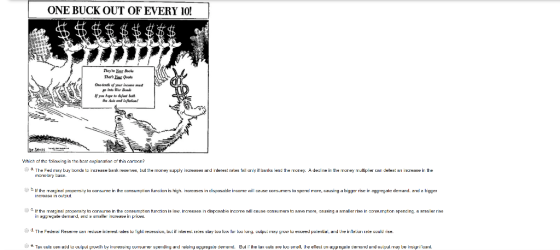
Which of the following is the best explanation of this cartoon?
| a. |
The Fed may buy bonds to increase bank reserves, but the money supply increases and interest rates fall only if banks lend the money. A decline in the money multiplier can defeat an increase in the monetary base. |
|
| b. |
If the marginal propensity to consume in the consumption function is high, increases in disposable income will cause consumers to spend more, causing a bigger rise in aggregate demand, and a bigger increase in output. |
|
| c. |
If the marginal propensity to consume in the consumption function is low, increases in disposable income will cause consumers to save more, causing a smaller rise in consumption spending, a smaller rise in aggregate demand, and a smaller increase in prices. |
|
| d. |
The Federal Reserve can reduce interest rates to fight recession, but if interest rates stay too low for too long, output may grow to exceed potential, and the inflation rate could rise. |
|
| e. |
Tax cuts can add to output growth by increasing consumer spending and raising aggregate demand. But if the tax cuts are too small, the effect on aggregate demand and output may be insignificant. |
Homework Answers
It is given that one tenth of your income goes to war bonds which is indicator of savings. When marginal propensity to consume is low it means that marginal propensity to save is high and that consumption spending will increase by a smaller amount so that you can achieve inflation target at a lower level but will have to to bear with a lower GDP
Select option C.
Add Answer to:
Which of the following is the best explanation of this
cartoon?
a.
The Fed may buy...
1. If the government reduces spending A) the IS curve will shift to the right B)...
 1. If the government reduces spending A) the IS curve will shift to the right B) output will increase if interest rates remain fixed C) consumption will increase D) all of the above 2. If the government cuts taxes A) disposable income falls B) planned expenditures rise C) the IS curve shifts to the left D) all of the above 3. Qualitatively, an increase in government purchases has the same impact as an increase in autonomous A) consumption B) investment...
Question 16 1 pts In the aggregate expenditures model of the economy, a downward shift in...
 Question 16 1 pts In the aggregate expenditures model of the economy, a downward shift in aggregate expenditures can be caused by a decrease in government spending or an increase in taxes. taxes or an increase in government spending. interest rates or a decrease in taxes. saving or an increase in government spending Question 18 As disposable income decreases, consumption and saving both increase. and saving both decrease. increases and saving decreases. decreases and saving increases. Question 19 1 pts...
The net export function illustrates that:A) net exports are a positive function of domestic income....
The net export function illustrates that:A) net exports are a positive function of domestic income.B) net exports are independent of domestic income.C) net exports are a negative function of domestic income.D) imports are independent of domestic income.E) exports are independent of foreign income. Suppose the marginal propensity to import for country A is 0.4. Calculate the change in total value of imports of the country if national income increases by $100,000.A) $16,000B) $20,000C) $60,000D) $40,000E) $25,000 An MPI of 0.4 indicates that...
Which of the following is an example of fiscal stimulus? Multiple Choice an increase in government...
Which of the following is an example of fiscal stimulus? Multiple Choice an increase in government spending on new military jet fighters an increase in consumption because of improved consumer confidence an increase in personal income taxes for families with children an increase in the purchase of office buildings by foreign investors If consumers spend 98 cents out of every extra dollar received, the Multiple Choice marginal propensity to consume is 98. marginal propensity to save is 1.02. marginal propensity...
QUESTION 1 This question is answered in Class 3-3. With deposit insurance, banks are not concerned...
QUESTION 1 This question is answered in Class 3-3. With deposit insurance, banks are not concerned about bank runs. As a result, they can a. keep lower reserves, and lend more at lower interest rates. b. keep higher reserves, and lend more at lower interest rates. c. keep lower reserves, and lend less at higher interest rates. d. keep higher reserves, and lend less at lower interest rates. 1 points QUESTION 2 This question is answered in Class 3-4....
Product 13) 13) The gap that exists when equilibrium real Gross Domestic (GDP) is greater than...
 Product 13) 13) The gap that exists when equilibrium real Gross Domestic (GDP) is greater than full employment real Gross Domestic Product (GDP) is called a(n) A) demand gap. C) recessionary gap B) employment gap D) inflationary gap 14) 14) Economic growth will NOT result in inflation if aggregate demand shifts A) outward to the right at the same speed as aggregate supply B) outward to the right as aggregate supply shifts inward to the left. C) inward to the...
Explain why each of the following are true, false, or uncertain. Use diagrams where appropriate. It...
Explain why each of the following are true, false, or uncertain. Use diagrams where appropriate. It is the explanation that is important. 5. When aggregate consumption is $100 (billion) while disposable income is $120 (billion), the marginal propensity to save from disposable income must be 20%. 6. Ceteris paribus, an increase in the domestic price level increases the price of domestic goods increases their price relative to foreign goods resulting in a downward shift of aggregate expenditures and a leftward...
69) Which of the following conditions describes a recessionary gap? The short-run equilibrium level of real...
69) Which of the following conditions describes a recessionary gap? The short-run equilibrium level of real GDP is below the potential GDP The short-run equilibrium level of real GDP is above the potential GDP The actual interest rate is below the equilibrium interest rate The actual interest rate is above the equilibrium interest rate 70) Question 701 pts Which of the following statements is completely true regarding a contractionary monetary policy? A. The Fed buys bonds, increase money supply and...
10. Open-market purchases of government bonds by the Fed will have the tendency to: A) Increase...
 10. Open-market purchases of government bonds by the Fed will have the tendency to: A) Increase interest rates, the money supply, and national income. B) Increase interest rates and the money supply, but decrease national income. C) Increase interest rates, but decrease the money supply and national income. D) Decrease interest rates, but increase the money supply and national income. E) Decrease interest rates, the money supply, and national income. 11. Aggregate demand would tend to be shifted up by...
1. Modern macroeconomists tend to believe that an increase in aggregate spending A) increases real output,...
1. Modern macroeconomists tend to believe that an increase in aggregate spending A) increases real output, especially in a depressed economy with lots of excess capacity, but also increases the price level, especially in an economy with little excess capacity B) always increases real output without affecting the price level as the simplest version of the "Keynesian cross" model with a fixed price level impliesalways increases real output without affecting the price level as the simplest version of the "Keynesian...
 1. If the government reduces spending A) the IS curve will shift to the right B) output will increase if interest rates remain fixed C) consumption will increase D) all of the above 2. If the government cuts taxes A) disposable income falls B) planned expenditures rise C) the IS curve shifts to the left D) all of the above 3. Qualitatively, an increase in government purchases has the same impact as an increase in autonomous A) consumption B) investment...
 Question 16 1 pts In the aggregate expenditures model of the economy, a downward shift in aggregate expenditures can be caused by a decrease in government spending or an increase in taxes. taxes or an increase in government spending. interest rates or a decrease in taxes. saving or an increase in government spending Question 18 As disposable income decreases, consumption and saving both increase. and saving both decrease. increases and saving decreases. decreases and saving increases. Question 19 1 pts...
 Product 13) 13) The gap that exists when equilibrium real Gross Domestic (GDP) is greater than full employment real Gross Domestic Product (GDP) is called a(n) A) demand gap. C) recessionary gap B) employment gap D) inflationary gap 14) 14) Economic growth will NOT result in inflation if aggregate demand shifts A) outward to the right at the same speed as aggregate supply B) outward to the right as aggregate supply shifts inward to the left. C) inward to the...
 10. Open-market purchases of government bonds by the Fed will have the tendency to: A) Increase interest rates, the money supply, and national income. B) Increase interest rates and the money supply, but decrease national income. C) Increase interest rates, but decrease the money supply and national income. D) Decrease interest rates, but increase the money supply and national income. E) Decrease interest rates, the money supply, and national income. 11. Aggregate demand would tend to be shifted up by...
Most questions answered within 3 hours.
-
Where is the error in this code sequence?
String s1 = "Hello";
String s2 = "ello";...
asked 11 months ago -
Financial data for Joel de Paris, Inc., for last year
follow:
Joel de Paris, Inc.
Balance...
asked 11 months ago -
Consider this reaction:
Al2(SO4)3 (aq)+ BaCl3
(aq) Al2Cl6 (aq)- +
3BaSO4(s) . What is the...
asked 11 months ago -
Suppose that Savneet is considering increasing her
recent random sample from 20 car rentals to 40...
asked 11 months ago -
Trucks arrive at an unloading terminal at an average rate of 120
per hour.
Trucks arrive...
asked 11 months ago -
Why are methanol and ethanol completely soluble in water while
octanol is not very little soluble....
asked 11 months ago -
A facilities manager at a university reads in a research report
that the mean amount of...
asked 11 months ago -
When the CuSO4 is rehydrated by adding water to the anhydrous
compound, is this an endothermic...
asked 11 months ago -
A ray of sunlight is passing from diamond into crown glass; the
angle of incidence is...
asked 11 months ago -
A block of mass 0.249 kg is placed on top of a light, vertical
spring of...
asked 11 months ago -
how do the kidneys compensate in the presences of acidosis
a) trigger hyperventilate
b) reserve acid...
asked 11 months ago -
Question 501 pts
The rental rate of capital to the firm increases. Which of the
following...
asked 11 months ago