Given: a mass (50) kg is on the edge of a rough horizontal turntable with radius...
Given:
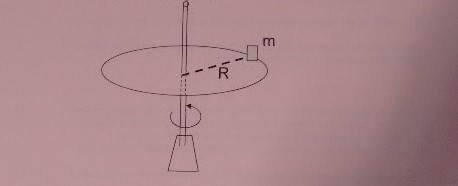
a mass (50) kg is on the edge of a rough horizontal turntable with radius R = 2.00 m
Friction coefficients between the mass and the table are μs = 0.50 and μk = 0.40.
The table starts to rotate (rotate) around the vertical axis of symmetry with a constant angular acceleration α = 0.60 rad / s2.
It has been requested to determine the distance (measured according to the track) that the mass has covered at the time t* (the point in time at which the mass just does not shift).
Can you help me further?
Homework Answers

Add Answer to:
Given:
a mass (50) kg is on the edge of a rough horizontal turntable with radius...
Given: a mass (50) kg is on the edge of a rough horizontal turntable with radius...
 Given:
a mass (50) kg is on the edge of a rough horizontal turntable with radius R = 2.00 m
Friction coefficients between the mass and the table are μs = 0.50 and μk = 0.40.
The table starts to rotate (rotate) around the vertical axis of symmetry with a constant angular acceleration α = 0.60 rad / s2.
It has been requested to calculate the labour that has delivered the frictional force from the start to the time t*...
Given:
a mass (50) kg is on the edge of a rough horizontal turntable with radius R = 2.00 m
Friction coefficients between the mass and the table are μs = 0.50 and μk = 0.40.
The table starts to rotate (rotate) around the vertical axis of symmetry with a constant angular acceleration α = 0.60 rad / s2.
It has been requested to calculate the labour that has delivered the frictional force from the start to the time t*...
Given: a mass (50) kg is on the edge of a rough horizontal turntable with radius...
 Given: a mass (50) kg is on the edge of a rough horizontal
turntable with radius R = 2.00 m Friction coefficients between the
mass and the table are μs = 0.50 and μk = 0.40. The table starts to
rotate (rotate) around the vertical axis of symmetry with a
constant angular acceleration α = 0.60 rad / s2.
It has been asked to calculate the time at which the mass just
will not shift. Can you help me further?
Given: a mass (50) kg is on the edge of a rough horizontal
turntable with radius R = 2.00 m Friction coefficients between the
mass and the table are μs = 0.50 and μk = 0.40. The table starts to
rotate (rotate) around the vertical axis of symmetry with a
constant angular acceleration α = 0.60 rad / s2.
It has been asked to calculate the time at which the mass just
will not shift. Can you help me further?
Given: a mass (50) kg is on the edge of a rough horizontal turntable with radius...
 Given: a mass (50) kg is on the edge of a rough horizontal turntable with radius R = 2.00 m
Friction coefficients between the mass and the table are μs = 0.50 and μk = 0.40.
The table starts to rotate (rotate) around the vertical axis of symmetry with a constant angular acceleration α = 0.60 rad / s2.
It has been requested to calculate the work of the frictional force from the start to the time t* (the point...
Given: a mass (50) kg is on the edge of a rough horizontal turntable with radius R = 2.00 m
Friction coefficients between the mass and the table are μs = 0.50 and μk = 0.40.
The table starts to rotate (rotate) around the vertical axis of symmetry with a constant angular acceleration α = 0.60 rad / s2.
It has been requested to calculate the work of the frictional force from the start to the time t* (the point...
Given: a mass (50) kg is on the edge of a rough horizontal turntable with radius...
 Given:
a mass (50) kg is on the edge of a rough horizontal turntable
with radius R = 2.00 m Friction coefficients between the mass and
the table are μs = 0.50 and μk = 0.40. The table starts to rotate
(rotate) around the vertical axis of symmetry with a constant
angular acceleration α = 0.60 rad / s2. It has been
asked to calculate the specific time t* at which the mass just will
not shift. We must use...
Given:
a mass (50) kg is on the edge of a rough horizontal turntable
with radius R = 2.00 m Friction coefficients between the mass and
the table are μs = 0.50 and μk = 0.40. The table starts to rotate
(rotate) around the vertical axis of symmetry with a constant
angular acceleration α = 0.60 rad / s2. It has been
asked to calculate the specific time t* at which the mass just will
not shift. We must use...
Given: a mass (50) kg is on the edge of a rough horizontal turntable with radius...
 Given:
a mass (50) kg is on the edge of a rough horizontal turntable
with radius R = 2.00 m
Friction coefficients between the mass and the table are μs =
0.50 and μk = 0.40.
The table starts to rotate (rotate) around the vertical axis of
symmetry with a constant angular acceleration α = 0.60 rad /
s2.
It has been asked to calculate the speed v* on which the mass
just will not shift. We must use a...
Given:
a mass (50) kg is on the edge of a rough horizontal turntable
with radius R = 2.00 m
Friction coefficients between the mass and the table are μs =
0.50 and μk = 0.40.
The table starts to rotate (rotate) around the vertical axis of
symmetry with a constant angular acceleration α = 0.60 rad /
s2.
It has been asked to calculate the speed v* on which the mass
just will not shift. We must use a...
A 55.0-kg woman stands at the rim of a horizontal turntable having a moment of inertia of 540 kg · m2 and a radius of...
A 55.0-kg woman stands at the rim of a horizontal turntable having a moment of inertia of 540 kg · m2 and a radius of 2.00 m. The turntable is initially at rest and is free to rotate about a frictionless vertical axle through its center. The woman then starts walking around the rim clockwise (as viewed from above the system) at a constant speed of 1.50 m/s relative to the Earth. (a) In what direction does the turntable rotate?...
A heavy turntable, used for rotating large objects, is a solid cylindrical wheel that can rotate...
 A heavy turntable, used for rotating large objects, is a solid cylindrical wheel that can rotate about its central axle with negligible friction. The radius of the wheel is 0.330 m. A constant tangential force of 200 N applied to its edge causes the wheel to have an angular acceleration of 0.896 rad/s2. (a) What is the moment of inertia of the wheel (in kg ·m2)? kg · m2 (b) What is the mass (in kg) of the wheel? kg...
A certain pulley is a uniform disk of mass 2.7 kg and radius 0.25 m. A...
A certain pulley is a uniform disk of mass 2.7 kg and radius 0.25 m. A rope applies a constant torque to the pulley, which is free to rotate without friction, resulting in an angular acceleration of 0.12 rad/s2. The pulley starts at rest at time t = 0 s. What is its rotational kinetic energy at t = 2.2 s?
1.A solid uniform sphere of mass 3.7 kg and radius 0.051 m rotates with angular velocity...
1.A solid uniform sphere of mass 3.7 kg and radius 0.051 m rotates with angular velocity 7.3 rad/s about an axis through its center. Find the sphere’s rotational kinetic energy. 2.A certain pulley is a uniform disk of mass 2.7 kg and radius 0.25 m. A rope applies a constant torque to the pulley, which is free to rotate without friction, resulting in an angular acceleration of 0.12 rad/s2. The pulley starts at rest at time t = 0 s....
Consider the following mass distribution where the x- and y-coordinates are given in meters: 5.0 kg...
Consider the following mass distribution where the x- and y-coordinates are given in meters: 5.0 kg at (0.0, 0.0) m, 3.3 kg at (0.0, 3.5) m, and 4.0 kg at (2.9, 0.0) m. Where should a fourth object of 7.5 kg be placed so that the center of gravity of the four-object arrangement will be at (0.0, 0.0) m? A 1.25 kg solid, uniform disk rolls without slipping across a level surface, translating at 4.00 m/s. If the disk's radius...
 Given:
a mass (50) kg is on the edge of a rough horizontal turntable with radius R = 2.00 m
Friction coefficients between the mass and the table are μs = 0.50 and μk = 0.40.
The table starts to rotate (rotate) around the vertical axis of symmetry with a constant angular acceleration α = 0.60 rad / s2.
It has been requested to calculate the labour that has delivered the frictional force from the start to the time t*...
Given:
a mass (50) kg is on the edge of a rough horizontal turntable with radius R = 2.00 m
Friction coefficients between the mass and the table are μs = 0.50 and μk = 0.40.
The table starts to rotate (rotate) around the vertical axis of symmetry with a constant angular acceleration α = 0.60 rad / s2.
It has been requested to calculate the labour that has delivered the frictional force from the start to the time t*...
 Given: a mass (50) kg is on the edge of a rough horizontal
turntable with radius R = 2.00 m Friction coefficients between the
mass and the table are μs = 0.50 and μk = 0.40. The table starts to
rotate (rotate) around the vertical axis of symmetry with a
constant angular acceleration α = 0.60 rad / s2.
It has been asked to calculate the time at which the mass just
will not shift. Can you help me further?
Given: a mass (50) kg is on the edge of a rough horizontal
turntable with radius R = 2.00 m Friction coefficients between the
mass and the table are μs = 0.50 and μk = 0.40. The table starts to
rotate (rotate) around the vertical axis of symmetry with a
constant angular acceleration α = 0.60 rad / s2.
It has been asked to calculate the time at which the mass just
will not shift. Can you help me further?
 Given: a mass (50) kg is on the edge of a rough horizontal turntable with radius R = 2.00 m
Friction coefficients between the mass and the table are μs = 0.50 and μk = 0.40.
The table starts to rotate (rotate) around the vertical axis of symmetry with a constant angular acceleration α = 0.60 rad / s2.
It has been requested to calculate the work of the frictional force from the start to the time t* (the point...
Given: a mass (50) kg is on the edge of a rough horizontal turntable with radius R = 2.00 m
Friction coefficients between the mass and the table are μs = 0.50 and μk = 0.40.
The table starts to rotate (rotate) around the vertical axis of symmetry with a constant angular acceleration α = 0.60 rad / s2.
It has been requested to calculate the work of the frictional force from the start to the time t* (the point...
 Given:
a mass (50) kg is on the edge of a rough horizontal turntable
with radius R = 2.00 m Friction coefficients between the mass and
the table are μs = 0.50 and μk = 0.40. The table starts to rotate
(rotate) around the vertical axis of symmetry with a constant
angular acceleration α = 0.60 rad / s2. It has been
asked to calculate the specific time t* at which the mass just will
not shift. We must use...
Given:
a mass (50) kg is on the edge of a rough horizontal turntable
with radius R = 2.00 m Friction coefficients between the mass and
the table are μs = 0.50 and μk = 0.40. The table starts to rotate
(rotate) around the vertical axis of symmetry with a constant
angular acceleration α = 0.60 rad / s2. It has been
asked to calculate the specific time t* at which the mass just will
not shift. We must use...
 Given:
a mass (50) kg is on the edge of a rough horizontal turntable
with radius R = 2.00 m
Friction coefficients between the mass and the table are μs =
0.50 and μk = 0.40.
The table starts to rotate (rotate) around the vertical axis of
symmetry with a constant angular acceleration α = 0.60 rad /
s2.
It has been asked to calculate the speed v* on which the mass
just will not shift. We must use a...
Given:
a mass (50) kg is on the edge of a rough horizontal turntable
with radius R = 2.00 m
Friction coefficients between the mass and the table are μs =
0.50 and μk = 0.40.
The table starts to rotate (rotate) around the vertical axis of
symmetry with a constant angular acceleration α = 0.60 rad /
s2.
It has been asked to calculate the speed v* on which the mass
just will not shift. We must use a...
 A heavy turntable, used for rotating large objects, is a solid cylindrical wheel that can rotate about its central axle with negligible friction. The radius of the wheel is 0.330 m. A constant tangential force of 200 N applied to its edge causes the wheel to have an angular acceleration of 0.896 rad/s2. (a) What is the moment of inertia of the wheel (in kg ·m2)? kg · m2 (b) What is the mass (in kg) of the wheel? kg...
Most questions answered within 3 hours.
-
Where is the error in this code sequence?
String s1 = "Hello";
String s2 = "ello";...
asked 11 months ago -
Financial data for Joel de Paris, Inc., for last year
follow:
Joel de Paris, Inc.
Balance...
asked 11 months ago -
Consider this reaction:
Al2(SO4)3 (aq)+ BaCl3
(aq) Al2Cl6 (aq)- +
3BaSO4(s) . What is the...
asked 11 months ago -
Suppose that Savneet is considering increasing her
recent random sample from 20 car rentals to 40...
asked 11 months ago -
Trucks arrive at an unloading terminal at an average rate of 120
per hour.
Trucks arrive...
asked 11 months ago -
Why are methanol and ethanol completely soluble in water while
octanol is not very little soluble....
asked 11 months ago -
A facilities manager at a university reads in a research report
that the mean amount of...
asked 11 months ago -
When the CuSO4 is rehydrated by adding water to the anhydrous
compound, is this an endothermic...
asked 11 months ago -
A ray of sunlight is passing from diamond into crown glass; the
angle of incidence is...
asked 11 months ago -
A block of mass 0.249 kg is placed on top of a light, vertical
spring of...
asked 11 months ago -
how do the kidneys compensate in the presences of acidosis
a) trigger hyperventilate
b) reserve acid...
asked 11 months ago -
Question 501 pts
The rental rate of capital to the firm increases. Which of the
following...
asked 11 months ago