


Homework Answers
1)
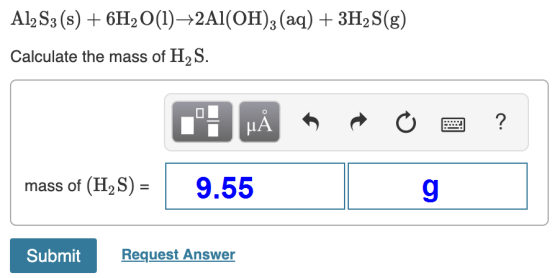
moles Al2S3 = 16.4 g / 150.1580772 g/mol = 0.10921823391 moles
moles H2O = 10.1 g / 18.01528 g/mol = 0.56063519412 moles
moles H2S produced = 0.56063519412 / 2 = 0.28031759706 moles
mass of H2S = 0.28031759706 mol x 34.08088 g/mol = 9.55347038736 g
Answer: Mass of H2S = 9.55 g
-------------------------------------------------------------------------------------------------------------
2) PART-D:
Are you sure Part-D is following up of above question, i mean relates to mass of H2S??????
percent yield = (actual yield / theoretical yield) x 100%
percent yield = (186 g / 9.55 g) x 100% = 1947 %
Answer: percent yield = 1947 % ------------------> this is impossible in any reaction
-------------------------------------------------------------------------------------------------------------
3) PART-B:
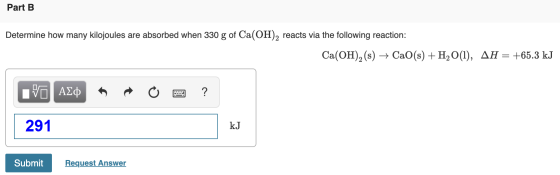
moles Ca(OH)2 = 330 g / 74.09268 g/mol = 4.4538812741 mol
energy absorbed = 4.4538812741 mol x 65.3 kJ = 291 kJ
energy absorbed =291 kJ
-------------------------------------------------------------------------------------------------------------

Hope this helped you!
Thank You So Much! Please Rate this answer as you wish.("Thumbs Up")
Add Answer to:
For each of the following reactions, calculate the grams of indicated product when 16.4 g of...
A Review | Constants Periodic Table Correct Learning Goal: To calculate theoretical and percent yields, given the masse...
 A Review | Constants Periodic Table Correct Learning Goal: To calculate theoretical and percent yields, given the masses of multiple reactants. A balanced chemical reaction gives the mole ratios between reactants and products. For example, one mole of white phosphorus, P4, reacts with five moles of oxygen, O2, to produce two moles of diphosphorus pentoxide, P205: Part B What is the maximum number of moles of P2O5 that can theoretically be made from 144 g of O2 and excess phosphorus?...
ng Mass of Product from a Limiting Reactant C 1901 - Review Constants Periodie Value ||...
 ng Mass of Product from a Limiting Reactant C 1901 - Review Constants Periodie Value || Units elds, given the Submit mole ratios example, one mole five moles of diphosphorus Part B What is the maximum number of moles of P20s that can theoretically be made from 176 g of O, and excess phosphorus? Express your answer to three significant figures and include the appropriate units. View Available Hint(s) 05 ber of moles of at much product can gh oxygen....
For each of the following reactions, calculate the grams of indicated product when 17.2 g of...
For each of the following reactions, calculate the grams of indicated product when 17.2 g of the first reactant and 10.5 g of the second reactant are used. Part B: Fe2O3(s)+3H2(g)→2Fe(s)+3H2O(l) Calculate the mass of Fe. Part C Al2S3(s)+6H2O(l)→2Al(OH)3(aq)+3H2S(g) Calculate the mass of H2S
Calculate the maximum numbers of moles and grams of H2S that can form when 153.0 g...
Calculate the maximum numbers of moles and grams of H2S that can form when 153.0 g of aluminum sulfide reacts with 143.0 g of water: Al2S3 + H2O → Al(OH)3 + H2S [unbalanced] ______ mol H2S ______ g H2S What mass of the excess reactant remains? ______ g excess reactant
What is the theoretical yield (in grams) of phosphorus pentachloride when 3.85 g of phosphorus reacts...
 What is the theoretical yield (in grams) of phosphorus
pentachloride when 3.85 g of phosphorus reacts with 25.8 g of
chlorine according to the following reaction:
P4 (s) + 10 Cl2 (g) → 4
PCl5 (l)
Use the correct number of significant figures, fill in the
number ONLY!
lan 4 15 What is the mass of excess reactant (in grams) that remains after the limiting reagent produces the maximum amount of phosphorus pentachloride possible upon the reaction of 4.69 g...
What is the theoretical yield (in grams) of phosphorus
pentachloride when 3.85 g of phosphorus reacts with 25.8 g of
chlorine according to the following reaction:
P4 (s) + 10 Cl2 (g) → 4
PCl5 (l)
Use the correct number of significant figures, fill in the
number ONLY!
lan 4 15 What is the mass of excess reactant (in grams) that remains after the limiting reagent produces the maximum amount of phosphorus pentachloride possible upon the reaction of 4.69 g...
For each of the following reactions, calculate the grams of indicated product when 27.0 g of...
For each of the following reactions, calculate the grams of indicated product when 27.0 g of the first reactant and 40.0 g of the second reactant is used: 3Fe(s)+4H2O(l)→Fe3O4(s)+4H2(g) find(H2)
How many moles of phosphorus trichloride may theoretically form when 2.409 g of chlorine reacts? (Use...
 How many moles of phosphorus trichloride may theoretically form when 2.409 g of chlorine reacts? (Use 70.90 g moll for the molar mass of chlorine.) P4(s) + 6 Cl2(g) -> 4 PC13(1) What is the limiting reagent when 0.7541 g of phosphorus reacts with 2.409 g of chlorine? P4(s) + 6 Cl2(g) - 4 PC13(0) P4 Cl2 PCI3 Calculate the theoretical yield of phosphorus trichloride (in g) when 0.7541 g of phosphorus reacts with 2.409 g of chlorine. (Use 137.3...
Work each of the following problems. SHOW ALL WORK TO RECEIVE ANY CREDIT (Hint: Make sure...
 Work each of the following problems. SHOW ALL WORK TO RECEIVE ANY CREDIT (Hint: Make sure your chemical equations are balanced.) 1. When 18.0 g of O2 reacts with 25.0 g of CHSOH, what is the limiting reactant? What is the theoretical yield in grams of CO2? C2HsOH +O2 CO2 +H2On 2. What is the limiting reactant when 126 g of Ag reacts with 142 g of HNO,? What is the theoretical yield in grams of AgNO3? AgNO (a) +NO+H2O...
Question 1 1 pts Calculate the mass of potassium chloride, KCI, (in grams) formed when 7.00 g of chlorine gas is allowe...
 Question 1 1 pts Calculate the mass of potassium chloride, KCI, (in grams) formed when 7.00 g of chlorine gas is allowed to react with 5.00 g of potassium. (write the chemical reaction first) 7.36 7.38 14.7 4.77 9.53 Question 2 1 pts Carbon dioxide is produced in the following reaction: 5 H2C204(aq) + 2 KMnO4 (aq) + 3 H2SO4 (aq) → 10 CO2(g) + 2 MnSO4 (aq) + K2SO4 (aq) + 8 H20 (1) What is the limiting reagent...
2C +02 2Pb + O2 → 2CO) → 2P50) Eqs. 7.1 reactants products CH, + 2O...
 2C +02 2Pb + O2 → 2CO) → 2P50) Eqs. 7.1 reactants products CH, + 2O + co, + 2H2O methane oxygen water C: carbon dioxide C: H: 2 x 2 O: 2 + 2 H: 4 4 1 = 4 = 4 O: 2 x 2 = Figure 7.4. A balanced chemical reaction with stoichiometric conventions noted. Question 7.4. Balance the following chemical reactions: a) CH4 +_2_02 _CO2 + 2 H20 b) CH-OH + 02 → CO2 + H2O...
 A Review | Constants Periodic Table Correct Learning Goal: To calculate theoretical and percent yields, given the masses of multiple reactants. A balanced chemical reaction gives the mole ratios between reactants and products. For example, one mole of white phosphorus, P4, reacts with five moles of oxygen, O2, to produce two moles of diphosphorus pentoxide, P205: Part B What is the maximum number of moles of P2O5 that can theoretically be made from 144 g of O2 and excess phosphorus?...
 ng Mass of Product from a Limiting Reactant C 1901 - Review Constants Periodie Value || Units elds, given the Submit mole ratios example, one mole five moles of diphosphorus Part B What is the maximum number of moles of P20s that can theoretically be made from 176 g of O, and excess phosphorus? Express your answer to three significant figures and include the appropriate units. View Available Hint(s) 05 ber of moles of at much product can gh oxygen....
 What is the theoretical yield (in grams) of phosphorus
pentachloride when 3.85 g of phosphorus reacts with 25.8 g of
chlorine according to the following reaction:
P4 (s) + 10 Cl2 (g) → 4
PCl5 (l)
Use the correct number of significant figures, fill in the
number ONLY!
lan 4 15 What is the mass of excess reactant (in grams) that remains after the limiting reagent produces the maximum amount of phosphorus pentachloride possible upon the reaction of 4.69 g...
What is the theoretical yield (in grams) of phosphorus
pentachloride when 3.85 g of phosphorus reacts with 25.8 g of
chlorine according to the following reaction:
P4 (s) + 10 Cl2 (g) → 4
PCl5 (l)
Use the correct number of significant figures, fill in the
number ONLY!
lan 4 15 What is the mass of excess reactant (in grams) that remains after the limiting reagent produces the maximum amount of phosphorus pentachloride possible upon the reaction of 4.69 g...
 How many moles of phosphorus trichloride may theoretically form when 2.409 g of chlorine reacts? (Use 70.90 g moll for the molar mass of chlorine.) P4(s) + 6 Cl2(g) -> 4 PC13(1) What is the limiting reagent when 0.7541 g of phosphorus reacts with 2.409 g of chlorine? P4(s) + 6 Cl2(g) - 4 PC13(0) P4 Cl2 PCI3 Calculate the theoretical yield of phosphorus trichloride (in g) when 0.7541 g of phosphorus reacts with 2.409 g of chlorine. (Use 137.3...
 Work each of the following problems. SHOW ALL WORK TO RECEIVE ANY CREDIT (Hint: Make sure your chemical equations are balanced.) 1. When 18.0 g of O2 reacts with 25.0 g of CHSOH, what is the limiting reactant? What is the theoretical yield in grams of CO2? C2HsOH +O2 CO2 +H2On 2. What is the limiting reactant when 126 g of Ag reacts with 142 g of HNO,? What is the theoretical yield in grams of AgNO3? AgNO (a) +NO+H2O...
 Question 1 1 pts Calculate the mass of potassium chloride, KCI, (in grams) formed when 7.00 g of chlorine gas is allowed to react with 5.00 g of potassium. (write the chemical reaction first) 7.36 7.38 14.7 4.77 9.53 Question 2 1 pts Carbon dioxide is produced in the following reaction: 5 H2C204(aq) + 2 KMnO4 (aq) + 3 H2SO4 (aq) → 10 CO2(g) + 2 MnSO4 (aq) + K2SO4 (aq) + 8 H20 (1) What is the limiting reagent...
 2C +02 2Pb + O2 → 2CO) → 2P50) Eqs. 7.1 reactants products CH, + 2O + co, + 2H2O methane oxygen water C: carbon dioxide C: H: 2 x 2 O: 2 + 2 H: 4 4 1 = 4 = 4 O: 2 x 2 = Figure 7.4. A balanced chemical reaction with stoichiometric conventions noted. Question 7.4. Balance the following chemical reactions: a) CH4 +_2_02 _CO2 + 2 H20 b) CH-OH + 02 → CO2 + H2O...
Most questions answered within 3 hours.
-
Where is the error in this code sequence?
String s1 = "Hello";
String s2 = "ello";...
asked 11 months ago -
Financial data for Joel de Paris, Inc., for last year
follow:
Joel de Paris, Inc.
Balance...
asked 11 months ago -
Consider this reaction:
Al2(SO4)3 (aq)+ BaCl3
(aq) Al2Cl6 (aq)- +
3BaSO4(s) . What is the...
asked 11 months ago -
Suppose that Savneet is considering increasing her
recent random sample from 20 car rentals to 40...
asked 11 months ago -
Trucks arrive at an unloading terminal at an average rate of 120
per hour.
Trucks arrive...
asked 11 months ago -
Why are methanol and ethanol completely soluble in water while
octanol is not very little soluble....
asked 11 months ago -
A facilities manager at a university reads in a research report
that the mean amount of...
asked 11 months ago -
When the CuSO4 is rehydrated by adding water to the anhydrous
compound, is this an endothermic...
asked 11 months ago -
A ray of sunlight is passing from diamond into crown glass; the
angle of incidence is...
asked 11 months ago -
A block of mass 0.249 kg is placed on top of a light, vertical
spring of...
asked 11 months ago -
how do the kidneys compensate in the presences of acidosis
a) trigger hyperventilate
b) reserve acid...
asked 11 months ago -
Question 501 pts
The rental rate of capital to the firm increases. Which of the
following...
asked 11 months ago