
Homework Answers
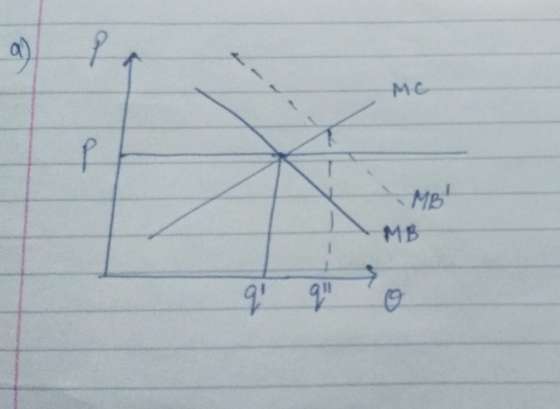
a) The Marginal Benefit curve slopes downwards while the Marginal Cost curve is increasing in quantity. Their intersection gives us the efficient equilibrium. In this diagram, q' is the quantity produced when price is controlled at p. However, the efficient quantity is q'' where the MB' curve intersects the MC curve.
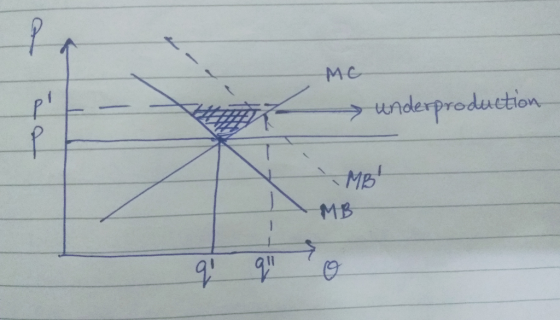
b) Had there been no price control p, the market would have cleared at p' and produced q'' the efficient equilibrium quantity, Therefore, the shaded triangle shows underproduction.
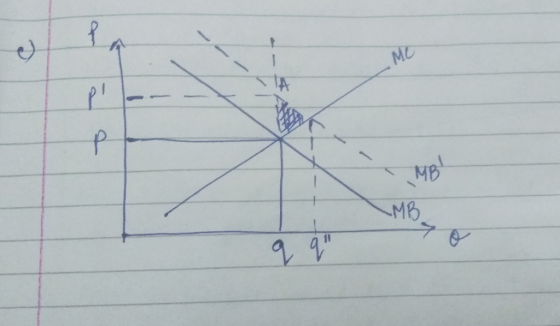
c) With quantity control at q, the true marginal benefit curve MB' cuts the MC curve at A with a higher price p'. The shaded triangle shows the loss to the economy because of the error.
d) The relative size of the loss triangle increases as the MC curve becomes flatter or its slope decreases.
Add Answer to:
4, Uncertain Benefits. Consider the problem of supplying an input to a division of a firm...
Problem Setup Analyze each of the following three scenarios (Efficient, A, and B) describing the market...
 Problem Setup
Analyze each of the following three scenarios (Efficient, A, and
B) describing the market for widgets.
Consider the market for widgets. Consumers have a market
(aggregate)
marginal benefit curve of MB = 50 – 3Q. The supplier(s) in that
market have a market (aggregate) marginal cost curve of MC = 10 +
2Q.
Efficient Outcome
● Use the marginal benefit and marginal cost equations given
above to determine the efficient quantity
Equilibrium with Marginal Cost Pricing (Scenario
A)...
Problem Setup
Analyze each of the following three scenarios (Efficient, A, and
B) describing the market for widgets.
Consider the market for widgets. Consumers have a market
(aggregate)
marginal benefit curve of MB = 50 – 3Q. The supplier(s) in that
market have a market (aggregate) marginal cost curve of MC = 10 +
2Q.
Efficient Outcome
● Use the marginal benefit and marginal cost equations given
above to determine the efficient quantity
Equilibrium with Marginal Cost Pricing (Scenario
A)...
Analyze the following three scenarios (Efficient, A, and B) describing the market for widgets. ● Consider...
Analyze the following three scenarios (Efficient, A, and B) describing the market for widgets. ● Consider the market for widgets, consumers have a market (aggregate) marginal benefit curve of MB = 90 – 2Q. The supplier(s) in that market have a market (aggregate) marginal cost curve of MC = 4Q. Efficient Outcome ● Use the marginal benefit and marginal cost equations given above to determine the efficient quantity (Q*) and the joint surplus (JS*) based on that quantity. Equilibrium with...
MBC Consider a monopsony consumer facing the following MB, supply, and monoposonist MC curves: M M...
 MBC Consider a monopsony consumer facing the following MB, supply, and monoposonist MC curves: M M 200 - 2Q if 0<Q<100 10 otherwise OSPP -20 if 20 <P To otherwise MCM(Q) = 2Q + 20 Solve for the price, quantity, and dead weight loss. (All answers should have no more than 1 digit after the decimal) P= Q= DWL= If the government wanted to eliminate the dead weight loss with a price control, should it use a price ceiling or...
Name: Consider the market for a good where the demand curve facing a firm who has...
 Name: Consider the market for a good where the demand curve facing a firm who has considerable market power is given by P = 80 -0.05Q, the marginal revenue curve is given by MR = 80 -0.1Q, and the firm's marginal cost curve is given by MC = 17 + 0.020. a. If the firm behaves like a competitive firm, find equilibrium price and quantity. Graphically identify and calculate consumer and producer surplus. b. If the firm behaves like a...
Consider the case of The Electric Company which produces electricity in New York State. The average...
Consider the case of The Electric Company which produces electricity in New York State. The average monthly demand curve for the firm can be represented by P=65-Q where Q represents the quantity of electricity produced, in megawatt-hours (mwh) and P is measured in cents. Their marginal costs can be represented by MC=5+0.5*Q. Please provide graphs to accompany your analysis. a. (5 Points) The firm has market power. What price should they charge? How much electricity will they produce? b. (5...
1. Consider the case of The Electric Company which produces electricity in New York State. The av...
1. Consider the case of The Electric Company which produces electricity in New York State. The average monthly demand curve for the firm can be represented by P=65-Q where Q represents the quantity of electricity produced, in megawatt-hours (mwh) and P is measured in cents. Their marginal costs can be represented by MC=5+0.5*Q. Please provide graphs to accompany your analysis. c. Suppose instead that the firm’s marginal cost curve is more complicated. The firm has two plants. The first plant...
3. Working with Numbers and Graphs 04 Consider a market with the following demand (D), marginal...
 3. Working with Numbers and Graphs 04 Consider a market with the following demand (D), marginal revenue (MR), and marginal cost (MC- ATC) curves. 150 130 110 MC-ATO 30 F5 F6 2 3 4 5 -QWERTY Tab 150 120 MC ATC 1 MR 020 40 100 120 140 100 180 QUANTITY (Units) ゲ Esc F4 FS F6 F8 4 0 20 40 0100120 14 0 10 QUANTITY (Units) if the market is perfectly competitive, profit equalsS f the market is...
I need parts D, E, F only! 1. Consider a firm that manufactures dyed textiles. The...
 I need parts D, E, F only!
1. Consider a firm that manufactures dyed textiles. The firm incurs a marginal cost of MC 2Q Suppose that for every textile produced, there is an externality cost of 12 (from dyes being leaked into the water). So the true social marginal cost of widget production is MC = 2Q+12. Imagine that the (a) Assuming this is a perfectly competitive market, write out the equation for the firm's supply (b) Calculate the equilibrium...
I need parts D, E, F only!
1. Consider a firm that manufactures dyed textiles. The firm incurs a marginal cost of MC 2Q Suppose that for every textile produced, there is an externality cost of 12 (from dyes being leaked into the water). So the true social marginal cost of widget production is MC = 2Q+12. Imagine that the (a) Assuming this is a perfectly competitive market, write out the equation for the firm's supply (b) Calculate the equilibrium...
Suppose that each firm in a competitive industry has the following costs: Total Cost: TC =...
 Suppose that each firm in a competitive industry has the following costs:Total Cost: TC=50+1/2 q2Marginal Cost: MC=qwhere q is an individual firm's quantity produced.The market demand curve for this product is:Demand QD=160-4 Pwhere P is the price and Q is the total quantity of the good.Each firm's fixed cost is $_______ What is each firm's variable cost?1/2 q50+1/2 q1/2 q^{2}qWhich of the following represents the equation for each firm's average total cost?50/q+1/2 q50+1/2 q50/q1/2 qComplete the following table by computing the...
Consider a representative firm with total cost of TC=16+Q^2 (and a marginal cost of of 2Q,...
Consider a representative firm with total cost of TC=16+Q^2 (and a marginal cost of of 2Q, MC=2Q). The market demand curve is given by P=18-(1/2)Q and the starting market price is $12. 1) Graph the starting condition of a comparative static scenario. 2) Annotate what happens in order to transition to the long run. 3) Graph the long run equilibrium using comparative statics. 4) How many firms are in the market in the long run?
 Problem Setup
Analyze each of the following three scenarios (Efficient, A, and
B) describing the market for widgets.
Consider the market for widgets. Consumers have a market
(aggregate)
marginal benefit curve of MB = 50 – 3Q. The supplier(s) in that
market have a market (aggregate) marginal cost curve of MC = 10 +
2Q.
Efficient Outcome
● Use the marginal benefit and marginal cost equations given
above to determine the efficient quantity
Equilibrium with Marginal Cost Pricing (Scenario
A)...
Problem Setup
Analyze each of the following three scenarios (Efficient, A, and
B) describing the market for widgets.
Consider the market for widgets. Consumers have a market
(aggregate)
marginal benefit curve of MB = 50 – 3Q. The supplier(s) in that
market have a market (aggregate) marginal cost curve of MC = 10 +
2Q.
Efficient Outcome
● Use the marginal benefit and marginal cost equations given
above to determine the efficient quantity
Equilibrium with Marginal Cost Pricing (Scenario
A)...
 MBC Consider a monopsony consumer facing the following MB, supply, and monoposonist MC curves: M M 200 - 2Q if 0<Q<100 10 otherwise OSPP -20 if 20 <P To otherwise MCM(Q) = 2Q + 20 Solve for the price, quantity, and dead weight loss. (All answers should have no more than 1 digit after the decimal) P= Q= DWL= If the government wanted to eliminate the dead weight loss with a price control, should it use a price ceiling or...
 Name: Consider the market for a good where the demand curve facing a firm who has considerable market power is given by P = 80 -0.05Q, the marginal revenue curve is given by MR = 80 -0.1Q, and the firm's marginal cost curve is given by MC = 17 + 0.020. a. If the firm behaves like a competitive firm, find equilibrium price and quantity. Graphically identify and calculate consumer and producer surplus. b. If the firm behaves like a...
 3. Working with Numbers and Graphs 04 Consider a market with the following demand (D), marginal revenue (MR), and marginal cost (MC- ATC) curves. 150 130 110 MC-ATO 30 F5 F6 2 3 4 5 -QWERTY Tab 150 120 MC ATC 1 MR 020 40 100 120 140 100 180 QUANTITY (Units) ゲ Esc F4 FS F6 F8 4 0 20 40 0100120 14 0 10 QUANTITY (Units) if the market is perfectly competitive, profit equalsS f the market is...
 I need parts D, E, F only!
1. Consider a firm that manufactures dyed textiles. The firm incurs a marginal cost of MC 2Q Suppose that for every textile produced, there is an externality cost of 12 (from dyes being leaked into the water). So the true social marginal cost of widget production is MC = 2Q+12. Imagine that the (a) Assuming this is a perfectly competitive market, write out the equation for the firm's supply (b) Calculate the equilibrium...
I need parts D, E, F only!
1. Consider a firm that manufactures dyed textiles. The firm incurs a marginal cost of MC 2Q Suppose that for every textile produced, there is an externality cost of 12 (from dyes being leaked into the water). So the true social marginal cost of widget production is MC = 2Q+12. Imagine that the (a) Assuming this is a perfectly competitive market, write out the equation for the firm's supply (b) Calculate the equilibrium...
Most questions answered within 3 hours.
-
Where is the error in this code sequence?
String s1 = "Hello";
String s2 = "ello";...
asked 10 months ago -
Financial data for Joel de Paris, Inc., for last year
follow:
Joel de Paris, Inc.
Balance...
asked 10 months ago -
Consider this reaction:
Al2(SO4)3 (aq)+ BaCl3
(aq) Al2Cl6 (aq)- +
3BaSO4(s) . What is the...
asked 10 months ago -
Suppose that Savneet is considering increasing her
recent random sample from 20 car rentals to 40...
asked 10 months ago -
Trucks arrive at an unloading terminal at an average rate of 120
per hour.
Trucks arrive...
asked 10 months ago -
Why are methanol and ethanol completely soluble in water while
octanol is not very little soluble....
asked 10 months ago -
A facilities manager at a university reads in a research report
that the mean amount of...
asked 10 months ago -
When the CuSO4 is rehydrated by adding water to the anhydrous
compound, is this an endothermic...
asked 10 months ago -
A ray of sunlight is passing from diamond into crown glass; the
angle of incidence is...
asked 10 months ago -
A block of mass 0.249 kg is placed on top of a light, vertical
spring of...
asked 10 months ago -
how do the kidneys compensate in the presences of acidosis
a) trigger hyperventilate
b) reserve acid...
asked 10 months ago -
Question 501 pts
The rental rate of capital to the firm increases. Which of the
following...
asked 10 months ago