
Homework Answers
Sol. :- We are given coefficient of linear expansion of steel
(a) = 12
K-1
And length of steel Bar (l) = 25 m
Change in temperature =
40
So, change in lenght of Bar = al =
12
= 0.012m or 1.2 cm
Hope this helps........
Add Answer to:
2. The coefficient of linear expansion of steel is 12 X 10° K'. What is the...
The coefficient of linear expansion of steel is 12 × 10-6 K-1. What is the change...
The coefficient of linear expansion of steel is 12 × 10-6 K-1. What is the change in length of a 25-m steel bridge span when it undergoes a temperature change of 40 K from winter to summer?
The Eiffel tower, which is made of steel (coefficient of linear expansion 13 x 10^-6/ degree...
The Eiffel tower, which is made of steel (coefficient of linear expansion 13 x 10^-6/ degree C.), is 320 m high at 20(Degrees C). the change in height of the tower between the winter months when the average temperature is -20C and the summer months when the average temperature is 35C is ? a. 42 cm b. 35 cm c. 23cm d. 15 cm e. 11cm
The coefficient of linear expansion of a mystery metal alloy is 1.20 x 10⁻⁵ K 1....
 The coefficient of linear expansion of a mystery metal alloy is 1.20 x 10⁻⁵ K 1. At 20.0° C a rod made of this alloy has a length of 11.9200 m. The rod is cooled to -29.0° C. Calculate the change in length (AL) of the rod. Remember that a negative change in length means that the length decreases, and a positive change in length means that the length increases. (There must be three significant figures in your answer.) x...
Expansion joints are used to allow for thermal expansion bridges. A steel bridge with a single...
Expansion joints are used to allow for thermal expansion bridges. A steel bridge with a single expansion joint must operate between temperature extremes -50 F and 150 F, the gap in the joint is fully closed and the bridge is 100 m long. The linear expansion coefficient of steel is 12 x 10^-6 (Celcius). What is the gap at -50 F? Express your answer in centimeters.
Chapter 13 Temperature and Kinetic Theory D) As shown in the figure, a bimetallic strip, consisting...
 Chapter 13 Temperature and Kinetic Theory D) As shown in the figure, a bimetallic strip, consisting of metal G on the top and metal on the bottom, is rigidly attached to a wall at the left. The coefficient of linear thermal expansion for metal G is greater than that of metal H. If the strip is uniformly heated, it will A) curve upward. B) curve downward. C) remain horizontal, but get longer. D) remain horizontal, but get shorter. E) bend...
Steel Beam A beam used in construction is made of steel, which has a coefficient of...
 Steel Beam A beam used in construction is made of steel, which has a coefficient of linear expansion of 1.3 x 10⁵ K1. The beam is 30 m long at a temperature of 1635 K when it is made. As it cools, the temperature of the beam decreases to 300 K 1) What is the change in the length of the beam due to cooling? m Submit 2) If the mass of the steel beam is 390 kg and the...
A bridge is made with segments of concrete 50 m long. If the linear expansion coefficient...
A bridge is made with segments of concrete 50 m long. If the linear expansion coefficient is 12 X 10–6 (°C)–1 , how much spacing (in cm) is needed to allow for expansion during an extreme temperature change of 150°F? ANSWER. 5.0 cm PLEASE EXPLAIN YOUR CONVERSIONS AND STEPS
The linear coefficient of thermal expansion for water at 20oC is 69 x 10-6 K -1...
The linear coefficient of thermal expansion for water at 20oC is 69 x 10-6 K -1 . What is the magnitude of the percentage change in density of 1 m3 of water when it is heated from 20oC to 21oC? Density of water = 1000 kgm-3.
a 10m steel rod has a coefficient of linear expansion 1.2 E -2 / Deg C...
a 10m steel rod has a coefficient of linear expansion 1.2 E -2 / Deg C and has is heated from 15 deg C to 45 degree C. Find the change in length of the rod.
3. The linear expansion coefficient is defined by AL/L = a AT. Consider a material for...
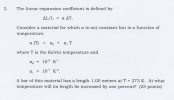 3. The linear expansion coefficient is defined by AL/L = a AT. Consider a material for which a is not constant but is a function of temperature: a (T) = 2o + QT where T is the Kelvin temperature and do = 10-5 K-1 Q = 10-7 K2 A bar of this material has a length 1.00 meters at T = 273 K. At what temperature will its length be increased by one percent? (25 points)
 The coefficient of linear expansion of a mystery metal alloy is 1.20 x 10⁻⁵ K 1. At 20.0° C a rod made of this alloy has a length of 11.9200 m. The rod is cooled to -29.0° C. Calculate the change in length (AL) of the rod. Remember that a negative change in length means that the length decreases, and a positive change in length means that the length increases. (There must be three significant figures in your answer.) x...
 Chapter 13 Temperature and Kinetic Theory D) As shown in the figure, a bimetallic strip, consisting of metal G on the top and metal on the bottom, is rigidly attached to a wall at the left. The coefficient of linear thermal expansion for metal G is greater than that of metal H. If the strip is uniformly heated, it will A) curve upward. B) curve downward. C) remain horizontal, but get longer. D) remain horizontal, but get shorter. E) bend...
 Steel Beam A beam used in construction is made of steel, which has a coefficient of linear expansion of 1.3 x 10⁵ K1. The beam is 30 m long at a temperature of 1635 K when it is made. As it cools, the temperature of the beam decreases to 300 K 1) What is the change in the length of the beam due to cooling? m Submit 2) If the mass of the steel beam is 390 kg and the...
 3. The linear expansion coefficient is defined by AL/L = a AT. Consider a material for which a is not constant but is a function of temperature: a (T) = 2o + QT where T is the Kelvin temperature and do = 10-5 K-1 Q = 10-7 K2 A bar of this material has a length 1.00 meters at T = 273 K. At what temperature will its length be increased by one percent? (25 points)
Most questions answered within 3 hours.
-
Where is the error in this code sequence?
String s1 = "Hello";
String s2 = "ello";...
asked 11 months ago -
Financial data for Joel de Paris, Inc., for last year
follow:
Joel de Paris, Inc.
Balance...
asked 11 months ago -
Consider this reaction:
Al2(SO4)3 (aq)+ BaCl3
(aq) Al2Cl6 (aq)- +
3BaSO4(s) . What is the...
asked 11 months ago -
Suppose that Savneet is considering increasing her
recent random sample from 20 car rentals to 40...
asked 11 months ago -
Trucks arrive at an unloading terminal at an average rate of 120
per hour.
Trucks arrive...
asked 11 months ago -
Why are methanol and ethanol completely soluble in water while
octanol is not very little soluble....
asked 11 months ago -
A facilities manager at a university reads in a research report
that the mean amount of...
asked 11 months ago -
When the CuSO4 is rehydrated by adding water to the anhydrous
compound, is this an endothermic...
asked 11 months ago -
A ray of sunlight is passing from diamond into crown glass; the
angle of incidence is...
asked 11 months ago -
A block of mass 0.249 kg is placed on top of a light, vertical
spring of...
asked 11 months ago -
how do the kidneys compensate in the presences of acidosis
a) trigger hyperventilate
b) reserve acid...
asked 11 months ago -
Question 501 pts
The rental rate of capital to the firm increases. Which of the
following...
asked 11 months ago