The probability of A, B, C, and D all equal .98. Please show
calculations.![2.3 Conditional probability and independence Example 3 An electrical system consists of four components as illustrated on the whiteboard. The system works if components A and B work and either of the components C or D works. The reliability (probability of working) of each component is also shown. Find the probability that [a] the entire system works and b] the component C does not work, given that the entire system works. Assume that the four components work independently.](http://img.homeworklib.com/questions/ac764ca0-7262-11ea-9e00-4b467b7e69ef.png?x-oss-process=image/resize,w_560)
Homework Answers
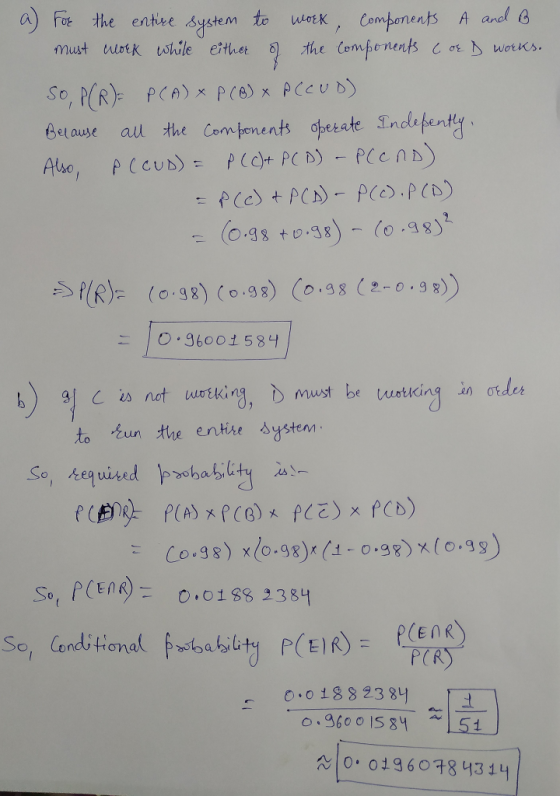
Define two events as below.
Let R be the event that the entire system works.
And let E be the event that the component C doesn't work.
Then we follow following calculations -
-----------------------------
Please ask if you have any doubt(s) in comments
Add Answer to:
The probability of A, B, C, and D all equal .98. Please show
calculations.
2.3 Conditional...
step by step procedure a) An electrical system consist of four components as illustrated in Figure...
 step by step procedure
a) An electrical system consist of four components as illustrated in Figure 1 below. The system works if components A and B work and either of the components C or D works. The reliability of each component is also shown in figure 1. What is the probability that the entire system works? Figure 0.8 0.9 0.9 0.8
step by step procedure
a) An electrical system consist of four components as illustrated in Figure 1 below. The system works if components A and B work and either of the components C or D works. The reliability of each component is also shown in figure 1. What is the probability that the entire system works? Figure 0.8 0.9 0.9 0.8
1. If the probability that C fails is 0.1 and the probability that D fails is 0.12,...
 1. If the probability that C fails is 0.1 and the
probability that D fails is 0.12, find the probability that the
system functions. Round the answer to four decimal places.
2. If both C and D have probability p of failing, what
must the value of p be so that the probability that the
system functions is 0.98?
3. If three components are connected in parallel, function
independently, and each has probability p of failing, what
must the value of...
1. If the probability that C fails is 0.1 and the
probability that D fails is 0.12, find the probability that the
system functions. Round the answer to four decimal places.
2. If both C and D have probability p of failing, what
must the value of p be so that the probability that the
system functions is 0.98?
3. If three components are connected in parallel, function
independently, and each has probability p of failing, what
must the value of...
I want the solution for this. Stat 352 Homework Set 2 Fall 2019: Conditional Probability and...
 I want the solution for this.
Stat 352 Homework Set 2 Fall 2019: Conditional Probability and Independence Deadline: Monday November 11, 2019 (1) In throwing two dice with the sample space Define the following events on : = {(x,y):x, y = 1,2,3,4,5,6). A = {sum less than 4) = {(x, y): x + y < 4, x, y = 1,2,3,4,5,6) B = {first number is 1) = {(x,y): x = 1, y = 1,2,3,4,5,6) C = {sum of number is...
I want the solution for this.
Stat 352 Homework Set 2 Fall 2019: Conditional Probability and Independence Deadline: Monday November 11, 2019 (1) In throwing two dice with the sample space Define the following events on : = {(x,y):x, y = 1,2,3,4,5,6). A = {sum less than 4) = {(x, y): x + y < 4, x, y = 1,2,3,4,5,6) B = {first number is 1) = {(x,y): x = 1, y = 1,2,3,4,5,6) C = {sum of number is...
(10) 3. A conditional probability P(BA) is equal to its marginal probability P(B) if A) it...
 (10) 3. A conditional probability P(BA) is equal to its marginal probability P(B) if A) it is a joint probability. B) statistical dependence exists. C) statistical independence exists. D) the events are mutually exclusive. E) P(A) = P(B).
Question 4 [20 marks] A system consists of five components in two branches as shown in...
 Question 4 [20 marks] A system consists of five components in two branches as shown in the following diagram: C-D-E- In other words, the system works if components A and B work or components C, D, and E work. Assume that the components fail independently with the following probabilities: P(A fails) = P(B fails) = 0.1 and P(C fails) = P(D fails) = P(E fails) = 0.2. (a) What is the probability that the system works? (b) Given that the...
A system consists of three components A, B and C, which fails independently with probabilities 0.2,...
 A system consists of three components A, B and C, which fails
independently with probabilities 0.2, 03 and 0.2. Let X be the
total number of failed components.
(a) Find the probability distribution of X.
(b) What is the probability that at least one component is
working.
(c) Find E(X^3 − 1).
3. (7 points) A system consists of three components A, B and C, which fails independently with probabilities 0.2, 03 and 0.2. Let X be the total number...
A system consists of three components A, B and C, which fails
independently with probabilities 0.2, 03 and 0.2. Let X be the
total number of failed components.
(a) Find the probability distribution of X.
(b) What is the probability that at least one component is
working.
(c) Find E(X^3 − 1).
3. (7 points) A system consists of three components A, B and C, which fails independently with probabilities 0.2, 03 and 0.2. Let X be the total number...
Please explain as much as you can. Thank you 4. Consider the following circuit made of...
 Please explain as much as you can. Thank
you
4. Consider the following circuit made of four identical electronic components A, B, C, and D, each with the reliability (probability that it works) specified in the appropriate box. The circuit operates if and only if there is a path of functional devices from left to right. Assume that the four components work independently. 0.99 0.90 0.95 0.93 What is the reliability of the whole system (probability that the circuit operates)?
Please explain as much as you can. Thank
you
4. Consider the following circuit made of four identical electronic components A, B, C, and D, each with the reliability (probability that it works) specified in the appropriate box. The circuit operates if and only if there is a path of functional devices from left to right. Assume that the four components work independently. 0.99 0.90 0.95 0.93 What is the reliability of the whole system (probability that the circuit operates)?
PLEASE EXPLAIN ALL STEPS 4. Suppose the diagram of an electrical system is as given in...
 PLEASE EXPLAIN ALL STEPS
4. Suppose the diagram of an electrical system is as given in the figure below. 0.85 0.92 0.95 0.75 (a) What is the probability that the system works? Assume the components fail inde- pendently. Round only your final answer to 3 decimals. (b) Given that the system works, what is the probability that the component C is not working? Round only your final answer to 3 decimals
PLEASE EXPLAIN ALL STEPS
4. Suppose the diagram of an electrical system is as given in the figure below. 0.85 0.92 0.95 0.75 (a) What is the probability that the system works? Assume the components fail inde- pendently. Round only your final answer to 3 decimals. (b) Given that the system works, what is the probability that the component C is not working? Round only your final answer to 3 decimals
Suppose a computer system is assembled out of 100 components, and these are completely assembled before...
 Suppose a computer system is assembled out of 100 components, and these are completely assembled before the power is ever applied. Assume that the computer fails to work properly if any component fails a) the rate of defects or each component of the system is only 0 22%, what is the probability that the assembled computer works when switched on, assuming the components are independent? b) For the probability that the system works to be 99% what is the largest...
A device consists of 100 independent modules of equal functionality. Zk is the event that the...
A device consists of 100 independent modules of equal functionality. Zk is the event that the kth group works reliably. a) What is the probability that the device will work reliably at P (Zk) = 99%? There are four independently operating machines in a hall, which do not fail within a certain period of time with the probabilities 0.9, 0.95, 0.8 and 0.85, respectively. Calculate the probability that in this period a) all four machines work b) no machine works...
 step by step procedure
a) An electrical system consist of four components as illustrated in Figure 1 below. The system works if components A and B work and either of the components C or D works. The reliability of each component is also shown in figure 1. What is the probability that the entire system works? Figure 0.8 0.9 0.9 0.8
step by step procedure
a) An electrical system consist of four components as illustrated in Figure 1 below. The system works if components A and B work and either of the components C or D works. The reliability of each component is also shown in figure 1. What is the probability that the entire system works? Figure 0.8 0.9 0.9 0.8
 1. If the probability that C fails is 0.1 and the
probability that D fails is 0.12, find the probability that the
system functions. Round the answer to four decimal places.
2. If both C and D have probability p of failing, what
must the value of p be so that the probability that the
system functions is 0.98?
3. If three components are connected in parallel, function
independently, and each has probability p of failing, what
must the value of...
1. If the probability that C fails is 0.1 and the
probability that D fails is 0.12, find the probability that the
system functions. Round the answer to four decimal places.
2. If both C and D have probability p of failing, what
must the value of p be so that the probability that the
system functions is 0.98?
3. If three components are connected in parallel, function
independently, and each has probability p of failing, what
must the value of...
 I want the solution for this.
Stat 352 Homework Set 2 Fall 2019: Conditional Probability and Independence Deadline: Monday November 11, 2019 (1) In throwing two dice with the sample space Define the following events on : = {(x,y):x, y = 1,2,3,4,5,6). A = {sum less than 4) = {(x, y): x + y < 4, x, y = 1,2,3,4,5,6) B = {first number is 1) = {(x,y): x = 1, y = 1,2,3,4,5,6) C = {sum of number is...
I want the solution for this.
Stat 352 Homework Set 2 Fall 2019: Conditional Probability and Independence Deadline: Monday November 11, 2019 (1) In throwing two dice with the sample space Define the following events on : = {(x,y):x, y = 1,2,3,4,5,6). A = {sum less than 4) = {(x, y): x + y < 4, x, y = 1,2,3,4,5,6) B = {first number is 1) = {(x,y): x = 1, y = 1,2,3,4,5,6) C = {sum of number is...
 (10) 3. A conditional probability P(BA) is equal to its marginal probability P(B) if A) it is a joint probability. B) statistical dependence exists. C) statistical independence exists. D) the events are mutually exclusive. E) P(A) = P(B).
 Question 4 [20 marks] A system consists of five components in two branches as shown in the following diagram: C-D-E- In other words, the system works if components A and B work or components C, D, and E work. Assume that the components fail independently with the following probabilities: P(A fails) = P(B fails) = 0.1 and P(C fails) = P(D fails) = P(E fails) = 0.2. (a) What is the probability that the system works? (b) Given that the...
 A system consists of three components A, B and C, which fails
independently with probabilities 0.2, 03 and 0.2. Let X be the
total number of failed components.
(a) Find the probability distribution of X.
(b) What is the probability that at least one component is
working.
(c) Find E(X^3 − 1).
3. (7 points) A system consists of three components A, B and C, which fails independently with probabilities 0.2, 03 and 0.2. Let X be the total number...
A system consists of three components A, B and C, which fails
independently with probabilities 0.2, 03 and 0.2. Let X be the
total number of failed components.
(a) Find the probability distribution of X.
(b) What is the probability that at least one component is
working.
(c) Find E(X^3 − 1).
3. (7 points) A system consists of three components A, B and C, which fails independently with probabilities 0.2, 03 and 0.2. Let X be the total number...
 Please explain as much as you can. Thank
you
4. Consider the following circuit made of four identical electronic components A, B, C, and D, each with the reliability (probability that it works) specified in the appropriate box. The circuit operates if and only if there is a path of functional devices from left to right. Assume that the four components work independently. 0.99 0.90 0.95 0.93 What is the reliability of the whole system (probability that the circuit operates)?
Please explain as much as you can. Thank
you
4. Consider the following circuit made of four identical electronic components A, B, C, and D, each with the reliability (probability that it works) specified in the appropriate box. The circuit operates if and only if there is a path of functional devices from left to right. Assume that the four components work independently. 0.99 0.90 0.95 0.93 What is the reliability of the whole system (probability that the circuit operates)?
 PLEASE EXPLAIN ALL STEPS
4. Suppose the diagram of an electrical system is as given in the figure below. 0.85 0.92 0.95 0.75 (a) What is the probability that the system works? Assume the components fail inde- pendently. Round only your final answer to 3 decimals. (b) Given that the system works, what is the probability that the component C is not working? Round only your final answer to 3 decimals
PLEASE EXPLAIN ALL STEPS
4. Suppose the diagram of an electrical system is as given in the figure below. 0.85 0.92 0.95 0.75 (a) What is the probability that the system works? Assume the components fail inde- pendently. Round only your final answer to 3 decimals. (b) Given that the system works, what is the probability that the component C is not working? Round only your final answer to 3 decimals
 Suppose a computer system is assembled out of 100 components, and these are completely assembled before the power is ever applied. Assume that the computer fails to work properly if any component fails a) the rate of defects or each component of the system is only 0 22%, what is the probability that the assembled computer works when switched on, assuming the components are independent? b) For the probability that the system works to be 99% what is the largest...
Most questions answered within 3 hours.
-
Where is the error in this code sequence?
String s1 = "Hello";
String s2 = "ello";...
asked 10 months ago -
Financial data for Joel de Paris, Inc., for last year
follow:
Joel de Paris, Inc.
Balance...
asked 10 months ago -
Consider this reaction:
Al2(SO4)3 (aq)+ BaCl3
(aq) Al2Cl6 (aq)- +
3BaSO4(s) . What is the...
asked 10 months ago -
Suppose that Savneet is considering increasing her
recent random sample from 20 car rentals to 40...
asked 10 months ago -
Trucks arrive at an unloading terminal at an average rate of 120
per hour.
Trucks arrive...
asked 10 months ago -
Why are methanol and ethanol completely soluble in water while
octanol is not very little soluble....
asked 10 months ago -
A facilities manager at a university reads in a research report
that the mean amount of...
asked 10 months ago -
When the CuSO4 is rehydrated by adding water to the anhydrous
compound, is this an endothermic...
asked 10 months ago -
A ray of sunlight is passing from diamond into crown glass; the
angle of incidence is...
asked 10 months ago -
A block of mass 0.249 kg is placed on top of a light, vertical
spring of...
asked 10 months ago -
how do the kidneys compensate in the presences of acidosis
a) trigger hyperventilate
b) reserve acid...
asked 10 months ago -
Question 501 pts
The rental rate of capital to the firm increases. Which of the
following...
asked 10 months ago