
Homework Answers

Add Answer to:
Question I: Suppose that the exchange rate is $0.92/€. Let rs = 4%, and re =...
Question I: Suppose that the exchange rate is $0.92/€. Let rs = 4%, and re =...
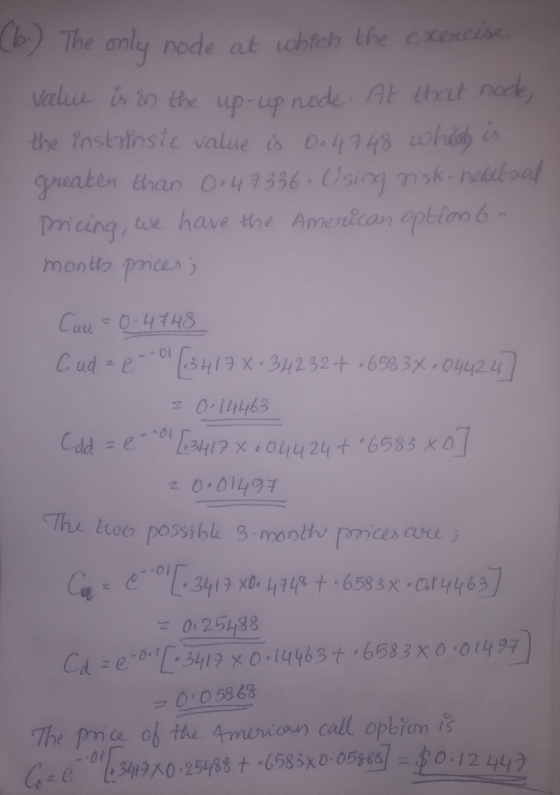
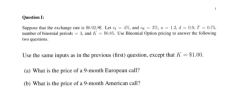 Question I: Suppose that the exchange rate is $0.92/€. Let rs = 4%, and re = 3%, u = 1.2, d =0.9, T = 0.75, number of binomial periods = 3, and K = $0.85. Use Binomial Option pricing to answer the following two questions. Use the same inputs as in the previous (first) question, except that K = $1.00. (a) What is the price of a 9-month European call? (b) What is the price of a 9-month American call?
Suppose the exchange rate is $1.95/£. Let r $ = 7%, r £ = 4%, u...
Suppose the exchange rate is $1.95/£. Let r $ = 7%, r £ = 4%, u = 1.14, d = 0.89, and T = 0.5. Using a 2-step binomial tree, calculate the value of a $2.05-strike European put option on the British pound? Please do NOT answer with Excel. Answer Choices: A. $0.1639 B. $0.1775 C. $0.1745 D. $0.1714 E. $0.1810 EDIT: This question does not need anymore information, everything I have written is all that was provided in the...
Suppose the exchange rate is $1.03/C$. Let r $ = 7%, r C$ = 3%, u...
 Suppose the exchange rate is $1.03/C$. Let r $ = 7%,
r C$ = 3%, u = 1.28, d = 0.83, and T = 1.5. Using a
2-step binomial tree, calculate the value of a $1.10-strike
European put option on the Canadian dollar.
Option D is correct, but how? Can you provide solution for
Excel? formulas and steps or actual excel work sheet please?
Answers:
a.
$0.1049
b.
$0.1229
c.
$0.1302
d.
$0.1106
e.
$0.1166
Suppose the exchange rate is $1.03/C$. Let r $ = 7%,
r C$ = 3%, u = 1.28, d = 0.83, and T = 1.5. Using a
2-step binomial tree, calculate the value of a $1.10-strike
European put option on the Canadian dollar.
Option D is correct, but how? Can you provide solution for
Excel? formulas and steps or actual excel work sheet please?
Answers:
a.
$0.1049
b.
$0.1229
c.
$0.1302
d.
$0.1106
e.
$0.1166
post all the necessary steps Suppose the exchange rate is $1.99/£. Let r$ = 6%, r£...
post all the necessary steps Suppose the exchange rate is $1.99/£. Let r$ = 6%, r£ = 7%, u = 1.27, d = 0.78, and T = 1. Using a 2-step binomial tree, calculate the value of a $2.10-strike European put option on the British pound. a. $0.2671 b. $0.3235 c. $0.3435 d. $0.3333 e. $0.3282
Pricing a European Call Option Data Current stock price: $50 Risk-free interest rate: 1% per annum,...
Pricing a European Call Option Data Current stock price: $50 Risk-free interest rate: 1% per annum, compounded continuously Volatility: 30% per annum Strike price of a 6-month European call option: $48 Question (a) If a Cox-Ross-Rubinstein approach is used, what are the values of u, d, and p that should be used in a two-period binomial tree where each period is 3 months long? Value of u Value of d Value of p
I. Consider the N-step binomial asset pricing model with 0 < d < 1 + r...
 I. Consider the N-step binomial asset pricing model with 0 < d < 1 + r < u. Assume N = 3, So 100, r = 0.05, u = 1.10, and d 0.90. Calculate the price at time zero of each of the following options using backward induction (a) A European put option expiring at time N 2 with strike price K-100 (b) A European put option expiring at time N 3 with strike price K- 100 (c) A European...
2. Consider the N-step binomial asset pricing model with 0 < d<1< u (a) Assume N-3....
 2. Consider the N-step binomial asset pricing model with 0 < d<1< u (a) Assume N-3. Sİ,-100, r-0.05, u-1.10, and d-0.90. Calculate the price at time (b) If the observed market price of the option in part (a) is $25 give a specific arbitrage trading (c) Suppose you wish to earn a profit of $100,000 from implementing your arbitrage trading zero, VO, of the European call-option with strike price K = 87.00. strategy to take advantage of any potential mis-pricing....
Suppose the current exchange rate is $ 1.77 divided by pound $1.77/£, the interest rate in...
Suppose the current exchange rate is $ 1.77 divided by pound $1.77/£, the interest rate in the United States is 5.41 % 5.41%, the interest rate in the United Kingdom is 4.12 % 4.12%, and the volatility of the $/£ exchange rate is 10.3 % 10.3%. Use the Black-Scholes formula to determine the price of a six-month European call option on the British pound with a strike price of $ 1.77 divided by pound $1.77/£. The corresponding forward exchange rate...
4. (4 points) The currency exchange rate for GBP is $1.25 per pound. The risk free...
 4. (4 points) The currency exchange rate for GBP is $1.25 per pound. The risk free interest rates for USD and GBP are 1% and 1.5% per year, respectively, with continuous compounding. The volatility of GBP exchange rate is o= 15%. Compute the price of a 6-month at-the-money European put option in a 3-step CRR binomial model. Compare the binomial price with the Black-Scholes price.
Problem1 A stock is currently trading at S $40, during next 6 months stock price will increase to $44 or decrease to $32-6-month risk-free rate is rf-2%. a. [4pts) What positions in stock and T-...
 Problem1 A stock is currently trading at S $40, during next 6 months stock price will increase to $44 or decrease to $32-6-month risk-free rate is rf-2%. a. [4pts) What positions in stock and T-bills will you put to replicate the pay off of a European call option with K = $38 and maturing in 6 months. b. 1pt What is the value of this European call option? Problem 2 Suppose that stock price will increase 5% and decrease 5%...
 Question I: Suppose that the exchange rate is $0.92/€. Let rs = 4%, and re = 3%, u = 1.2, d =0.9, T = 0.75, number of binomial periods = 3, and K = $0.85. Use Binomial Option pricing to answer the following two questions. Use the same inputs as in the previous (first) question, except that K = $1.00. (a) What is the price of a 9-month European call? (b) What is the price of a 9-month American call?
 Suppose the exchange rate is $1.03/C$. Let r $ = 7%,
r C$ = 3%, u = 1.28, d = 0.83, and T = 1.5. Using a
2-step binomial tree, calculate the value of a $1.10-strike
European put option on the Canadian dollar.
Option D is correct, but how? Can you provide solution for
Excel? formulas and steps or actual excel work sheet please?
Answers:
a.
$0.1049
b.
$0.1229
c.
$0.1302
d.
$0.1106
e.
$0.1166
Suppose the exchange rate is $1.03/C$. Let r $ = 7%,
r C$ = 3%, u = 1.28, d = 0.83, and T = 1.5. Using a
2-step binomial tree, calculate the value of a $1.10-strike
European put option on the Canadian dollar.
Option D is correct, but how? Can you provide solution for
Excel? formulas and steps or actual excel work sheet please?
Answers:
a.
$0.1049
b.
$0.1229
c.
$0.1302
d.
$0.1106
e.
$0.1166
 I. Consider the N-step binomial asset pricing model with 0 < d < 1 + r < u. Assume N = 3, So 100, r = 0.05, u = 1.10, and d 0.90. Calculate the price at time zero of each of the following options using backward induction (a) A European put option expiring at time N 2 with strike price K-100 (b) A European put option expiring at time N 3 with strike price K- 100 (c) A European...
 2. Consider the N-step binomial asset pricing model with 0 < d<1< u (a) Assume N-3. Sİ,-100, r-0.05, u-1.10, and d-0.90. Calculate the price at time (b) If the observed market price of the option in part (a) is $25 give a specific arbitrage trading (c) Suppose you wish to earn a profit of $100,000 from implementing your arbitrage trading zero, VO, of the European call-option with strike price K = 87.00. strategy to take advantage of any potential mis-pricing....
 4. (4 points) The currency exchange rate for GBP is $1.25 per pound. The risk free interest rates for USD and GBP are 1% and 1.5% per year, respectively, with continuous compounding. The volatility of GBP exchange rate is o= 15%. Compute the price of a 6-month at-the-money European put option in a 3-step CRR binomial model. Compare the binomial price with the Black-Scholes price.
 Problem1 A stock is currently trading at S $40, during next 6 months stock price will increase to $44 or decrease to $32-6-month risk-free rate is rf-2%. a. [4pts) What positions in stock and T-bills will you put to replicate the pay off of a European call option with K = $38 and maturing in 6 months. b. 1pt What is the value of this European call option? Problem 2 Suppose that stock price will increase 5% and decrease 5%...
Most questions answered within 3 hours.
-
Where is the error in this code sequence?
String s1 = "Hello";
String s2 = "ello";...
asked 10 months ago -
Financial data for Joel de Paris, Inc., for last year
follow:
Joel de Paris, Inc.
Balance...
asked 10 months ago -
Consider this reaction:
Al2(SO4)3 (aq)+ BaCl3
(aq) Al2Cl6 (aq)- +
3BaSO4(s) . What is the...
asked 10 months ago -
Suppose that Savneet is considering increasing her
recent random sample from 20 car rentals to 40...
asked 10 months ago -
Trucks arrive at an unloading terminal at an average rate of 120
per hour.
Trucks arrive...
asked 10 months ago -
Why are methanol and ethanol completely soluble in water while
octanol is not very little soluble....
asked 10 months ago -
A facilities manager at a university reads in a research report
that the mean amount of...
asked 10 months ago -
When the CuSO4 is rehydrated by adding water to the anhydrous
compound, is this an endothermic...
asked 10 months ago -
A ray of sunlight is passing from diamond into crown glass; the
angle of incidence is...
asked 10 months ago -
A block of mass 0.249 kg is placed on top of a light, vertical
spring of...
asked 10 months ago -
how do the kidneys compensate in the presences of acidosis
a) trigger hyperventilate
b) reserve acid...
asked 10 months ago -
Question 501 pts
The rental rate of capital to the firm increases. Which of the
following...
asked 10 months ago