
Homework Answers
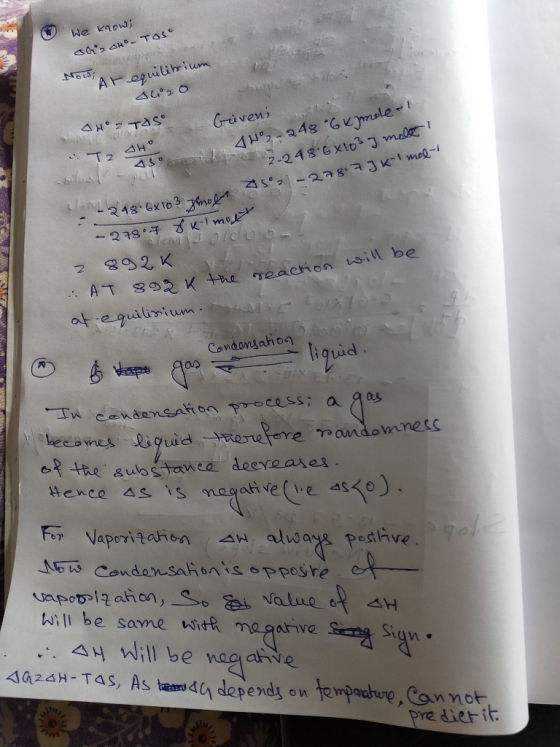
2. The reaction N2 (g)+3 F2 (g)2 NF3 (g), has AH° is -248.6 kJ mol and...
 2. The reaction N2 (g)+3 F2 (g)2 NF3 (g), has AH° is -248.6 kJ mol and ArS° is -278.7J K mol. Calculate the temperature at which the reaction will be at equilibrium. Assume A,H° and A,S are independent of temperature.
N2(8) + 3F2(g) → 2 NF3() AH 298 = - 264 kJ mol-'; AS98 = -...
 N2(8) + 3F2(g) → 2 NF3() AH 298 = - 264 kJ mol-'; AS98 = - 278 J K-'mol-' The following questions relate to the synthesis reaction represented by the chemical equation in the box above. a. Calculate the value of the standard free energy change, AG 298. for the reaction. b. Determine the temperature at which the equilibrium constant, Keg, for the reaction is equal to 1.00. (Assume that Hº and AS are independent of temperature.) c. Calculate the...
3. Condensation of a gas to a liquid is an example of a process for which...
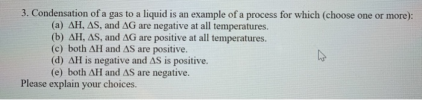 3. Condensation of a gas to a liquid is an example of a process for which (choose one or more): (a) AH, AS, and AG are negative at all temperatures. (b) AH, AS, and AG are positive at all temperatures. (c) both AH and AS are positive. (d) AH is negative and AS is positive. (e) both AH and AS are negative. Please explain your choices.
23. What is AS for the reaction, N2(g) + 3 F2(g) → 2 NF3(g), based on...
 23. What is AS for the reaction, N2(g) + 3 F2(g) → 2 NF3(g), based on the data table (below)? a. -133.6 J/K b. -278.4 J/K c. +127 J/K d. +521.2 J/K Compound S, J/mol K N2(g) 191.5 F2(g) 202.7 NF3(g) 260.6
Consider the reaction: AS° -278 J K N2 (g) + 3 F2 (g) --> 2 NH3(g)...
 Consider the reaction: AS° -278 J K N2 (g) + 3 F2 (g) --> 2 NH3(g) AH = –249 kJ at 25 C Calculate AGº and state whether the equilibrium composition contains mostly products or reactants at standard conditions. O AG° = –166 kJ The equilibrium composition contains mostly products. 0 AG = -6.7 kJ The equilibrium composition contains mostly products. O AG° = +82.6 kJ The equilibrium composition contains mostly reactants. O AGⓇ = -332 kJ The equilibrium composition...
For the reaction CO2(g) + H2(9)—-CO(g) +H30(9) AH° = 41.2 kJ and A Sº = 42.1...
 For the reaction CO2(g) + H2(9)—-CO(g) +H30(9) AH° = 41.2 kJ and A Sº = 42.1 JK The equilibrium constant for this reaction at 252.0 K is Assume that AH and AS are independent of temperature. For the reaction N2(g) + 3H2(g) 2NH3(g) AH° = -92.2 kJ and AS™ = -198.7 J/K The equilibrium constant for this reaction at 347.0 K is Assume that AHⓇ and AS are independent of temperature.
Consider the reaction: at N2(g) + 3 F2 (g) --> 2 NH3(g) AH° = -249 kJ...
 Consider the reaction: at N2(g) + 3 F2 (g) --> 2 NH3(g) AH° = -249 kJ AS° = -278 25 C K Calculate AGº and state whether the equilibrium composition contains mostly products or reactants at standard conditions. AG --332 kJ The equilibrium composition contains mostly reactants. AG = :-166 kJ The equilibrium composition contains mostly products. AG -6.7 kJ The equilibrium composition contains mostly products. O AGⓇ = +29.0 kJ The equilibrium composition contains mostly products. = AG +82.6...
Condensation is a process for which O AG is negative at high temperature but positive at...
 Condensation is a process for which O AG is negative at high temperature but positive at low temperature. O AH, AS, and AG are positive at all temperatures. AG is positive when condensation occurs spontaneously. O AH and AS are positive at all temperatures. O AH and AS are negative at all temperatures.
1. Determine the ∆Sº using Appendix G for the following reaction. C2H5OH(l) + 3 O2(g) -->...
1. Determine the ∆Sº using Appendix G for the following reaction. C2H5OH(l) + 3 O2(g) --> 2 CO2(g) + 3 H2O(l) Report your answer to three sig figs. Omit unit labels. Only add a - number is the sign is negative. Adding a + to a positive answer messes up the grading. 2. Which of the following equations will have a negative ∆S? A. 3 H2(g)+ N2(g) --> 2 NH3(g) B. C6H6(l)--> C6H6(g) C. NH4OH(s)--> H2O(l)+ NH3(g) D. NaCl(s) -->...
For the reaction 2NH3(g) 202(g)N20(g)+3H20(I) AH 683 kJ and AS° = -366 JK AGo would be...
 For the reaction 2NH3(g) 202(g)N20(g)+3H20(I) AH 683 kJ and AS° = -366 JK AGo would be less than zero at temperatures (above, below) K. Enter above or below in the first box and enter the temperature in the second box. Assume that AH° and AS° are constant For the reaction N2(g)O2(g)>2NO(g) AHo 181 kJ and AS° = 24.9 J/K K. AGo would be negative at temperatures (above, below) Enter above or below in the first box and enter the temperature...
 2. The reaction N2 (g)+3 F2 (g)2 NF3 (g), has AH° is -248.6 kJ mol and ArS° is -278.7J K mol. Calculate the temperature at which the reaction will be at equilibrium. Assume A,H° and A,S are independent of temperature.
 N2(8) + 3F2(g) → 2 NF3() AH 298 = - 264 kJ mol-'; AS98 = - 278 J K-'mol-' The following questions relate to the synthesis reaction represented by the chemical equation in the box above. a. Calculate the value of the standard free energy change, AG 298. for the reaction. b. Determine the temperature at which the equilibrium constant, Keg, for the reaction is equal to 1.00. (Assume that Hº and AS are independent of temperature.) c. Calculate the...
 3. Condensation of a gas to a liquid is an example of a process for which (choose one or more): (a) AH, AS, and AG are negative at all temperatures. (b) AH, AS, and AG are positive at all temperatures. (c) both AH and AS are positive. (d) AH is negative and AS is positive. (e) both AH and AS are negative. Please explain your choices.
 23. What is AS for the reaction, N2(g) + 3 F2(g) → 2 NF3(g), based on the data table (below)? a. -133.6 J/K b. -278.4 J/K c. +127 J/K d. +521.2 J/K Compound S, J/mol K N2(g) 191.5 F2(g) 202.7 NF3(g) 260.6
 Consider the reaction: AS° -278 J K N2 (g) + 3 F2 (g) --> 2 NH3(g) AH = –249 kJ at 25 C Calculate AGº and state whether the equilibrium composition contains mostly products or reactants at standard conditions. O AG° = –166 kJ The equilibrium composition contains mostly products. 0 AG = -6.7 kJ The equilibrium composition contains mostly products. O AG° = +82.6 kJ The equilibrium composition contains mostly reactants. O AGⓇ = -332 kJ The equilibrium composition...
 For the reaction CO2(g) + H2(9)—-CO(g) +H30(9) AH° = 41.2 kJ and A Sº = 42.1 JK The equilibrium constant for this reaction at 252.0 K is Assume that AH and AS are independent of temperature. For the reaction N2(g) + 3H2(g) 2NH3(g) AH° = -92.2 kJ and AS™ = -198.7 J/K The equilibrium constant for this reaction at 347.0 K is Assume that AHⓇ and AS are independent of temperature.
 Consider the reaction: at N2(g) + 3 F2 (g) --> 2 NH3(g) AH° = -249 kJ AS° = -278 25 C K Calculate AGº and state whether the equilibrium composition contains mostly products or reactants at standard conditions. AG --332 kJ The equilibrium composition contains mostly reactants. AG = :-166 kJ The equilibrium composition contains mostly products. AG -6.7 kJ The equilibrium composition contains mostly products. O AGⓇ = +29.0 kJ The equilibrium composition contains mostly products. = AG +82.6...
 Condensation is a process for which O AG is negative at high temperature but positive at low temperature. O AH, AS, and AG are positive at all temperatures. AG is positive when condensation occurs spontaneously. O AH and AS are positive at all temperatures. O AH and AS are negative at all temperatures.
 For the reaction 2NH3(g) 202(g)N20(g)+3H20(I) AH 683 kJ and AS° = -366 JK AGo would be less than zero at temperatures (above, below) K. Enter above or below in the first box and enter the temperature in the second box. Assume that AH° and AS° are constant For the reaction N2(g)O2(g)>2NO(g) AHo 181 kJ and AS° = 24.9 J/K K. AGo would be negative at temperatures (above, below) Enter above or below in the first box and enter the temperature...
Most questions answered within 3 hours.
-
Where is the error in this code sequence?
String s1 = "Hello";
String s2 = "ello";...
asked 11 months ago -
Financial data for Joel de Paris, Inc., for last year
follow:
Joel de Paris, Inc.
Balance...
asked 11 months ago -
Consider this reaction:
Al2(SO4)3 (aq)+ BaCl3
(aq) Al2Cl6 (aq)- +
3BaSO4(s) . What is the...
asked 11 months ago -
Suppose that Savneet is considering increasing her
recent random sample from 20 car rentals to 40...
asked 11 months ago -
Trucks arrive at an unloading terminal at an average rate of 120
per hour.
Trucks arrive...
asked 11 months ago -
Why are methanol and ethanol completely soluble in water while
octanol is not very little soluble....
asked 11 months ago -
A facilities manager at a university reads in a research report
that the mean amount of...
asked 11 months ago -
When the CuSO4 is rehydrated by adding water to the anhydrous
compound, is this an endothermic...
asked 11 months ago -
A ray of sunlight is passing from diamond into crown glass; the
angle of incidence is...
asked 11 months ago -
A block of mass 0.249 kg is placed on top of a light, vertical
spring of...
asked 11 months ago -
how do the kidneys compensate in the presences of acidosis
a) trigger hyperventilate
b) reserve acid...
asked 11 months ago -
Question 501 pts
The rental rate of capital to the firm increases. Which of the
following...
asked 11 months ago