
Homework Answers
a)
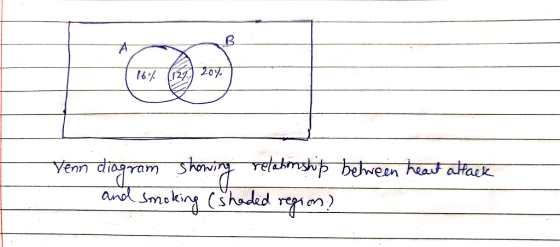
b)
P(A) = 0.16
P(B) = 0.2
P(AB) = 0.12
P(B) = P(B) -
P(AB) = 0.2 - 0.12 = 0.08
c)
Given that the person is smoker, probability that person suffer from heart attack = P(B | A) = P(AB) / P(A)
= 0.12 / 0.16 = 0.75
d)
Given that the person is non-smoker, probability that person
suffer from heart attack = P(B | ) =
P(
B) /
P(
)
= P(B) / (1 -
P(A))
= 0.08 / (1 - 0.16) = 0.095
e)
Risk of having heart attack for current smoker = P(B | A) = 0.75
Risk of having heart attack for current non-smoker = P(B |
) =
0.095
f)
Relative risk for current smokers compared to current non-smokers = Risk of having heart attack for current smoker / Risk of having heart attack for current non-smoker
= 0.75 / 0.095 = 7.89
Relative risk for current non-smokers compared to current smokers = Risk of having heart attack for current smoker / Risk of having heart attack for current non-smoker
= 0.095 / 0.75 = 0.1267
g)
Odds of having heart attack among current smokers = 0.75 / (1 - 0.75) = 3
Odds of having heart attack among non-current smokers = 0.095 / (1 - 0.095) = 0.105
h)
Odds ratio of having a heart attack for current smokers compared with non-smokers = Odds of having heart attack among current smokers / Odds of having heart attack among non-current smokers = 3 / 0.105 = 28.57
Odds ratio of having a heart attack for non-current smokers compared with smokers = Odds of having heart attack among current non-smokers / Odds of having heart attack among current smokers = 0.105 / 3 = 0.035
Add Answer to:
4.3 Heart attack is one of the leading causes of death in many countries and cigarette...
4.3 Heart attack is one of the leading causes of death in many countries and cigarette...
 4.3 Heart attack is one of the leading causes of death in many countries and cigarette smoking is the most preventable risk factor for heart attack. In a particular population, 20% of people suffered a heart attack, 16% of people are current smokers, and 12% of people had a heart attack while they were smokers. Let event A be a person who is a current smoker and event B be a person who had heart attack a) Construct a Venn...
3. A researcher collected data to study the effect of smoking on the risk of a heart attack. The variables were x - a categorical variable with the categories: (1) Present smoker (2) Past smoker (...
 3. A researcher collected data to study the effect of smoking on the risk of a heart attack. The variables were x - a categorical variable with the categories: (1) Present smoker (2) Past smoker (smoked but quit) (3) Non-smoker Y - a binary variable defined by: Y 1 if the person had a heart attack Y-0 if the person didn't have a heart attack Since the X-variables are categorical, the researcher coded the X-variable by two dummy variables: X2...
A group of pregnant women were followed prospectively to investigate the role of cigarette smoking and...
 A group of pregnant women were followed prospectively to investigate the role of cigarette smoking and risk of low birth weight. At the first prenatal visit, 2200 women were classified as current smokers or non-smokers (defined as former smokers or never smokers). The outcome, low birthweight, was defined as a birthweight < 2500 grams. After completion of the study, the investigators reported the results in the form of calculated rates and measures of effect. What study design was used to...
In your opinion, which of the below three study design is best to assess the relationship...
In your opinion, which of the below three study design is best to assess the relationship between smoking and CRC? Why? (6 sentences) No plagiarism please Cross Sectional Study 1. Verga Enterprises is conducting a study to assess the relationship between smoking and colorectal cancer (CRC). In the survey that was conducted, 20 out of 100 non-smokers had CRC, while 40 out of 60 smokers had CRC. (a) What makes this a Cross Sectional study design? This particular case is...
s Question Completion Status: QUESTION 65 Please complete the calculations for the following questions. You must correctly explicitly state the including the disease/outcome, the place of interes...
 s Question Completion Status: QUESTION 65 Please complete the calculations for the following questions. You must correctly explicitly state the including the disease/outcome, the place of interest, and the time/duration or appropriate time units (for example: "Smokers had 5.2 times the odds of having lung cancer compared to non-smokers context of your answer by A 15 year follow-up study was conducted examining the relationship between environmental tobacco smoke (ETS) and developing a myocardial infarction (MI). ETS was measured based on...
5. Smoking and duodenal ulcers. The Health Professionals Follow-up Study is a prospective study of heart...
5. Smoking and duodenal ulcers. The Health Professionals Follow-up Study is a prospective study of heart disease and cancer among more than 50,000 health professionals in the United States who were 40–75 years of age in 1986. Every two years questionnaires are sent to these individuals, and newly diagnosed cases of various diseases reported. The following data are constructed from the surveys returned in the 1993 mailing. The investigators in this study were interested in the relationship between smoking status...
Multiple Question: 12. The relative risk for dying from lung cancer among smokers is 10. The...
Multiple Question: 12. The relative risk for dying from lung cancer among smokers is 10. The relative risk for dying from heart disease among smokers is 1.5. The etiologic fraction for lung cancer due to smoking is 0.8 and the etiologic fraction for heart disease due to smoking is 0.2. Based on these finding, we can say that Smoking seems much more likely to be causally related to heart disease than to lung cancer. Smoking seems much more likely to...
Lung Cancer & Smoking Case Study A causal relationship between cigarette smoking and lung cancer was...
 Lung Cancer & Smoking Case Study A causal relationship between cigarette smoking and lung cancer was first suspected in the 1920s on the basis of clinical observations. To test this apparent association, numerous epidemiologic studies were undertaken between 1930 and 1960. Two studies were conducted by Richard Doll and Austin Bradford Hill in Great Britain The first was a case-control study begun in 1947 comparing the smoking habits of lung cancer patients with the smoking habits of other patients. The...
Stroke A stroke is serious, just like a heart attack, so it's important to know the...
 Stroke
A stroke is serious, just like a heart attack, so it's important
to know the signs of stroke and act quickly if you suspect someone
is having one. Stroke is the fourth leading cause of death in the
United States, and causes more serious long-term disabilities than
any other disease. Older people are at higher risk. You can take
steps to lower your chance of having a stroke.
Know the Signs of Stroke
Knowing the symptoms of a stroke...
Stroke
A stroke is serious, just like a heart attack, so it's important
to know the signs of stroke and act quickly if you suspect someone
is having one. Stroke is the fourth leading cause of death in the
United States, and causes more serious long-term disabilities than
any other disease. Older people are at higher risk. You can take
steps to lower your chance of having a stroke.
Know the Signs of Stroke
Knowing the symptoms of a stroke...
Indicate the one major type of limitation that is possible in each of the situations described...
Indicate the one major type of limitation that is possible in each of the situations described below. Choose from the following: selection bias, information bias, confounding, random error, limited generalizability or no error. Choose only one per example. A case-control study was conducted to determine whether lower socioeconomic status was associated with a higher risk of cervical cancer. The cases consisted of 250 women with cervical cancer who had been referred to Massachusetts General Hospital for treatment for cervical cancer. They were referred from...
 4.3 Heart attack is one of the leading causes of death in many countries and cigarette smoking is the most preventable risk factor for heart attack. In a particular population, 20% of people suffered a heart attack, 16% of people are current smokers, and 12% of people had a heart attack while they were smokers. Let event A be a person who is a current smoker and event B be a person who had heart attack a) Construct a Venn...
 3. A researcher collected data to study the effect of smoking on the risk of a heart attack. The variables were x - a categorical variable with the categories: (1) Present smoker (2) Past smoker (smoked but quit) (3) Non-smoker Y - a binary variable defined by: Y 1 if the person had a heart attack Y-0 if the person didn't have a heart attack Since the X-variables are categorical, the researcher coded the X-variable by two dummy variables: X2...
 A group of pregnant women were followed prospectively to investigate the role of cigarette smoking and risk of low birth weight. At the first prenatal visit, 2200 women were classified as current smokers or non-smokers (defined as former smokers or never smokers). The outcome, low birthweight, was defined as a birthweight < 2500 grams. After completion of the study, the investigators reported the results in the form of calculated rates and measures of effect. What study design was used to...
 s Question Completion Status: QUESTION 65 Please complete the calculations for the following questions. You must correctly explicitly state the including the disease/outcome, the place of interest, and the time/duration or appropriate time units (for example: "Smokers had 5.2 times the odds of having lung cancer compared to non-smokers context of your answer by A 15 year follow-up study was conducted examining the relationship between environmental tobacco smoke (ETS) and developing a myocardial infarction (MI). ETS was measured based on...
 Lung Cancer & Smoking Case Study A causal relationship between cigarette smoking and lung cancer was first suspected in the 1920s on the basis of clinical observations. To test this apparent association, numerous epidemiologic studies were undertaken between 1930 and 1960. Two studies were conducted by Richard Doll and Austin Bradford Hill in Great Britain The first was a case-control study begun in 1947 comparing the smoking habits of lung cancer patients with the smoking habits of other patients. The...
 Stroke
A stroke is serious, just like a heart attack, so it's important
to know the signs of stroke and act quickly if you suspect someone
is having one. Stroke is the fourth leading cause of death in the
United States, and causes more serious long-term disabilities than
any other disease. Older people are at higher risk. You can take
steps to lower your chance of having a stroke.
Know the Signs of Stroke
Knowing the symptoms of a stroke...
Stroke
A stroke is serious, just like a heart attack, so it's important
to know the signs of stroke and act quickly if you suspect someone
is having one. Stroke is the fourth leading cause of death in the
United States, and causes more serious long-term disabilities than
any other disease. Older people are at higher risk. You can take
steps to lower your chance of having a stroke.
Know the Signs of Stroke
Knowing the symptoms of a stroke...
Most questions answered within 3 hours.
-
Where is the error in this code sequence?
String s1 = "Hello";
String s2 = "ello";...
asked 11 months ago -
Financial data for Joel de Paris, Inc., for last year
follow:
Joel de Paris, Inc.
Balance...
asked 11 months ago -
Consider this reaction:
Al2(SO4)3 (aq)+ BaCl3
(aq) Al2Cl6 (aq)- +
3BaSO4(s) . What is the...
asked 11 months ago -
Suppose that Savneet is considering increasing her
recent random sample from 20 car rentals to 40...
asked 11 months ago -
Trucks arrive at an unloading terminal at an average rate of 120
per hour.
Trucks arrive...
asked 11 months ago -
Why are methanol and ethanol completely soluble in water while
octanol is not very little soluble....
asked 11 months ago -
A facilities manager at a university reads in a research report
that the mean amount of...
asked 11 months ago -
When the CuSO4 is rehydrated by adding water to the anhydrous
compound, is this an endothermic...
asked 11 months ago -
A ray of sunlight is passing from diamond into crown glass; the
angle of incidence is...
asked 11 months ago -
A block of mass 0.249 kg is placed on top of a light, vertical
spring of...
asked 11 months ago -
how do the kidneys compensate in the presences of acidosis
a) trigger hyperventilate
b) reserve acid...
asked 11 months ago -
Question 501 pts
The rental rate of capital to the firm increases. Which of the
following...
asked 11 months ago