
Homework Answers
Add Answer to:
3. Generate random numbers as indicated and comment on the results. (a) generate 10 random numbers...
3. Generate random numbers as indicated and comment on the results. (a) generate 10 random numbers...
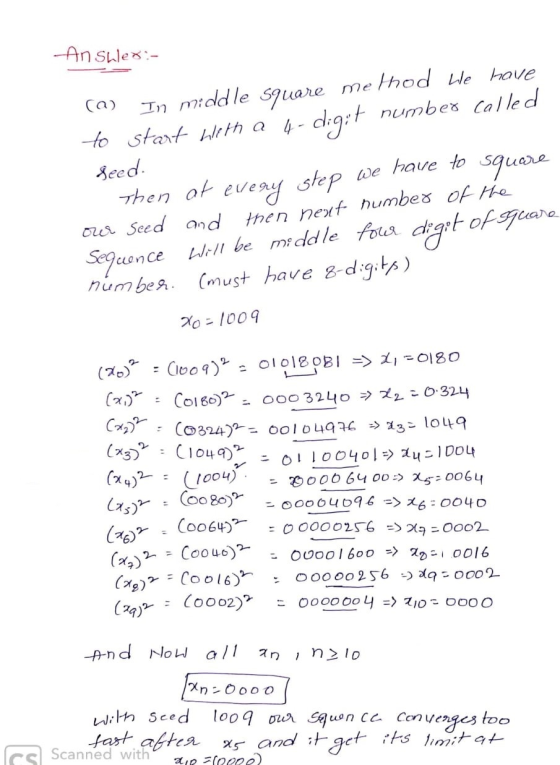
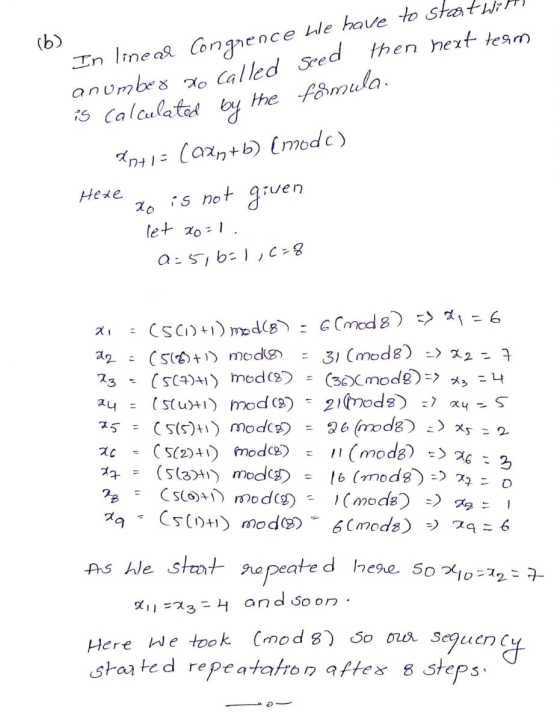
 3. Generate random numbers as indicated and comment on the results. (a) generate 10 random numbers using the middle-square method using zo = 1009. (b) generate 10 random numbers using linear congruence with a = 5,b=1 and c= 8.
1. Generate at least 8 random numbers within the range of 1 to 9999 using Midsquare...
1. Generate at least 8 random numbers within the range of 1 to 9999 using Midsquare method. 2. Generate at least 10 random numbers within the range of 1 to 9000 using linear congruent method. Xi = (aXo + C) mod m using a = 91, c = 22 and Xo = 19
Generate 10 random numbers using the following linear congruential generator with 7 as the seed: si+1...
Generate 10 random numbers using the following linear congruential generator with 7 as the seed: si+1 = (5 * si + 1) mod 20.
Generate 10 random numbers using the following linear congruential generator with 7 as the seed: si+1...
Generate 10 random numbers using the following linear congruential generator with 7 as the seed: si+1 = (5 * si + 1) mod 20.
In C++ Exercise #3: Write a for loop that will generate and display 10 random numbers...
In C++ Exercise #3: Write a for loop that will generate and display 10 random numbers from 1 to 50. Output all of the randomly generated numbers.
Alice is using a linear congruential generator, axi + b mod 11, to generate pseudo-random numbers....
Alice is using a linear congruential generator, axi + b mod 11, to generate pseudo-random numbers. Eve sees three numbers in a row, 3, 5, 0, that are generated from Alice’s function. What are the values of a and b?
Write a program in C to generate random numbers. The program recieves 4 items on activation...
Write a program in C to generate random numbers. The program recieves 4 items on activation through argv: 1. Name of the data file 2. Number of items for program to generate 3. Range of numbers 4. Seed of the random number generator Example run: ./rand datafile.txt 20 1000 3127 Program must convert all numbers to ints using atoi(), must save all parameters into variables, opens the data file to write the random numbers into it, program loops to generate...
Excel was asked to generate 50 Poisson random numbers with mean λ = 5. x Frequency 0 1 1 1 2 4 3 7 4 7 5 8 6 10 7 3 ...
Excel was asked to generate 50 Poisson random numbers with mean λ = 5. x Frequency 0 1 1 1 2 4 3 7 4 7 5 8 6 10 7 3 8 3 9 4 10 1 11 1 (a) Calculate the sample mean. (Round your sample mean value to 2 decimal places.) Sample mean (b) Carry out the chi-square test at α = .05, combining end categories as needed to ensure that all expected frequencies are at least...
Pseudo-random numbers are pervasive and extremely important in modern computing and scientific applications. But how exactly...
 Pseudo-random numbers are pervasive and extremely important in modern computing and scientific applications. But how exactly is a sequence of apparently random number generated? Here we study one early method which has the benefit of being very easy to implement 1. If we take a positive integer n having k digits (k 1), then n 10*, so that n2 (10)2 02. Thus we would expt up to 2k digits in the square of the k digit number 1l So, for...
Write a Java program named BSTree.java that will: 1) Generate 20 random integer numbers ranging from...
Write a Java program named BSTree.java that will: 1) Generate 20 random integer numbers ranging from 1-99. 2) Build a Binary Search Tree using this set of numbers. Write the add method. 3) After building the tree, display the data into three formats: prefix order, infix order, and postfix order. 4) Write a method to delete an element from the Binary Search Tree. First search the item in your TREE and then delete it.
 3. Generate random numbers as indicated and comment on the results. (a) generate 10 random numbers using the middle-square method using zo = 1009. (b) generate 10 random numbers using linear congruence with a = 5,b=1 and c= 8.
 Pseudo-random numbers are pervasive and extremely important in modern computing and scientific applications. But how exactly is a sequence of apparently random number generated? Here we study one early method which has the benefit of being very easy to implement 1. If we take a positive integer n having k digits (k 1), then n 10*, so that n2 (10)2 02. Thus we would expt up to 2k digits in the square of the k digit number 1l So, for...
Most questions answered within 3 hours.
-
Where is the error in this code sequence?
String s1 = "Hello";
String s2 = "ello";...
asked 10 months ago -
Financial data for Joel de Paris, Inc., for last year
follow:
Joel de Paris, Inc.
Balance...
asked 10 months ago -
Consider this reaction:
Al2(SO4)3 (aq)+ BaCl3
(aq) Al2Cl6 (aq)- +
3BaSO4(s) . What is the...
asked 10 months ago -
Suppose that Savneet is considering increasing her
recent random sample from 20 car rentals to 40...
asked 10 months ago -
Trucks arrive at an unloading terminal at an average rate of 120
per hour.
Trucks arrive...
asked 10 months ago -
Why are methanol and ethanol completely soluble in water while
octanol is not very little soluble....
asked 10 months ago -
A facilities manager at a university reads in a research report
that the mean amount of...
asked 10 months ago -
When the CuSO4 is rehydrated by adding water to the anhydrous
compound, is this an endothermic...
asked 10 months ago -
A ray of sunlight is passing from diamond into crown glass; the
angle of incidence is...
asked 10 months ago -
A block of mass 0.249 kg is placed on top of a light, vertical
spring of...
asked 10 months ago -
how do the kidneys compensate in the presences of acidosis
a) trigger hyperventilate
b) reserve acid...
asked 10 months ago -
Question 501 pts
The rental rate of capital to the firm increases. Which of the
following...
asked 10 months ago