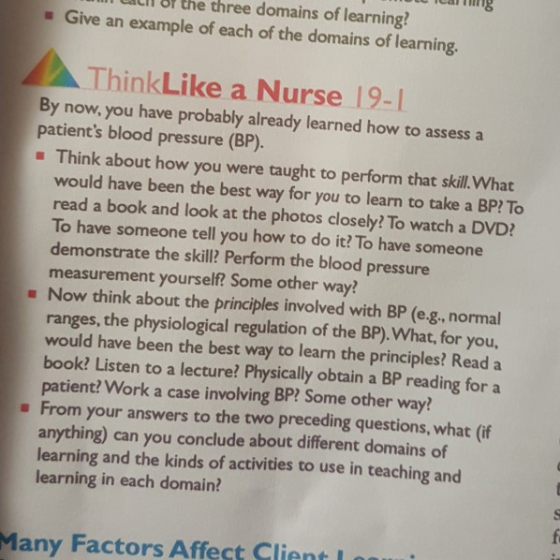
Fundamental of nursing chapter chapter 19 think like a nurse.
This question is from Fundamental of nursing (Judith
M. Wilkinson) 3rd edition vol 1
it is an assignment in the the for nursing student and is titled
think like a nurse.
the assignment is the same as the answers on Davis Basic nursing questions. The difference is the basic nursing is 1st and second edition and the fundamental of nursing 3rd edition, so they both have different questions when you get to chapter 19 of the fundamentals.
Homework Answers
1. The best way to learn how to take BP for me is to have someone demonstrate the skill because it's easy for me to grab things by practically seeing it someone do .
2. The best way to learn the principles of BP for me is to read a book .
3.Different domains of learning :-
Cognitive: mental skills (knowledge)
Affective: growth in feelings or emotional areas (attitude or self)
Psychomotor: manual or physical skills (skills)
Cognitive domain :
Includes objectives related to information or knowledge, naming, solving, predicting, and other intellectual aspects of learning.
Psychomotor Domain :
Encompasses the skills requiring the use and coordination of skeletal muscles, as in the physical activities of performing, manipulating, and constructing.
Affective Domain :
Involves objectives concerning attitudes, appreciations, values, and emotions such as enjoying, conserving, and respecting.
Add Answer to:
Fundamental of nursing chapter chapter 19 think like a
nurse.
This question is from Fundamental of...
Fundamental of nursing Think Like a Nurse A client with brain injury needs to learn how...
 Fundamental of nursing
Think Like a Nurse A client with brain injury needs to learn how to administer insulin. Another learner, who must learn to change a wound dressing, has attention deficit-hyperactivity disairder (ADHD). •How do you think this client's health status might affect motivation to learn? How do you think this client's health status might affect the ability to be actively involved in the learning? Think Like a Nurse (cont'd) What approaches or changes might you need to make...
Fundamental of nursing
Think Like a Nurse A client with brain injury needs to learn how to administer insulin. Another learner, who must learn to change a wound dressing, has attention deficit-hyperactivity disairder (ADHD). •How do you think this client's health status might affect motivation to learn? How do you think this client's health status might affect the ability to be actively involved in the learning? Think Like a Nurse (cont'd) What approaches or changes might you need to make...
Fundamental of nursing chapter 8-1 ThinkLike a Nurse 8-1 Go to Student Resources: Chapter 4, Standardized...
 Fundamental of nursing chapter 8-1
ThinkLike a Nurse 8-1 Go to Student Resources: Chapter 4, Standardized Language, NANDA-International Taxonomy Il: Domains, Classes, and Diagnoses (Labels), on DavisPlus. Do you think this is a theory, a conceptual framework, or a model?
Fundamental of nursing chapter 8-1
ThinkLike a Nurse 8-1 Go to Student Resources: Chapter 4, Standardized Language, NANDA-International Taxonomy Il: Domains, Classes, and Diagnoses (Labels), on DavisPlus. Do you think this is a theory, a conceptual framework, or a model?
Think about how you are working with your peers at this time. What mentor responsibilities are...
Think about how you are working with your peers at this time. What mentor responsibilities are you exhibiting? Is there someone who is already mentoring you? If so, what qualities does this person exhibit? think like a nurse chapter 40-4 fundamental of nursing 3rd edition
fundamental of nursing 3rd edition change but doing nothing to effect it; and simply 1g- noring...
 fundamental of nursing 3rd edition
change but doing nothing to effect it; and simply 1g- noring the entire process as much as possible. Think Like a Nurse 40-6 Recall one change that you have experienced that was put into effect by a command (or a new rule, policy, or law). - What effects did this change have on your life (e.g., work, school, home)? • How did the command make you feel? • What would have made this change easier...
fundamental of nursing 3rd edition
change but doing nothing to effect it; and simply 1g- noring the entire process as much as possible. Think Like a Nurse 40-6 Recall one change that you have experienced that was put into effect by a command (or a new rule, policy, or law). - What effects did this change have on your life (e.g., work, school, home)? • How did the command make you feel? • What would have made this change easier...
Nursing care plan for this case study. Chapter 19: Nursing Management of Pregnancy at Risk: Pregnancy-Related...
Nursing care plan for this case study. Chapter 19: Nursing Management of Pregnancy at Risk: Pregnancy-Related Complications 1. Teresa is a 36-year-old primigravida who is expecting twins. She is 26 weeks pregnant. She stays after your “What to Expect with Twins” class to talk to you. Although Teresa is a nurse, she has many questions and concerns. Her twins are a result of years of trying to get pregnant and in vitro fertilization. She is nervous about whether she will...
think of some other "defined situations" for which unit standards of care might be useful. think...
 think of some other "defined situations" for which
unit standards of care might be useful. think like a nurse
suggest some other subgroups for which a protocol might be
appropriate. fundamentals of nursing chapter 5
Knowledge Check 5-2 edition to care related to the patient's ces of information does a comprehensive care plan ents basic needs, what other types of informa contain? How are critical pathways different from ent from other standardized the main disadvantage of computerized and care plans?...
think of some other "defined situations" for which
unit standards of care might be useful. think like a nurse
suggest some other subgroups for which a protocol might be
appropriate. fundamentals of nursing chapter 5
Knowledge Check 5-2 edition to care related to the patient's ces of information does a comprehensive care plan ents basic needs, what other types of informa contain? How are critical pathways different from ent from other standardized the main disadvantage of computerized and care plans?...
Chapter 19: Nursing Management of Pregnancy at Risk: Pregnancy-Related Complications 2. Sarah is 19-year-old G1P0 at 36...
Chapter 19: Nursing Management of Pregnancy at Risk: Pregnancy-Related Complications 2. Sarah is 19-year-old G1P0 at 36 weeks' gestation. Sarah has been followed weekly in the clinic for mild–moderate preeclampsia. At her clinic appointment today, Sarah’s blood pressure reading was 188/104. She is admitted to the antepartum unit for management of her worsening preeclampsia. You perform her admission assessment and note that her reflexes are brisk, her heart rate is 94, she complains of having an intense headache, and is...
Chapter 12: Nursing Management During Pregnancy 1. Nancy, age 38, and her husband, Dan, age 37,...
 Chapter 12: Nursing Management During Pregnancy 1. Nancy, age 38, and her husband, Dan, age 37, arrive at a midwife clinic for an initial prenatal visit. They have been married for 10 years and trying to have a child for 3 years. Nancy completes the initial paperwork and the nurse notes the following obstetrical history: G3, TO, PO, A2, LO. Nancy is approximately 8 weeks pregnant. (Learning Objectives 2, 3, and 4) A. What questions in the history are the...
Discussion Topics, Mohr Chapter 8, Nursing Values, Attitudes, and Self-Awareness Discussion Topics Learning Object...
Discussion Topics, Mohr Chapter 8, Nursing Values, Attitudes, and Self-Awareness Discussion Topics Learning Objective 1. It has been found that in a group setting, people may act in a way that is not within their typical character. Read the information in the chapter about Zimbardo’s “Stanford Prison Experiment.” How do you think you would have acted as a prison guard or as a prisoner? Have you ever been influenced by a group to behave in a manner that you normally...
Discussion Topics, Mohr Chapter 21, Forensic Psychiatric Nursing Discussion Topics Learning Objective 1. You have just...
Discussion Topics, Mohr Chapter 21, Forensic Psychiatric Nursing Discussion Topics Learning Objective 1. You have just graduated from nursing school and you are considering working in forensic nursing. Explain the psychiatric nurse’s role in the forensic milieu. What are your fears in dealing with people in correctional facilities? What do you think would be most difficult about working with the forensic client? Have you ever witnessed acting-out behavior in a client? What happened? How did it make you feel? What...
 Fundamental of nursing
Think Like a Nurse A client with brain injury needs to learn how to administer insulin. Another learner, who must learn to change a wound dressing, has attention deficit-hyperactivity disairder (ADHD). •How do you think this client's health status might affect motivation to learn? How do you think this client's health status might affect the ability to be actively involved in the learning? Think Like a Nurse (cont'd) What approaches or changes might you need to make...
Fundamental of nursing
Think Like a Nurse A client with brain injury needs to learn how to administer insulin. Another learner, who must learn to change a wound dressing, has attention deficit-hyperactivity disairder (ADHD). •How do you think this client's health status might affect motivation to learn? How do you think this client's health status might affect the ability to be actively involved in the learning? Think Like a Nurse (cont'd) What approaches or changes might you need to make...
 Fundamental of nursing chapter 8-1
ThinkLike a Nurse 8-1 Go to Student Resources: Chapter 4, Standardized Language, NANDA-International Taxonomy Il: Domains, Classes, and Diagnoses (Labels), on DavisPlus. Do you think this is a theory, a conceptual framework, or a model?
Fundamental of nursing chapter 8-1
ThinkLike a Nurse 8-1 Go to Student Resources: Chapter 4, Standardized Language, NANDA-International Taxonomy Il: Domains, Classes, and Diagnoses (Labels), on DavisPlus. Do you think this is a theory, a conceptual framework, or a model?
 fundamental of nursing 3rd edition
change but doing nothing to effect it; and simply 1g- noring the entire process as much as possible. Think Like a Nurse 40-6 Recall one change that you have experienced that was put into effect by a command (or a new rule, policy, or law). - What effects did this change have on your life (e.g., work, school, home)? • How did the command make you feel? • What would have made this change easier...
fundamental of nursing 3rd edition
change but doing nothing to effect it; and simply 1g- noring the entire process as much as possible. Think Like a Nurse 40-6 Recall one change that you have experienced that was put into effect by a command (or a new rule, policy, or law). - What effects did this change have on your life (e.g., work, school, home)? • How did the command make you feel? • What would have made this change easier...
 think of some other "defined situations" for which
unit standards of care might be useful. think like a nurse
suggest some other subgroups for which a protocol might be
appropriate. fundamentals of nursing chapter 5
Knowledge Check 5-2 edition to care related to the patient's ces of information does a comprehensive care plan ents basic needs, what other types of informa contain? How are critical pathways different from ent from other standardized the main disadvantage of computerized and care plans?...
think of some other "defined situations" for which
unit standards of care might be useful. think like a nurse
suggest some other subgroups for which a protocol might be
appropriate. fundamentals of nursing chapter 5
Knowledge Check 5-2 edition to care related to the patient's ces of information does a comprehensive care plan ents basic needs, what other types of informa contain? How are critical pathways different from ent from other standardized the main disadvantage of computerized and care plans?...
 Chapter 12: Nursing Management During Pregnancy 1. Nancy, age 38, and her husband, Dan, age 37, arrive at a midwife clinic for an initial prenatal visit. They have been married for 10 years and trying to have a child for 3 years. Nancy completes the initial paperwork and the nurse notes the following obstetrical history: G3, TO, PO, A2, LO. Nancy is approximately 8 weeks pregnant. (Learning Objectives 2, 3, and 4) A. What questions in the history are the...
Most questions answered within 3 hours.
-
Where is the error in this code sequence?
String s1 = "Hello";
String s2 = "ello";...
asked 10 months ago -
Financial data for Joel de Paris, Inc., for last year
follow:
Joel de Paris, Inc.
Balance...
asked 10 months ago -
Consider this reaction:
Al2(SO4)3 (aq)+ BaCl3
(aq) Al2Cl6 (aq)- +
3BaSO4(s) . What is the...
asked 10 months ago -
Suppose that Savneet is considering increasing her
recent random sample from 20 car rentals to 40...
asked 10 months ago -
Trucks arrive at an unloading terminal at an average rate of 120
per hour.
Trucks arrive...
asked 10 months ago -
Why are methanol and ethanol completely soluble in water while
octanol is not very little soluble....
asked 10 months ago -
A facilities manager at a university reads in a research report
that the mean amount of...
asked 10 months ago -
When the CuSO4 is rehydrated by adding water to the anhydrous
compound, is this an endothermic...
asked 10 months ago -
A ray of sunlight is passing from diamond into crown glass; the
angle of incidence is...
asked 10 months ago -
A block of mass 0.249 kg is placed on top of a light, vertical
spring of...
asked 10 months ago -
how do the kidneys compensate in the presences of acidosis
a) trigger hyperventilate
b) reserve acid...
asked 10 months ago -
Question 501 pts
The rental rate of capital to the firm increases. Which of the
following...
asked 10 months ago