When ethane (C2H6) reacts with chlorine (Cl2), the main product is C2H5Cl; but other products containing...
When ethane (C2H6) reacts with chlorine (Cl2), the main product is C2H5Cl; but other products containing Cl, such as C2H4Cl2, are also obtained in small quantities. The formation of these other products reduces the yield of C2H5Cl.
a. Calculate the theoretical yield of C2H5Cl when 111 g of C2H6 reacts with 207 g of Cl2, assuming that C2H6 and Cl2 react only to form C2H5Cl and HCl.
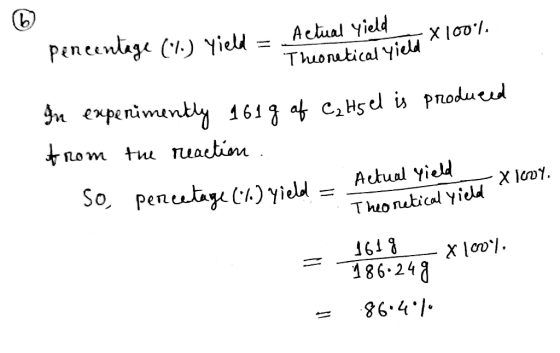
b. Calculate the percent yield of C2H5Cl if the reaction produces 161 g of C2H5Cl.
Homework Answers

Add Answer to:
When ethane (C2H6) reacts with chlorine (Cl2), the main product
is C2H5Cl; but other products containing...
When ethane, C2H6, reacts with chlorine, Cl2, the main product is C2H5Cl, but other products containing...
When ethane, C2H6, reacts with chlorine, Cl2, the main product is C2H5Cl, but other products containing Cl such as C2H4Cl2 are also obtained in small quantities. C2H6 + Cl2 C2H5Cl + "Other Stuff" The formation of these other products reduces the yield of C2H5Cl. Using the stoichiometry given in the chemical formula above, calculate the percent yield of C2H5Cl if the reaction of 150 g of C2H6 with 230. g of Cl2 produced 170 g of C2H5Cl.
Calculate the theoretical yield of C2H5Cl when 125 g of C2H6 reacts with 216 g of...
Calculate the theoretical yield of C2H5Cl when 125 g of C2H6 reacts with 216 g of Cl2, assuming that C2H6 and Cl2 react only to form C2H5Cl and HCl.
Ethyl chloride is prepared by the reaction of chlorine with ethane according to the following balanced...
Ethyl chloride is prepared by the reaction of chlorine with ethane according to the following balanced equation. C2H6(g) + Cl2(g) -----> C2H5Cl(l) + HCl(g) When 5.6 g of ethane is reacted with excess chlorine, 8.8 g of ethyl chloride forms. Calculate the percent yield of ethyl chloride. Percent yield of ethyl chloride = _____%
When manganese(IV) oxide (MnO2) reacts with hydrochloric acid (HCl), chlorine gas (Cl2) is produced as follows....
When manganese(IV) oxide (MnO2) reacts with hydrochloric acid (HCl), chlorine gas (Cl2) is produced as follows. MnO2(s) + 4 HCl(aq) → MnCl2(aq) + 2 H2O(g) + Cl2(g) How much HCl (in grams) needs to react with MnO2 to produce 96.00 g of Cl2?
Draw all possible products when 2,2,4-trimethylpentane reacts with Cl2 in the presence of light.
Draw all possible products when 2,2,4-trimethylpentane reacts with Cl2 in the presence of light. Compute the theoretical yield of all the products. Using curved arrows, show the reaction mechanism for the formation of the major product of the reaction below.
How many moles of phosphorus trichloride may theoretically form when 2.409 g of chlorine reacts? (Use...
 How many moles of phosphorus trichloride may theoretically form when 2.409 g of chlorine reacts? (Use 70.90 g moll for the molar mass of chlorine.) P4(s) + 6 Cl2(g) -> 4 PC13(1) What is the limiting reagent when 0.7541 g of phosphorus reacts with 2.409 g of chlorine? P4(s) + 6 Cl2(g) - 4 PC13(0) P4 Cl2 PCI3 Calculate the theoretical yield of phosphorus trichloride (in g) when 0.7541 g of phosphorus reacts with 2.409 g of chlorine. (Use 137.3...
When bromide-containing waters are disinfected with chlorine, Br– can be oxidized into HOBr and other reactive...
When bromide-containing waters are disinfected with chlorine, Br– can be oxidized into HOBr and other reactive bromine species that are capable of generating toxic, brominated disinfection by-products. Consider the reaction shown below: HOCl(aq) + Br– ⇌ HOBr(aq) + Cl– The rate of the forward reaction can be described by the following equation: rate=-d[Br^- ]/dt=k[HOCl][Br^-] where the rate constant (k) equals 1.55 × 10³ M–1 s–1 at 25 C. A sample of raw (untreated) drinking water (with pH 7.30 and [Br–]...
Question 1 1 pts Calculate the mass of potassium chloride, KCI, (in grams) formed when 7.00 g of chlorine gas is allowe...
 Question 1 1 pts Calculate the mass of potassium chloride, KCI, (in grams) formed when 7.00 g of chlorine gas is allowed to react with 5.00 g of potassium. (write the chemical reaction first) 7.36 7.38 14.7 4.77 9.53 Question 2 1 pts Carbon dioxide is produced in the following reaction: 5 H2C204(aq) + 2 KMnO4 (aq) + 3 H2SO4 (aq) → 10 CO2(g) + 2 MnSO4 (aq) + K2SO4 (aq) + 8 H20 (1) What is the limiting reagent...
Limiting Reactants, Excess Reactant, and % Yield Name H2+Cl2HCI A gaseous mixture containing 7.5 g of H; gas and 9....
 Limiting Reactants, Excess Reactant, and % Yield Name H2+Cl2HCI A gaseous mixture containing 7.5 g of H; gas and 9.00 g of Cl2 gas react to form hydrogen chloride gas. а) Which is the limiting reactant? If all the limiting reactant is consumed, how many grams of HCl are produced? How many grams of excess reactant remain un-reacted? b) c) Cl2+3F22CIF Chlorine reacts with fluorine to form gaseous chlorine trifluoride. You start with 50.0g of chlorine and 95.0g of fluorine....
Predict the products when aqueous solutions of magnesium sulfate and barium nitrate react with each other....
Predict the products when aqueous solutions of magnesium sulfate and barium nitrate react with each other. Write the balanced chemical equation and indicate which product would be the precipitate (insoluble). 2. Suppose the solutions contained 0.3181 g of magnesium sulfate 1.000 g of barium nitrate. a) Calculate the number of moles of each reactant. (Show your work) b) Determine the limiting reactant for the precipitate. (Show your work) c) Calculate the theoretical yield for the precipitate. (Show your work)
 How many moles of phosphorus trichloride may theoretically form when 2.409 g of chlorine reacts? (Use 70.90 g moll for the molar mass of chlorine.) P4(s) + 6 Cl2(g) -> 4 PC13(1) What is the limiting reagent when 0.7541 g of phosphorus reacts with 2.409 g of chlorine? P4(s) + 6 Cl2(g) - 4 PC13(0) P4 Cl2 PCI3 Calculate the theoretical yield of phosphorus trichloride (in g) when 0.7541 g of phosphorus reacts with 2.409 g of chlorine. (Use 137.3...
 Question 1 1 pts Calculate the mass of potassium chloride, KCI, (in grams) formed when 7.00 g of chlorine gas is allowed to react with 5.00 g of potassium. (write the chemical reaction first) 7.36 7.38 14.7 4.77 9.53 Question 2 1 pts Carbon dioxide is produced in the following reaction: 5 H2C204(aq) + 2 KMnO4 (aq) + 3 H2SO4 (aq) → 10 CO2(g) + 2 MnSO4 (aq) + K2SO4 (aq) + 8 H20 (1) What is the limiting reagent...
 Limiting Reactants, Excess Reactant, and % Yield Name H2+Cl2HCI A gaseous mixture containing 7.5 g of H; gas and 9.00 g of Cl2 gas react to form hydrogen chloride gas. а) Which is the limiting reactant? If all the limiting reactant is consumed, how many grams of HCl are produced? How many grams of excess reactant remain un-reacted? b) c) Cl2+3F22CIF Chlorine reacts with fluorine to form gaseous chlorine trifluoride. You start with 50.0g of chlorine and 95.0g of fluorine....
Most questions answered within 3 hours.
-
Where is the error in this code sequence?
String s1 = "Hello";
String s2 = "ello";...
asked 11 months ago -
Financial data for Joel de Paris, Inc., for last year
follow:
Joel de Paris, Inc.
Balance...
asked 11 months ago -
Consider this reaction:
Al2(SO4)3 (aq)+ BaCl3
(aq) Al2Cl6 (aq)- +
3BaSO4(s) . What is the...
asked 11 months ago -
Suppose that Savneet is considering increasing her
recent random sample from 20 car rentals to 40...
asked 11 months ago -
Trucks arrive at an unloading terminal at an average rate of 120
per hour.
Trucks arrive...
asked 11 months ago -
Why are methanol and ethanol completely soluble in water while
octanol is not very little soluble....
asked 11 months ago -
A facilities manager at a university reads in a research report
that the mean amount of...
asked 11 months ago -
When the CuSO4 is rehydrated by adding water to the anhydrous
compound, is this an endothermic...
asked 11 months ago -
A ray of sunlight is passing from diamond into crown glass; the
angle of incidence is...
asked 11 months ago -
A block of mass 0.249 kg is placed on top of a light, vertical
spring of...
asked 11 months ago -
how do the kidneys compensate in the presences of acidosis
a) trigger hyperventilate
b) reserve acid...
asked 11 months ago -
Question 501 pts
The rental rate of capital to the firm increases. Which of the
following...
asked 11 months ago