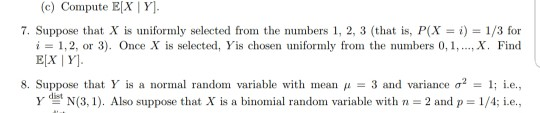
Suppose that X is uniformly selected from the numbers
1, 2, 3 (that is, P(X = i) = 1/3 for
i = 1, 2, or 3). Once X is selected, Y is chosen uniformly from the
numbers 0, 1, ..., X. Find
E[X | Y ].
Homework Answers
![s ufomadly Selkd for the h ㄚ once X 18 Selected, y 18 cho易eh uniformuly prom dhehu,benso, l, Find ELxIvJ PT y- 8 心1 ot 丄[ 1+1+3] 2,22% Yr](http://img.homeworklib.com/questions/c6512a10-7278-11ea-8c23-e7bbb8bb3d91.png?x-oss-process=image/resize,w_560)
Add Answer to:
Suppose that X is uniformly selected from the numbers
1, 2, 3 (that is, P(X =...
7. Suppose that X is uniformly selected from the numbers 1, 2, 3 (that is, P(X...
 7. Suppose that X is uniformly selected from the numbers 1, 2, 3 (that is, P(X - i)-1/3 for i = 1,2, or 3). Once X is selected, Yis chosen uniformly from the numbers 0,1, , X. Find
. Suppose that Y is a normal random variable with mean µ = 3 and variance...
 . Suppose that Y is a normal random variable with mean
µ = 3 and variance σ
2 = 1; i.e.,
Y
dist = N(3, 1). Also suppose that X is a binomial random variable
with n = 2 and p = 1/4; i.e.,
X
dist = Bin(2, 1/4). Suppose X and Y are independent random
variables. Find the expected
value of Y
X. Hint: Consider conditioning on the events {X = j} for j = 0, 1,
2.
8....
. Suppose that Y is a normal random variable with mean
µ = 3 and variance σ
2 = 1; i.e.,
Y
dist = N(3, 1). Also suppose that X is a binomial random variable
with n = 2 and p = 1/4; i.e.,
X
dist = Bin(2, 1/4). Suppose X and Y are independent random
variables. Find the expected
value of Y
X. Hint: Consider conditioning on the events {X = j} for j = 0, 1,
2.
8....
3) Suppose X,,X,,X, (n > 1) is a random sample from Bernoulli distribution with Circle out...
 3) Suppose X,,X,,X, (n > 1) is a random sample from Bernoulli distribution with Circle out your Class: Mon&Wed or Mon.Evening p.mf. p(x)=p"(I-p)'-x , x = 0,1, , thenyi follows ( ). Binomial distribution B(a.p) eNormal distribution N(p,mp(- O Poisson distribution P(np) Dcan not be determined. 4) Suppose X-N(0,1) and Y~N(24), they are independent, then )is incorrect. X+Y N(2, 5) C X-Y-NC-2,5) BP(Y <2)>0.5 D Var(X) < Var(Y) x,X,, ,X, (n>1) is a random sample from N(μσ2), let-1ΣΧί 5) Suppose...
Suppose that a point X is selected at random from the interval (0,1). After the value X = x has been selected, a point Y is then chosen at random from the interval (0,x^2). a) Indicate the region R on...
Suppose that a point X is selected at random from the interval (0,1). After the value X = x has been selected, a point Y is then chosen at random from the interval (0,x^2). a) Indicate the region R on the xy-plane of possible values of the random vector (X,Y). b) Find the marginal pdf f2(y) of Y.
1. Let X~b(x; n, p) (a) For n 6, p .2, find () Prx> 3), (ii) Pr(x23), (ii) Pr(x (b) For n = 15, p= .8, find (i) Pr(X-2), (ii) Pr(X-12), (iii) Pr(X-8). (c) For n 10, find p so that Pr(X 2 8)6778....
 1. Let X~b(x; n, p) (a) For n 6, p .2, find () Prx> 3), (ii) Pr(x23), (ii) Pr(x (b) For n = 15, p= .8, find (i) Pr(X-2), (ii) Pr(X-12), (iii) Pr(X-8). (c) For n 10, find p so that Pr(X 2 8)6778. く2). 2. Let X be a binomial random variable with μ-6 and σ2-2.4. Fin (a) Pr(X> 2) (b) Pr(2 < X < 8). (c) Pr(Xs 8).
1. Let X~b(x; n, p) (a) For n 6, p...
1. Let X~b(x; n, p) (a) For n 6, p .2, find () Prx> 3), (ii) Pr(x23), (ii) Pr(x (b) For n = 15, p= .8, find (i) Pr(X-2), (ii) Pr(X-12), (iii) Pr(X-8). (c) For n 10, find p so that Pr(X 2 8)6778. く2). 2. Let X be a binomial random variable with μ-6 and σ2-2.4. Fin (a) Pr(X> 2) (b) Pr(2 < X < 8). (c) Pr(Xs 8).
1. Let X~b(x; n, p) (a) For n 6, p...
[Probability] Let N be a geometric random variable with parameter p. Given N,generate N many i.i.d....
[Probability] Let N be a geometric random variable with parameter p. Given N,generate N many i.i.d. random numbers U1, U2, . . . , UN uniformly from [0,1]. Let M= max 1≤i≤N Ui. Find the cdf of M, i.e., find P(M≤x).
1. Let U be a random variable that is uniformly distributed on the interval (0,1) (a)...
 1. Let U be a random variable that is uniformly distributed on the interval (0,1) (a) Show that V 1 - U is also a uniformly distributed random variable on the interval (0,1) (b) Show that X-In(U) is an exponential random variable and find its associated parameter (c) Let W be another random variable that is uformly distributed on (0,1). Assume that U and W are independent. Show that a probability density function of Y-U+W is y, if y E...
problems binomial random, veriable has the moment generating function, y(t)=E eux 1. A nd+ 1-p)n. Show...
 problems binomial random, veriable has the moment generating function, y(t)=E eux 1. A nd+ 1-p)n. Show that EIX|-np and Var(X) np(1-p) using that EIX)-v(0) nd E.X2 =ψ (0). 2. Lex X be uniformly distributed over (a b). Show that ElXI 쌓 and Var(X) = (b and second moments of this random variable where the pdf of X is (x)N of a continuous randonn variable is defined as E[X"-广.nf(z)dz. )a using the first Note that the nth moment 3. Show that...
Suppose X is a Binomial Random Variable with n = 4 and p = 2. What...
Suppose X is a Binomial Random Variable with n = 4 and p = 2. What is the pdf of Y = 2X + 1? Note: The pdf of a Binomial Random Variable X is pX(k) = n k (1 − p) kp n−k , k = 0, 1, 2, . . . ,
Suppose X and Y are independent Binomial random variables, each with n=3 and p=9/10. a. Find...
Suppose X and Y are independent Binomial random variables, each with n=3 and p=9/10. a. Find the probability that X and Y are equal, i.e., find P(X=Y). b. Find the probability that X is strictly larger than Y, i.e., find P(X>Y). c. Find the probability that Y is strictly larger than X, i.e., find P(Y>X).
 7. Suppose that X is uniformly selected from the numbers 1, 2, 3 (that is, P(X - i)-1/3 for i = 1,2, or 3). Once X is selected, Yis chosen uniformly from the numbers 0,1, , X. Find
 . Suppose that Y is a normal random variable with mean
µ = 3 and variance σ
2 = 1; i.e.,
Y
dist = N(3, 1). Also suppose that X is a binomial random variable
with n = 2 and p = 1/4; i.e.,
X
dist = Bin(2, 1/4). Suppose X and Y are independent random
variables. Find the expected
value of Y
X. Hint: Consider conditioning on the events {X = j} for j = 0, 1,
2.
8....
. Suppose that Y is a normal random variable with mean
µ = 3 and variance σ
2 = 1; i.e.,
Y
dist = N(3, 1). Also suppose that X is a binomial random variable
with n = 2 and p = 1/4; i.e.,
X
dist = Bin(2, 1/4). Suppose X and Y are independent random
variables. Find the expected
value of Y
X. Hint: Consider conditioning on the events {X = j} for j = 0, 1,
2.
8....
 3) Suppose X,,X,,X, (n > 1) is a random sample from Bernoulli distribution with Circle out your Class: Mon&Wed or Mon.Evening p.mf. p(x)=p"(I-p)'-x , x = 0,1, , thenyi follows ( ). Binomial distribution B(a.p) eNormal distribution N(p,mp(- O Poisson distribution P(np) Dcan not be determined. 4) Suppose X-N(0,1) and Y~N(24), they are independent, then )is incorrect. X+Y N(2, 5) C X-Y-NC-2,5) BP(Y <2)>0.5 D Var(X) < Var(Y) x,X,, ,X, (n>1) is a random sample from N(μσ2), let-1ΣΧί 5) Suppose...
 1. Let X~b(x; n, p) (a) For n 6, p .2, find () Prx> 3), (ii) Pr(x23), (ii) Pr(x (b) For n = 15, p= .8, find (i) Pr(X-2), (ii) Pr(X-12), (iii) Pr(X-8). (c) For n 10, find p so that Pr(X 2 8)6778. く2). 2. Let X be a binomial random variable with μ-6 and σ2-2.4. Fin (a) Pr(X> 2) (b) Pr(2 < X < 8). (c) Pr(Xs 8).
1. Let X~b(x; n, p) (a) For n 6, p...
1. Let X~b(x; n, p) (a) For n 6, p .2, find () Prx> 3), (ii) Pr(x23), (ii) Pr(x (b) For n = 15, p= .8, find (i) Pr(X-2), (ii) Pr(X-12), (iii) Pr(X-8). (c) For n 10, find p so that Pr(X 2 8)6778. く2). 2. Let X be a binomial random variable with μ-6 and σ2-2.4. Fin (a) Pr(X> 2) (b) Pr(2 < X < 8). (c) Pr(Xs 8).
1. Let X~b(x; n, p) (a) For n 6, p...
 1. Let U be a random variable that is uniformly distributed on the interval (0,1) (a) Show that V 1 - U is also a uniformly distributed random variable on the interval (0,1) (b) Show that X-In(U) is an exponential random variable and find its associated parameter (c) Let W be another random variable that is uformly distributed on (0,1). Assume that U and W are independent. Show that a probability density function of Y-U+W is y, if y E...
 problems binomial random, veriable has the moment generating function, y(t)=E eux 1. A nd+ 1-p)n. Show that EIX|-np and Var(X) np(1-p) using that EIX)-v(0) nd E.X2 =ψ (0). 2. Lex X be uniformly distributed over (a b). Show that ElXI 쌓 and Var(X) = (b and second moments of this random variable where the pdf of X is (x)N of a continuous randonn variable is defined as E[X"-广.nf(z)dz. )a using the first Note that the nth moment 3. Show that...
Most questions answered within 3 hours.
-
Where is the error in this code sequence?
String s1 = "Hello";
String s2 = "ello";...
asked 10 months ago -
Financial data for Joel de Paris, Inc., for last year
follow:
Joel de Paris, Inc.
Balance...
asked 10 months ago -
Consider this reaction:
Al2(SO4)3 (aq)+ BaCl3
(aq) Al2Cl6 (aq)- +
3BaSO4(s) . What is the...
asked 10 months ago -
Suppose that Savneet is considering increasing her
recent random sample from 20 car rentals to 40...
asked 10 months ago -
Trucks arrive at an unloading terminal at an average rate of 120
per hour.
Trucks arrive...
asked 10 months ago -
Why are methanol and ethanol completely soluble in water while
octanol is not very little soluble....
asked 10 months ago -
A facilities manager at a university reads in a research report
that the mean amount of...
asked 10 months ago -
When the CuSO4 is rehydrated by adding water to the anhydrous
compound, is this an endothermic...
asked 10 months ago -
A ray of sunlight is passing from diamond into crown glass; the
angle of incidence is...
asked 10 months ago -
A block of mass 0.249 kg is placed on top of a light, vertical
spring of...
asked 10 months ago -
how do the kidneys compensate in the presences of acidosis
a) trigger hyperventilate
b) reserve acid...
asked 10 months ago -
Question 501 pts
The rental rate of capital to the firm increases. Which of the
following...
asked 10 months ago