

Homework Answers
Add Answer to:
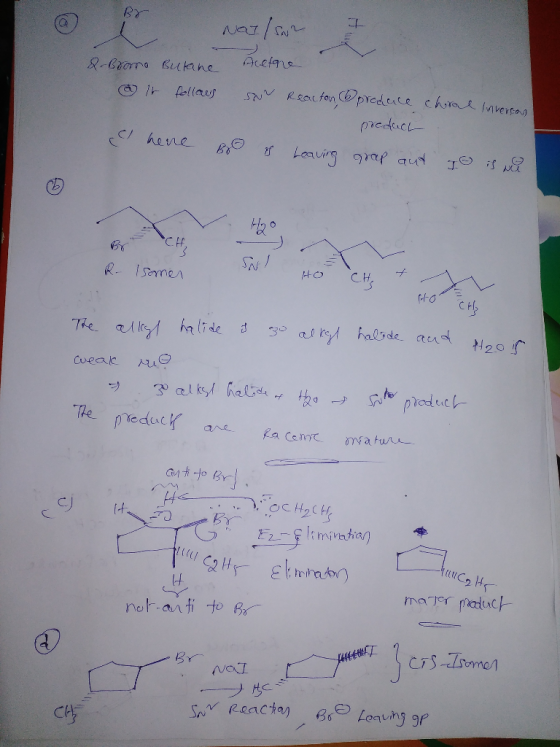
Predict the substitution product(s) for each of the following reactions and mechanisms by which they are...
Predict the products and mechanisms of the following reactions. When more than one product or mechanism...
Predict the products and mechanisms of the following reactions. When more than one product or mechanism is possible, explain which are most likely. (a) 1-bromohexane + sodium ethoxide in ethanol (b) 2-chlorohexane + NaOCH3 in methanol (c) 2-chloro-2-methylbutane + NaOCH CH in ethanol 23 (d) 2-chloro-2-methylbutane heated in ethanol (e) isobutyl iodide + KOH in ethanol>water (f) isobutyl chloride + AgNO3 in ethanol>water (g) 1@bromo@1@methylcyclopentane + NaOEt in ethanol (h) 1-bromo-1-methylcyclopentane heated in methanol
Predict if the given compounds below undergo SN2 or SN1 in presence of NaI / acetone...
Predict if the given compounds below undergo SN2 or SN1 in presence of NaI / acetone and AgNO3 / ethanol medium. (1-bromobutane, 1-chlorobutane, 2-bromobutane, 2-chlorobutane, 2-chloro-2methylpropane, 2-bromo-2-methylpropane)
7. Predict the product(s) of each of the following reactions include stereochemistry where important and indicate...
 7. Predict the product(s) of each of the following reactions include stereochemistry where important and indicate the mechanism (S, S,2, El, E2). 80°C a 2-chloro-2-methylbutane NaOH Н.о b. (R)-2-chloropentane Nac c-H DMSO с1 (снс. Cн, CH,ОН d. trans-1-chloro-3-methylcyclohexane+ NaOC(CH) e. 2-chloro-3-phenylbutane Н.о f. trans-1-bromo-3-methyleyclopentane Nal acetone NaOCH THон g 2-chloro-2-methylbutane EIOH h R-3-bromo-2-methylpentane . trans-1-bromo-2-isopropyleyclohexane CHCOK NaSH Н,о j. 1-bromopropaе NaOCH снон CH коссH). I-bromobutane m. cis-1-chloro-3-methyleyclobutane Nal DMSO сHсH,он n. (R)-2-iodo-2-phenylethane NaOH o. 1-iodobutane p. 2-bromo-3-methylbutane KOC(CH). но (S)-3-chlorocyclopentene...
-Compare rates of S2 and SN1 product formation for 5 halides (1-chlorobutane, 1- bromobutane, 2-bromobutane, 2-chloro-2-methylpropane,...
 -Compare rates of S2 and SN1 product formation for 5 halides (1-chlorobutane, 1- bromobutane, 2-bromobutane, 2-chloro-2-methylpropane, and chlorobenzene) -Arrange 5 compounds in order of decreasing reactivity toward (a) Nal in acetone, and (b) AgNO3 in ethanol reagents. [Use structural formula for halides]
(1) What mechanism do you believe will be favored with Nal in acetone? What order of...
 (1) What mechanism do you believe will be favored with Nal in acetone? What order of reactivity do you predict will be observed when each of the alkyl halides in Figure 1 is reacted with Nal in acetone? Complete the below table; list the relative ranking of the reactivity of the alkyl halides and your reason for placing that alkyl halide at that ranking. Write your prediction of the mechanism and the order of reactivity with Nal in acetone as...
For the Reactions that formed precipitates, what are the drawn out reaction equations with stereochemistry if...
 For the Reactions that formed precipitates, what are the drawn
out reaction equations with stereochemistry if applicable?
Part 1. Enter the results of each test into the table below: 1°, 2° or 3°? Alkyl Halides 1-chlorobutane Sn2 (Nal/acetone) Precipitate formed 1-bromobutane Precipitate formed 2-chlorobutane No precipitate formed 2-bromobutane No precipitate formed bromocyclohexane No precipitate formed 2-chloro-2-methylpropane (t-butyl chloride) No precipitate formed Crotyl chloride No precipitate formed Benzyl chloride (a-chlorotoluene) No precipitate formed Arrange the alkyl halides in order of reactivity...
For the Reactions that formed precipitates, what are the drawn
out reaction equations with stereochemistry if applicable?
Part 1. Enter the results of each test into the table below: 1°, 2° or 3°? Alkyl Halides 1-chlorobutane Sn2 (Nal/acetone) Precipitate formed 1-bromobutane Precipitate formed 2-chlorobutane No precipitate formed 2-bromobutane No precipitate formed bromocyclohexane No precipitate formed 2-chloro-2-methylpropane (t-butyl chloride) No precipitate formed Crotyl chloride No precipitate formed Benzyl chloride (a-chlorotoluene) No precipitate formed Arrange the alkyl halides in order of reactivity...
Arrange the following chloroalkanes in order of increasing reactivity towards a S_N1 reaction: 1-chloro-2-methylbutane, 1-chloro-3-methylbutane, 2-chloro-2-methylbutane,...
 Arrange the following chloroalkanes in order of increasing reactivity towards a S_N1 reaction: 1-chloro-2-methylbutane, 1-chloro-3-methylbutane, 2-chloro-2-methylbutane, 1-chloropentane (A complete answer will provide a bond line drawing of each of the compounds listed) For the same compounds found in question 1, list them in order of increasing reactivity towards an S_N2 reaction (list them as structures as well) Provide a bond line drawing of the product for the following reactions: (answer on back) a. (2S)-2-bromobutane + NaCN in acetone b. (3R)-3-iodo-1...
3. for each of the following, choose the reaction that would proceed more rapidly and give...
 3. for each of the following, choose the reaction that would proceed more rapidly and give an explanation for your choice: (a) iodomethane or bromomethane with aqueous KOH (b) iodomethane or iodoethane with aqueous KOH (c) methanol or bromomethane with Nal dissolved in acetone (d) 2-bromopropane or 1-bromopropane with Nal dissolved in acetone (e) 2-bromo-2-methylbutane or 2-bromo-3-methylbutane with ethanol (f) aqueous KBr or aqueous HBr with butanol (g) 2-chloro-3,3-dimethylbutane or 2-chloro-3-methylbutane with potassium tert- butoxide (h) 1:1 or 1:4 by...
Experiment F. Nucleophilic Substitution Reactions. Pre -Lab Report 2. SPECIAL INSTRUCTIONS: a. Work in groups of 2-...
 Experiment F. Nucleophilic Substitution Reactions. Pre -Lab Report
2. SPECIAL INSTRUCTIONS: a. Work in groups of 2-3 students. Each group will complete and turn in one report for grade. You will not complete the lab report in your lab notebook using the usual format. Instead, the entire report is provided in the procedures section of these lab materials. You will complete the report by providing the missing information. Report is due at the end of the lab period. b. While...
Experiment F. Nucleophilic Substitution Reactions. Pre -Lab Report
2. SPECIAL INSTRUCTIONS: a. Work in groups of 2-3 students. Each group will complete and turn in one report for grade. You will not complete the lab report in your lab notebook using the usual format. Instead, the entire report is provided in the procedures section of these lab materials. You will complete the report by providing the missing information. Report is due at the end of the lab period. b. While...
For each compound listed below, predict the dominant mechanism for each reactant (SN1 and/or SN2). The...
For each compound listed below, predict the dominant mechanism for each reactant (SN1 and/or SN2). The two test reagent mixtures you will be using are sodium iodide in acetone and silver nitrate in ethanol.Note: a compound may not react at all or react under both mechanisms. If both mechanisms are possible, one is usually dominant. Indicate that where applicable. Reactant KI/acetone AgNO3/ethanol 1 bromobenzene 2 bromocyclopentane 3 bromocyclohexane 4 2-bromobutane 5 2-chlorobutane 6 1-chloropropan-2-one 7 1-chlorobutane 8 2-chloro-2-methylpropane 9 1-chloromethylbenzene
 7. Predict the product(s) of each of the following reactions include stereochemistry where important and indicate the mechanism (S, S,2, El, E2). 80°C a 2-chloro-2-methylbutane NaOH Н.о b. (R)-2-chloropentane Nac c-H DMSO с1 (снс. Cн, CH,ОН d. trans-1-chloro-3-methylcyclohexane+ NaOC(CH) e. 2-chloro-3-phenylbutane Н.о f. trans-1-bromo-3-methyleyclopentane Nal acetone NaOCH THон g 2-chloro-2-methylbutane EIOH h R-3-bromo-2-methylpentane . trans-1-bromo-2-isopropyleyclohexane CHCOK NaSH Н,о j. 1-bromopropaе NaOCH снон CH коссH). I-bromobutane m. cis-1-chloro-3-methyleyclobutane Nal DMSO сHсH,он n. (R)-2-iodo-2-phenylethane NaOH o. 1-iodobutane p. 2-bromo-3-methylbutane KOC(CH). но (S)-3-chlorocyclopentene...
 -Compare rates of S2 and SN1 product formation for 5 halides (1-chlorobutane, 1- bromobutane, 2-bromobutane, 2-chloro-2-methylpropane, and chlorobenzene) -Arrange 5 compounds in order of decreasing reactivity toward (a) Nal in acetone, and (b) AgNO3 in ethanol reagents. [Use structural formula for halides]
 (1) What mechanism do you believe will be favored with Nal in acetone? What order of reactivity do you predict will be observed when each of the alkyl halides in Figure 1 is reacted with Nal in acetone? Complete the below table; list the relative ranking of the reactivity of the alkyl halides and your reason for placing that alkyl halide at that ranking. Write your prediction of the mechanism and the order of reactivity with Nal in acetone as...
 For the Reactions that formed precipitates, what are the drawn
out reaction equations with stereochemistry if applicable?
Part 1. Enter the results of each test into the table below: 1°, 2° or 3°? Alkyl Halides 1-chlorobutane Sn2 (Nal/acetone) Precipitate formed 1-bromobutane Precipitate formed 2-chlorobutane No precipitate formed 2-bromobutane No precipitate formed bromocyclohexane No precipitate formed 2-chloro-2-methylpropane (t-butyl chloride) No precipitate formed Crotyl chloride No precipitate formed Benzyl chloride (a-chlorotoluene) No precipitate formed Arrange the alkyl halides in order of reactivity...
For the Reactions that formed precipitates, what are the drawn
out reaction equations with stereochemistry if applicable?
Part 1. Enter the results of each test into the table below: 1°, 2° or 3°? Alkyl Halides 1-chlorobutane Sn2 (Nal/acetone) Precipitate formed 1-bromobutane Precipitate formed 2-chlorobutane No precipitate formed 2-bromobutane No precipitate formed bromocyclohexane No precipitate formed 2-chloro-2-methylpropane (t-butyl chloride) No precipitate formed Crotyl chloride No precipitate formed Benzyl chloride (a-chlorotoluene) No precipitate formed Arrange the alkyl halides in order of reactivity...
 Arrange the following chloroalkanes in order of increasing reactivity towards a S_N1 reaction: 1-chloro-2-methylbutane, 1-chloro-3-methylbutane, 2-chloro-2-methylbutane, 1-chloropentane (A complete answer will provide a bond line drawing of each of the compounds listed) For the same compounds found in question 1, list them in order of increasing reactivity towards an S_N2 reaction (list them as structures as well) Provide a bond line drawing of the product for the following reactions: (answer on back) a. (2S)-2-bromobutane + NaCN in acetone b. (3R)-3-iodo-1...
 3. for each of the following, choose the reaction that would proceed more rapidly and give an explanation for your choice: (a) iodomethane or bromomethane with aqueous KOH (b) iodomethane or iodoethane with aqueous KOH (c) methanol or bromomethane with Nal dissolved in acetone (d) 2-bromopropane or 1-bromopropane with Nal dissolved in acetone (e) 2-bromo-2-methylbutane or 2-bromo-3-methylbutane with ethanol (f) aqueous KBr or aqueous HBr with butanol (g) 2-chloro-3,3-dimethylbutane or 2-chloro-3-methylbutane with potassium tert- butoxide (h) 1:1 or 1:4 by...
 Experiment F. Nucleophilic Substitution Reactions. Pre -Lab Report
2. SPECIAL INSTRUCTIONS: a. Work in groups of 2-3 students. Each group will complete and turn in one report for grade. You will not complete the lab report in your lab notebook using the usual format. Instead, the entire report is provided in the procedures section of these lab materials. You will complete the report by providing the missing information. Report is due at the end of the lab period. b. While...
Experiment F. Nucleophilic Substitution Reactions. Pre -Lab Report
2. SPECIAL INSTRUCTIONS: a. Work in groups of 2-3 students. Each group will complete and turn in one report for grade. You will not complete the lab report in your lab notebook using the usual format. Instead, the entire report is provided in the procedures section of these lab materials. You will complete the report by providing the missing information. Report is due at the end of the lab period. b. While...
Most questions answered within 3 hours.
-
Where is the error in this code sequence?
String s1 = "Hello";
String s2 = "ello";...
asked 11 months ago -
Financial data for Joel de Paris, Inc., for last year
follow:
Joel de Paris, Inc.
Balance...
asked 11 months ago -
Consider this reaction:
Al2(SO4)3 (aq)+ BaCl3
(aq) Al2Cl6 (aq)- +
3BaSO4(s) . What is the...
asked 11 months ago -
Suppose that Savneet is considering increasing her
recent random sample from 20 car rentals to 40...
asked 11 months ago -
Trucks arrive at an unloading terminal at an average rate of 120
per hour.
Trucks arrive...
asked 11 months ago -
Why are methanol and ethanol completely soluble in water while
octanol is not very little soluble....
asked 11 months ago -
A facilities manager at a university reads in a research report
that the mean amount of...
asked 11 months ago -
When the CuSO4 is rehydrated by adding water to the anhydrous
compound, is this an endothermic...
asked 11 months ago -
A ray of sunlight is passing from diamond into crown glass; the
angle of incidence is...
asked 11 months ago -
A block of mass 0.249 kg is placed on top of a light, vertical
spring of...
asked 11 months ago -
how do the kidneys compensate in the presences of acidosis
a) trigger hyperventilate
b) reserve acid...
asked 11 months ago -
Question 501 pts
The rental rate of capital to the firm increases. Which of the
following...
asked 11 months ago