
Homework Answers



Add Answer to:
4. Given the following UNBALANCED equation: Fe + Ss --> FeS What type of reaction is...
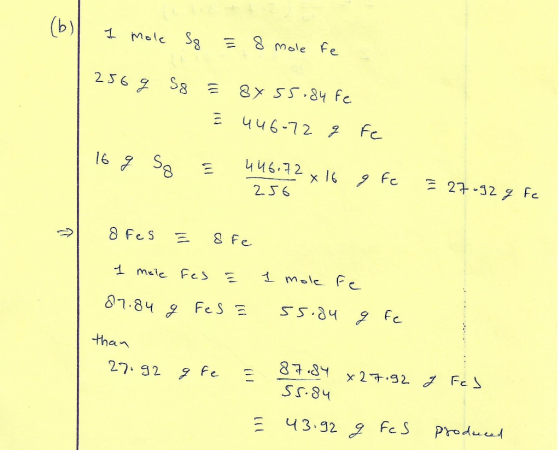
6. What mass of iron (Fe) is needed to react with 16.0 grams of sulfur (Ss)?...
 6. What mass of iron (Fe) is needed to react with 16.0 grams of sulfur (Ss)? 8 Fe +S8 ->8 FeS
6CO2 + 6H20 → C6H12O6 + 602 Glucose Oxygen Carbon Dioxide Water What type of energy...
 6CO2 + 6H20 → C6H12O6 + 602 Glucose Oxygen Carbon Dioxide Water What type of energy needs to be added to make this reaction occur?
For the following reaction, 3.36 grams of copper are mixed with excess silver nitrate. The reaction...
 For the following reaction, 3.36 grams of copper are mixed with excess silver nitrate. The reaction yields 9.36 grams of copper(II) nitrate silver nitrate (aq) + copper (6) — copper(II) nitrate (aq) + silver (1) grams What is the ideal yield of copper(II) nitrate? What is the percent yield for this reaction? We were unable to transcribe this imageps2rea Review Topical References Use the References to access important values if needed for this question According to the following reaction, how...
o dess important values if needed for this question. For the following reaction, 3.76 grams of...
 o dess important values if needed for this question. For the following reaction, 3.76 grams of sulfur are mixed with excess carbon monoxide. The reaction yields 6.18 grams of sulfur dioxide. sulfur (%) + carbon monoxide (g)- sulfur dioxide (g) + carbon (6) grams What is the theoretical yield of sulfur dioxide ? What is the percent yield of sulfur dioxide ? Submit Answer Retry Entire Group 9 more group attempts remaining
1. For the following reaction, 5.47 grams of oxygen gas are mixed with excess sulfur dioxide...
1. For the following reaction, 5.47 grams of oxygen gas are mixed with excess sulfur dioxide . The reaction yields 19.3 grams of sulfur trioxide . sulfur dioxide ( g ) + oxygen ( g ) sulfur trioxide ( g ) What is the theoretical yield of sulfur trioxide ? grams What is the percent yield for this reaction ? % 2. For the following reaction, 6.54 grams of chlorine gas are mixed with excess carbon disulfide. The reaction yields 3.11...
For the following reaction, 16.9 grams of sulfur are allowed to react with 21.1 grams of...
 For the following reaction, 16.9 grams of sulfur are allowed to react with 21.1 grams of carbon monoxide. sulfur ($)+ carbon monoxide (8) —>sulfur dioxide (g) + carbon (5) What is the maximum amount of sulfur dioxide that can be formed? grams What is the FORMULA for the limiting reagent? What amount of the excess reagent remains after the reaction is complete? grams
For the following reaction, 55.9 grams of diphosphorus pentoxide are allowed to react with 24.7 grams...
 For the following reaction, 55.9 grams of diphosphorus pentoxide are allowed to react with 24.7 grams of water diphosphorus pentoxide (s) + water (1) phosphoric acid (aq) What is the maximum amount of phosphoric acid that can be formed? What is the FORMULA for the limiting reagent? What amount of the excess reagent remains after the reaction is complete? grams For the following reaction, 5.73 grams of water are mixed with excess carbon monoxide. The reaction yields 9.36 grams of...
For the following reaction, 14.7 grams of sulfur are allowed to react with 19.3 grams of...
 For the following reaction, 14.7 grams of sulfur are allowed to react with 19.3 grams of carbon monoxide . sulfur(s) + carbon monoxide(g) → sulfur dioxide(g) + carbon(s) What is the maximum amount of sulfur dioxide that can be formed? | grams What is the FORMULA for the limiting reagent? What amount of the excess reagent remains after the reaction is complete? grams
For the following reaction, 12.8 grams of sulfur are allowed to react with 26.2 grams of carbon monoxide.
For the following reaction, 12.8 grams of sulfur are allowed to react with 26.2 grams of carbon monoxide.sulfur(s) + carbon monoxide(g) → sulfur dioxide(g) +carbon(s)What is the maximum amount of sulfur dioxide that can be formed? gramsWhat is the FORMULA for the limiting reagent?What amount of the excess reagent remains after the reaction is complete? grams
Question 1: For the following reaction, 8.72 grams of nitrogen gas are allowed to react with...
Question 1: For the following reaction, 8.72 grams of nitrogen gas are allowed to react with 1.04 grams of hydrogen gas . nitrogen(g) + hydrogen(g) = ammonia(g) What is the maximum mass of ammonia that can be formed? grams What is the FORMULA for the limiting reagent? What mass of the excess reagent remains after the reaction is complete? grams Question 2: For the following reaction, 10.8 grams of glucose (C6H12O6) are allowed to react with 15.9 grams of oxygen...
 6. What mass of iron (Fe) is needed to react with 16.0 grams of sulfur (Ss)? 8 Fe +S8 ->8 FeS
 6CO2 + 6H20 → C6H12O6 + 602 Glucose Oxygen Carbon Dioxide Water What type of energy needs to be added to make this reaction occur?
 For the following reaction, 3.36 grams of copper are mixed with excess silver nitrate. The reaction yields 9.36 grams of copper(II) nitrate silver nitrate (aq) + copper (6) — copper(II) nitrate (aq) + silver (1) grams What is the ideal yield of copper(II) nitrate? What is the percent yield for this reaction? We were unable to transcribe this imageps2rea Review Topical References Use the References to access important values if needed for this question According to the following reaction, how...
 o dess important values if needed for this question. For the following reaction, 3.76 grams of sulfur are mixed with excess carbon monoxide. The reaction yields 6.18 grams of sulfur dioxide. sulfur (%) + carbon monoxide (g)- sulfur dioxide (g) + carbon (6) grams What is the theoretical yield of sulfur dioxide ? What is the percent yield of sulfur dioxide ? Submit Answer Retry Entire Group 9 more group attempts remaining
 For the following reaction, 16.9 grams of sulfur are allowed to react with 21.1 grams of carbon monoxide. sulfur ($)+ carbon monoxide (8) —>sulfur dioxide (g) + carbon (5) What is the maximum amount of sulfur dioxide that can be formed? grams What is the FORMULA for the limiting reagent? What amount of the excess reagent remains after the reaction is complete? grams
 For the following reaction, 55.9 grams of diphosphorus pentoxide are allowed to react with 24.7 grams of water diphosphorus pentoxide (s) + water (1) phosphoric acid (aq) What is the maximum amount of phosphoric acid that can be formed? What is the FORMULA for the limiting reagent? What amount of the excess reagent remains after the reaction is complete? grams For the following reaction, 5.73 grams of water are mixed with excess carbon monoxide. The reaction yields 9.36 grams of...
 For the following reaction, 14.7 grams of sulfur are allowed to react with 19.3 grams of carbon monoxide . sulfur(s) + carbon monoxide(g) → sulfur dioxide(g) + carbon(s) What is the maximum amount of sulfur dioxide that can be formed? | grams What is the FORMULA for the limiting reagent? What amount of the excess reagent remains after the reaction is complete? grams
Most questions answered within 3 hours.
-
Where is the error in this code sequence?
String s1 = "Hello";
String s2 = "ello";...
asked 10 months ago -
Financial data for Joel de Paris, Inc., for last year
follow:
Joel de Paris, Inc.
Balance...
asked 10 months ago -
Consider this reaction:
Al2(SO4)3 (aq)+ BaCl3
(aq) Al2Cl6 (aq)- +
3BaSO4(s) . What is the...
asked 10 months ago -
Suppose that Savneet is considering increasing her
recent random sample from 20 car rentals to 40...
asked 10 months ago -
Trucks arrive at an unloading terminal at an average rate of 120
per hour.
Trucks arrive...
asked 10 months ago -
Why are methanol and ethanol completely soluble in water while
octanol is not very little soluble....
asked 10 months ago -
A facilities manager at a university reads in a research report
that the mean amount of...
asked 10 months ago -
When the CuSO4 is rehydrated by adding water to the anhydrous
compound, is this an endothermic...
asked 10 months ago -
A ray of sunlight is passing from diamond into crown glass; the
angle of incidence is...
asked 10 months ago -
A block of mass 0.249 kg is placed on top of a light, vertical
spring of...
asked 10 months ago -
how do the kidneys compensate in the presences of acidosis
a) trigger hyperventilate
b) reserve acid...
asked 10 months ago -
Question 501 pts
The rental rate of capital to the firm increases. Which of the
following...
asked 10 months ago