
Homework Answers
Add Answer to:
Please help 4 and 5. Will rate.
4. For the reaction below, draw the intermedi ate...
2. Be able to decide when to use sodium borohydride and when to use lithium aluminum...
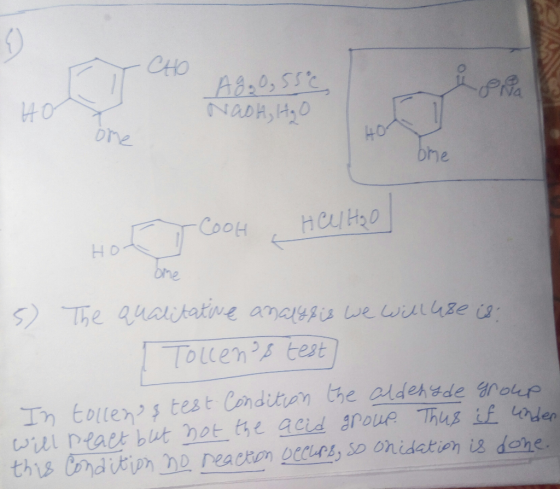
 2. Be able to decide when to use sodium borohydride and when to use lithium aluminum hydride for reducing an aldehyde. 3. If you reduce a compound containing an aldehyde, what qualitative test would you use to determine if the product is good or bad? 4. Draw the mechanism for the reduction of vanillin vanillyl alcohol. Oxidation of an Aldehyde (Vanillin III) 5. Be able to determine the oxidation of carbon in different molecules. 6. Write the mechanism for this...
This is for the Grignard Reaction laboratory. Please help me answer this question, much appreciated. 1....
This is for the Grignard Reaction laboratory. Please help me answer this question, much appreciated. 1. If a student performing Laboratory with Grignard reaction accidently used acetone as the reaction solvent instead of diethyl ether, what would the major organic product(s) be? Draw the structure of the product(s) (no mechanism necessary). b. What was the purpose of adding magnesium sulfate in this experiment? c. Grignard reagents react with both aldehyde and ketone functional groups. How do you predict the reaction...
Can you help me identify reagent (i), Compound 8 and Compound 12 in the reaction scheme?...
 Can you help me identify reagent (i), Compound 8 and
Compound 12 in the reaction scheme?
You have laboratory data on all the compounds in the
synthesis, however the amount of data available to you varies. Some
have the entirety of the spectral data, others have as little as
the elemental analysis. Use the laboratory data to help you
discover which reaction has been performed.
The lab data for Compound 8 and 12 is as
follows:
You can use any...
Can you help me identify reagent (i), Compound 8 and
Compound 12 in the reaction scheme?
You have laboratory data on all the compounds in the
synthesis, however the amount of data available to you varies. Some
have the entirety of the spectral data, others have as little as
the elemental analysis. Use the laboratory data to help you
discover which reaction has been performed.
The lab data for Compound 8 and 12 is as
follows:
You can use any...
please help with number 6! 1.(2) What is the meaning of “E” in E-stilbene? 2.(4) What...
 please help with number 6!
1.(2) What is the meaning of “E” in E-stilbene? 2.(4) What functional groups are present in E-stilbene? 3.(2) Write the reaction that occurs between E-stilbene and bromine. 4.(4) Write the mechanism for the addition of bromine to €- stilbene to give meso-stilbene dibromide via the intermediate cyclic bromonium ion. 5.(2) Which reagent, E-sitlbene or bromine, acts as the nucleophile in this reaction? Which reagent is the electrophile? 6.(4) Calculate the theoretical yield of meso-stilbene dibromide...
please help with number 6!
1.(2) What is the meaning of “E” in E-stilbene? 2.(4) What functional groups are present in E-stilbene? 3.(2) Write the reaction that occurs between E-stilbene and bromine. 4.(4) Write the mechanism for the addition of bromine to €- stilbene to give meso-stilbene dibromide via the intermediate cyclic bromonium ion. 5.(2) Which reagent, E-sitlbene or bromine, acts as the nucleophile in this reaction? Which reagent is the electrophile? 6.(4) Calculate the theoretical yield of meso-stilbene dibromide...
PRE-LAB QUIZ for EXPERIMENT 27 Name 1. In Experiment 27, a modified Perkin reaction is performed....
 PRE-LAB QUIZ for EXPERIMENT 27 Name 1. In Experiment 27, a modified Perkin reaction is performed. The Perkin reaction is a carbonyl condensation reaction that is related to the Claisen condensation and aldol condensation. In this experiment, the reactants are benzaldehyde and 3-benzoylpropionic acid with sodium acetate and acetic anhydride as catalysts. Draw the structures of these compounds in the space below. benzaldehyde 3-benzoylpropionic acid acetic anhydride 2. The first step of the reaction is the formation of the mixed...
Draw the structure of the major organic product(s) of the reaction. raw the structure of the...
 Draw the structure of the major organic product(s) of the reaction.
raw the structure of the major organic product(s) of the reaction. нзо . All carboxyl and amino groups should be drawn in the neutral form. . Draw one structure per sketcher. Add additional sketchers using the drop-down menu in the bottom right Separate multiple products using the + sign from the drop-down menu. backspace 8 9 6 5 Review Topics] Draw the structure of the major organic product(s) of...
Draw the structure of the major organic product(s) of the reaction.
raw the structure of the major organic product(s) of the reaction. нзо . All carboxyl and amino groups should be drawn in the neutral form. . Draw one structure per sketcher. Add additional sketchers using the drop-down menu in the bottom right Separate multiple products using the + sign from the drop-down menu. backspace 8 9 6 5 Review Topics] Draw the structure of the major organic product(s) of...
3. Mechanism: Draw the curved arrow mechanism for the following hydrolysis reaction, only draw the mechanism...
 3. Mechanism: Draw the curved arrow mechanism for the following hydrolysis reaction, only draw the mechanism from the starting material to the neutral functional group intermediate. Additionally, indicate what is in the final product by writing Y="appropriate atom here". Use only the reagents provided below, in your mechanism. (5 pts) excess NaOH H2O, heat HNĐ neutral functional group intermediate 9. Mechanism: Draw the curved arrow mechanism for the following reaction. Please be aware that during the mechanism you will form...
please help 12. Each reaction below is a Diels-Alder cycloaddition. Draw the major pr addition. Draw...
 please help
12. Each reaction below is a Diels-Alder cycloaddition. Draw the major pr addition. Draw the major product or the missing reactants. er of inco nation)
please help
12. Each reaction below is a Diels-Alder cycloaddition. Draw the major pr addition. Draw the major product or the missing reactants. er of inco nation)
What is the splitting and integration for the protons indicated below? triplet, 2H multiplet (5), 1H...
 What is the splitting and integration for the protons indicated below? triplet, 2H multiplet (5), 1H singlet, 1H doublet, 1H triplet, 1H NH2 OOO The integration on a 'H NMR spectra containing three peaks is as follows for a molecule with the molecular formula C6H12O; A = 18, B = 12, and C = 6.0. How many hydrogens does peak B represent? OB = 12 B = 2 B = 6 B = 6.0 B=4 Draw the structure for 2,4Z-2-bromo-4-ethyl-2,4-hexandiene....
Qualitative Analysis of Organic Compounds: Pre lab questions (5 pts) 1. (1 point) Identify the functional...
Qualitative Analysis of Organic Compounds: Pre lab questions (5 pts) 1. (1 point) Identify the functional groups based on color / odor a. Dark yellow to red color indicates that the functional group could possibly be------------- b. Fruity / Floral odor indicates that the functional group could possibly be------------- c. Fishy odor indicates that the functional group could possibly be------------- d. Sharp, biting odor indicates that the functional group could possibly be------------- 2. (0.5 pts) If a liquid is soluble...
 2. Be able to decide when to use sodium borohydride and when to use lithium aluminum hydride for reducing an aldehyde. 3. If you reduce a compound containing an aldehyde, what qualitative test would you use to determine if the product is good or bad? 4. Draw the mechanism for the reduction of vanillin vanillyl alcohol. Oxidation of an Aldehyde (Vanillin III) 5. Be able to determine the oxidation of carbon in different molecules. 6. Write the mechanism for this...
 Can you help me identify reagent (i), Compound 8 and
Compound 12 in the reaction scheme?
You have laboratory data on all the compounds in the
synthesis, however the amount of data available to you varies. Some
have the entirety of the spectral data, others have as little as
the elemental analysis. Use the laboratory data to help you
discover which reaction has been performed.
The lab data for Compound 8 and 12 is as
follows:
You can use any...
Can you help me identify reagent (i), Compound 8 and
Compound 12 in the reaction scheme?
You have laboratory data on all the compounds in the
synthesis, however the amount of data available to you varies. Some
have the entirety of the spectral data, others have as little as
the elemental analysis. Use the laboratory data to help you
discover which reaction has been performed.
The lab data for Compound 8 and 12 is as
follows:
You can use any...
 please help with number 6!
1.(2) What is the meaning of “E” in E-stilbene? 2.(4) What functional groups are present in E-stilbene? 3.(2) Write the reaction that occurs between E-stilbene and bromine. 4.(4) Write the mechanism for the addition of bromine to €- stilbene to give meso-stilbene dibromide via the intermediate cyclic bromonium ion. 5.(2) Which reagent, E-sitlbene or bromine, acts as the nucleophile in this reaction? Which reagent is the electrophile? 6.(4) Calculate the theoretical yield of meso-stilbene dibromide...
please help with number 6!
1.(2) What is the meaning of “E” in E-stilbene? 2.(4) What functional groups are present in E-stilbene? 3.(2) Write the reaction that occurs between E-stilbene and bromine. 4.(4) Write the mechanism for the addition of bromine to €- stilbene to give meso-stilbene dibromide via the intermediate cyclic bromonium ion. 5.(2) Which reagent, E-sitlbene or bromine, acts as the nucleophile in this reaction? Which reagent is the electrophile? 6.(4) Calculate the theoretical yield of meso-stilbene dibromide...
 PRE-LAB QUIZ for EXPERIMENT 27 Name 1. In Experiment 27, a modified Perkin reaction is performed. The Perkin reaction is a carbonyl condensation reaction that is related to the Claisen condensation and aldol condensation. In this experiment, the reactants are benzaldehyde and 3-benzoylpropionic acid with sodium acetate and acetic anhydride as catalysts. Draw the structures of these compounds in the space below. benzaldehyde 3-benzoylpropionic acid acetic anhydride 2. The first step of the reaction is the formation of the mixed...
 Draw the structure of the major organic product(s) of the reaction.
raw the structure of the major organic product(s) of the reaction. нзо . All carboxyl and amino groups should be drawn in the neutral form. . Draw one structure per sketcher. Add additional sketchers using the drop-down menu in the bottom right Separate multiple products using the + sign from the drop-down menu. backspace 8 9 6 5 Review Topics] Draw the structure of the major organic product(s) of...
Draw the structure of the major organic product(s) of the reaction.
raw the structure of the major organic product(s) of the reaction. нзо . All carboxyl and amino groups should be drawn in the neutral form. . Draw one structure per sketcher. Add additional sketchers using the drop-down menu in the bottom right Separate multiple products using the + sign from the drop-down menu. backspace 8 9 6 5 Review Topics] Draw the structure of the major organic product(s) of...
 3. Mechanism: Draw the curved arrow mechanism for the following hydrolysis reaction, only draw the mechanism from the starting material to the neutral functional group intermediate. Additionally, indicate what is in the final product by writing Y="appropriate atom here". Use only the reagents provided below, in your mechanism. (5 pts) excess NaOH H2O, heat HNĐ neutral functional group intermediate 9. Mechanism: Draw the curved arrow mechanism for the following reaction. Please be aware that during the mechanism you will form...
 please help
12. Each reaction below is a Diels-Alder cycloaddition. Draw the major pr addition. Draw the major product or the missing reactants. er of inco nation)
please help
12. Each reaction below is a Diels-Alder cycloaddition. Draw the major pr addition. Draw the major product or the missing reactants. er of inco nation)
 What is the splitting and integration for the protons indicated below? triplet, 2H multiplet (5), 1H singlet, 1H doublet, 1H triplet, 1H NH2 OOO The integration on a 'H NMR spectra containing three peaks is as follows for a molecule with the molecular formula C6H12O; A = 18, B = 12, and C = 6.0. How many hydrogens does peak B represent? OB = 12 B = 2 B = 6 B = 6.0 B=4 Draw the structure for 2,4Z-2-bromo-4-ethyl-2,4-hexandiene....
Most questions answered within 3 hours.
-
Where is the error in this code sequence?
String s1 = "Hello";
String s2 = "ello";...
asked 10 months ago -
Financial data for Joel de Paris, Inc., for last year
follow:
Joel de Paris, Inc.
Balance...
asked 10 months ago -
Consider this reaction:
Al2(SO4)3 (aq)+ BaCl3
(aq) Al2Cl6 (aq)- +
3BaSO4(s) . What is the...
asked 10 months ago -
Suppose that Savneet is considering increasing her
recent random sample from 20 car rentals to 40...
asked 10 months ago -
Trucks arrive at an unloading terminal at an average rate of 120
per hour.
Trucks arrive...
asked 10 months ago -
Why are methanol and ethanol completely soluble in water while
octanol is not very little soluble....
asked 10 months ago -
A facilities manager at a university reads in a research report
that the mean amount of...
asked 10 months ago -
When the CuSO4 is rehydrated by adding water to the anhydrous
compound, is this an endothermic...
asked 10 months ago -
A ray of sunlight is passing from diamond into crown glass; the
angle of incidence is...
asked 10 months ago -
A block of mass 0.249 kg is placed on top of a light, vertical
spring of...
asked 10 months ago -
how do the kidneys compensate in the presences of acidosis
a) trigger hyperventilate
b) reserve acid...
asked 10 months ago -
Question 501 pts
The rental rate of capital to the firm increases. Which of the
following...
asked 10 months ago