
Homework Answers
Here number of components are n=4, probability that a component will fail is p=0.1
X: Number of failures. Then X~ Binomial(n=4, p=0.1)
The Probability Mass Function of Binomial distribution is

1 ) The probability that none fail within a year is'

2) The probability that at least 1 fails within a year
is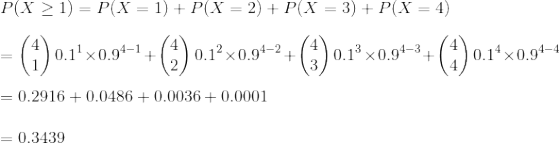
3) The probability that all fails within a year is

4) Here we use p=1-0.1=0.9 and X: Number of working components.
The probability that at least 1 works entire year is 
Add Answer to:
upposea components of system all act independently, and each fails within a year 10% of the...
Suppose 4 components of system all act independently, and each fails within a year 10% of...
 Suppose 4 components of system all act independently, and each fails within a year 10% of the time. Find the probability none fails within a year Find the probability at least one fails within a year Find the probability all fail within a year. Find the probability at least one works the entire year.
8 (10 polints) A ystem conslists of 4 components ln a eries, so the system works properly if all of the for 1- 1,2,3,4 components are functional. In other words, the system fails if and only I...
 8 (10 polints) A ystem conslists of 4 components ln a eries, so the system works properly if all of the for 1- 1,2,3,4 components are functional. In other words, the system fails if and only If at least one of its components als Suppose the probability that the component falils is less than or equal to p Flad n pper bound on the probability that the syetem fails 6. (10 points) A system consists of 4 components in a...
A system consists of three components A, B and C, which fails independently with probabilities 0.2,...
 A system consists of three components A, B and C, which fails
independently with probabilities 0.2, 03 and 0.2. Let X be the
total number of failed components.
(a) Find the probability distribution of X.
(b) What is the probability that at least one component is
working.
(c) Find E(X^3 − 1).
3. (7 points) A system consists of three components A, B and C, which fails independently with probabilities 0.2, 03 and 0.2. Let X be the total number...
A system consists of three components A, B and C, which fails
independently with probabilities 0.2, 03 and 0.2. Let X be the
total number of failed components.
(a) Find the probability distribution of X.
(b) What is the probability that at least one component is
working.
(c) Find E(X^3 − 1).
3. (7 points) A system consists of three components A, B and C, which fails independently with probabilities 0.2, 03 and 0.2. Let X be the total number...
A system consists of five components is connected in series as shown below. -1 42 43...
 A system consists of five components is connected in series as shown below. -1 42 43 44 45 As soon as one component fails, the entire system will fail. Assume that the components fail independently of one another. (a) Suppose that each of the first two components have lifetimes that are exponentially distributed with mean 107 weeks, and that each of the last three components have lifetimes that are exponentially distributed with mean 136 weeks. Find the probability that the...
An electronic control system contains 10 components that work independently of one another, and is capable...
An electronic control system contains 10 components that work independently of one another, and is capable of working normally if at most two components fail. Due to unfavorable climate conditions, each component has a failure probability of 20%. What is the probability that the system as a whole works?
An electronic system contains 10 cooling components that operate independently. The probability of each component's failure...
An electronic system contains 10 cooling components that operate independently. The probability of each component's failure is 0.2. The system will overheat if and only if at least 3 components fail. Calculate the probability that system will overheat. (Hint: You might need to use the Binomial Table)
Question 4 [20 marks] A system consists of five components in two branches as shown in...
 Question 4 [20 marks] A system consists of five components in two branches as shown in the following diagram: C-D-E- In other words, the system works if components A and B work or components C, D, and E work. Assume that the components fail independently with the following probabilities: P(A fails) = P(B fails) = 0.1 and P(C fails) = P(D fails) = P(E fails) = 0.2. (a) What is the probability that the system works? (b) Given that the...
A system consists of five identical components connected in seriesas shown:As soon as one...
 A system consists of five identical components connected in series
as shown:As soon as one components fails, the entire system will fail.
Suppose each component has a lifetime that is exponentially
distributed with ? = 0.01 and that components fail independently of one another.
Define eventsAi= {ith
component lasts at least t hours}, i = 1, . . . , 5, so that the Ais
are independent events. Let X = the time at which the system failsthat is, the...
A system consists of five identical components connected in series
as shown:As soon as one components fails, the entire system will fail.
Suppose each component has a lifetime that is exponentially
distributed with ? = 0.01 and that components fail independently of one another.
Define eventsAi= {ith
component lasts at least t hours}, i = 1, . . . , 5, so that the Ais
are independent events. Let X = the time at which the system failsthat is, the...
1. If the probability that C fails is 0.1 and the probability that D fails is 0.12,...
 1. If the probability that C fails is 0.1 and the
probability that D fails is 0.12, find the probability that the
system functions. Round the answer to four decimal places.
2. If both C and D have probability p of failing, what
must the value of p be so that the probability that the
system functions is 0.98?
3. If three components are connected in parallel, function
independently, and each has probability p of failing, what
must the value of...
1. If the probability that C fails is 0.1 and the
probability that D fails is 0.12, find the probability that the
system functions. Round the answer to four decimal places.
2. If both C and D have probability p of failing, what
must the value of p be so that the probability that the
system functions is 0.98?
3. If three components are connected in parallel, function
independently, and each has probability p of failing, what
must the value of...
Problem #7: Suppose that 26% of all steel shafts produced by a certain process are nonconforming...
 Problem #7: Suppose that 26% of all steel shafts produced by a certain process are nonconforming but can be reworked (rather than having to be scrapped). (a) In a random sample of 175 shafts, find the approximate probability that between 37 and 53 (inclusive) are nonconforming and can be reworked. (b) In a random sample of 175 shafts, find the approximate probability that at least 49 are nonconforming and can be reworked. Problem #8: A system consists of five components...
 Suppose 4 components of system all act independently, and each fails within a year 10% of the time. Find the probability none fails within a year Find the probability at least one fails within a year Find the probability all fail within a year. Find the probability at least one works the entire year.
 8 (10 polints) A ystem conslists of 4 components ln a eries, so the system works properly if all of the for 1- 1,2,3,4 components are functional. In other words, the system fails if and only If at least one of its components als Suppose the probability that the component falils is less than or equal to p Flad n pper bound on the probability that the syetem fails 6. (10 points) A system consists of 4 components in a...
 A system consists of three components A, B and C, which fails
independently with probabilities 0.2, 03 and 0.2. Let X be the
total number of failed components.
(a) Find the probability distribution of X.
(b) What is the probability that at least one component is
working.
(c) Find E(X^3 − 1).
3. (7 points) A system consists of three components A, B and C, which fails independently with probabilities 0.2, 03 and 0.2. Let X be the total number...
A system consists of three components A, B and C, which fails
independently with probabilities 0.2, 03 and 0.2. Let X be the
total number of failed components.
(a) Find the probability distribution of X.
(b) What is the probability that at least one component is
working.
(c) Find E(X^3 − 1).
3. (7 points) A system consists of three components A, B and C, which fails independently with probabilities 0.2, 03 and 0.2. Let X be the total number...
 A system consists of five components is connected in series as shown below. -1 42 43 44 45 As soon as one component fails, the entire system will fail. Assume that the components fail independently of one another. (a) Suppose that each of the first two components have lifetimes that are exponentially distributed with mean 107 weeks, and that each of the last three components have lifetimes that are exponentially distributed with mean 136 weeks. Find the probability that the...
 Question 4 [20 marks] A system consists of five components in two branches as shown in the following diagram: C-D-E- In other words, the system works if components A and B work or components C, D, and E work. Assume that the components fail independently with the following probabilities: P(A fails) = P(B fails) = 0.1 and P(C fails) = P(D fails) = P(E fails) = 0.2. (a) What is the probability that the system works? (b) Given that the...
 A system consists of five identical components connected in series
as shown:As soon as one components fails, the entire system will fail.
Suppose each component has a lifetime that is exponentially
distributed with ? = 0.01 and that components fail independently of one another.
Define eventsAi= {ith
component lasts at least t hours}, i = 1, . . . , 5, so that the Ais
are independent events. Let X = the time at which the system failsthat is, the...
A system consists of five identical components connected in series
as shown:As soon as one components fails, the entire system will fail.
Suppose each component has a lifetime that is exponentially
distributed with ? = 0.01 and that components fail independently of one another.
Define eventsAi= {ith
component lasts at least t hours}, i = 1, . . . , 5, so that the Ais
are independent events. Let X = the time at which the system failsthat is, the...
 1. If the probability that C fails is 0.1 and the
probability that D fails is 0.12, find the probability that the
system functions. Round the answer to four decimal places.
2. If both C and D have probability p of failing, what
must the value of p be so that the probability that the
system functions is 0.98?
3. If three components are connected in parallel, function
independently, and each has probability p of failing, what
must the value of...
1. If the probability that C fails is 0.1 and the
probability that D fails is 0.12, find the probability that the
system functions. Round the answer to four decimal places.
2. If both C and D have probability p of failing, what
must the value of p be so that the probability that the
system functions is 0.98?
3. If three components are connected in parallel, function
independently, and each has probability p of failing, what
must the value of...
 Problem #7: Suppose that 26% of all steel shafts produced by a certain process are nonconforming but can be reworked (rather than having to be scrapped). (a) In a random sample of 175 shafts, find the approximate probability that between 37 and 53 (inclusive) are nonconforming and can be reworked. (b) In a random sample of 175 shafts, find the approximate probability that at least 49 are nonconforming and can be reworked. Problem #8: A system consists of five components...
Most questions answered within 3 hours.
-
Where is the error in this code sequence?
String s1 = "Hello";
String s2 = "ello";...
asked 10 months ago -
Financial data for Joel de Paris, Inc., for last year
follow:
Joel de Paris, Inc.
Balance...
asked 10 months ago -
Consider this reaction:
Al2(SO4)3 (aq)+ BaCl3
(aq) Al2Cl6 (aq)- +
3BaSO4(s) . What is the...
asked 10 months ago -
Suppose that Savneet is considering increasing her
recent random sample from 20 car rentals to 40...
asked 10 months ago -
Trucks arrive at an unloading terminal at an average rate of 120
per hour.
Trucks arrive...
asked 10 months ago -
Why are methanol and ethanol completely soluble in water while
octanol is not very little soluble....
asked 10 months ago -
A facilities manager at a university reads in a research report
that the mean amount of...
asked 10 months ago -
When the CuSO4 is rehydrated by adding water to the anhydrous
compound, is this an endothermic...
asked 10 months ago -
A ray of sunlight is passing from diamond into crown glass; the
angle of incidence is...
asked 10 months ago -
A block of mass 0.249 kg is placed on top of a light, vertical
spring of...
asked 10 months ago -
how do the kidneys compensate in the presences of acidosis
a) trigger hyperventilate
b) reserve acid...
asked 10 months ago -
Question 501 pts
The rental rate of capital to the firm increases. Which of the
following...
asked 10 months ago