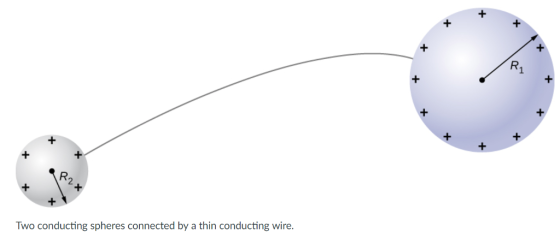
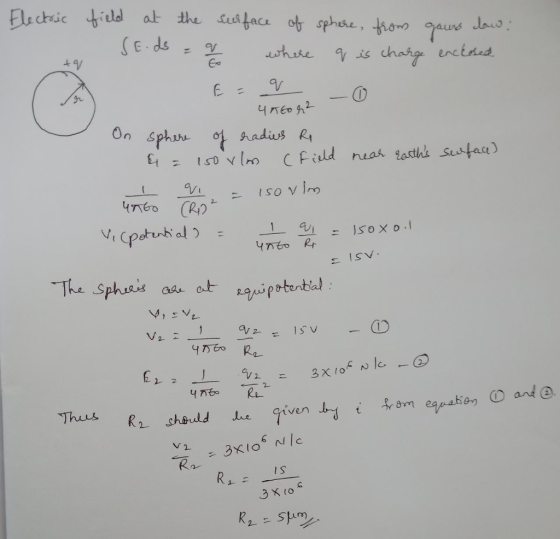
Your friend gets really excited by the idea of making a lightning rod or maybe just a sparking toy by connecting two spheres as shown in the figure below, and making R2 so small that the electric field is greater than the dielectric strength of air (3 x 10^6 N/C), just from the usual 150 V/m electric field near the surface of the Earth. If R1 is 10 cm, how small does R2 need to be, and does this seem practical? (Hint: recall the calculation for electric field at the surface of a conductor from Gauss’s Law.)
Clarification: Two isolated conducting spheres. Once connected, they must become equipotential surfaces. Use this to determine how small R2 must be in order for the electric field at the surface of the smaller sphere to exceed the dielectric strength of air.
Please show detailed work including a sketch.
Homework Answers
Add Answer to:
Your friend gets really excited by the idea of making a
lightning rod or maybe just...
Your friend gets really excited by the idea of making a lightning rod or maybe just...
 Your friend gets really excited by the idea of making
a lightning rod or maybe just a sparking toy by connecting two
spheres as shown in the figure below, and making
R2 so small that the
electric field is greater than the dielectric strength of air (3 x
106 N/C), just from the usual 150 V/m electric field
near the surface of the Earth. If R1 is 10 cm, how small does
R2 need to be, and
does this seem...
Your friend gets really excited by the idea of making
a lightning rod or maybe just a sparking toy by connecting two
spheres as shown in the figure below, and making
R2 so small that the
electric field is greater than the dielectric strength of air (3 x
106 N/C), just from the usual 150 V/m electric field
near the surface of the Earth. If R1 is 10 cm, how small does
R2 need to be, and
does this seem...
Electric potential for a continuous charge distribution: Let's consider a line of charge, of length L...
 Electric potential for a continuous charge distribution: Let's consider a line of charge, of length L having a uniform charge density lambda = 10^-6 C/m and length L=10 cm. Find the electric potential at point P, which is at a distance Z=5 cm. above the midpoint of the line. where In is the natural logarithm. Consider two charged conducting spheres, radii r1 and r2, with charges q1 and q2, respectively. The spheres are far away from each other but connected...
Select Tru or False. 1. A conducting sphere with charge Q at equilibrium has zero E...
Select Tru or False. 1. A conducting sphere with charge Q at equilibrium has zero E field inside it. The E field outside is the same as that of a point charge Q, E=keQ/r2. The potential outside it is the same as that of a point charge Q. V= keQ/r. (r is the distance to the center). The potential inside the conducting sphere is equal to the potential at its surface. V= keQ/R. (R is the radius of the sphere)...
Consider a cylindrical capacitor like that shown in Fig. 24.6. Let d = rb − ra...
 Consider a cylindrical capacitor like that shown in Fig. 24.6. Let d = rb − ra be the spacing between the inner and outer conductors. (a) Let the radii of the two conductors be only slightly different, so that d << ra. Show that the result derived in Example 24.4 (Section 24.1) for the capacitance of a cylindrical capacitor then reduces to Eq. (24.2), the equation for the capacitance of a parallel-plate capacitor, with A being the surface area of...
In your judgement, and given only the facts described in this case, should the management of...
 In your judgement, and given only the facts described in this
case, should the management of Massey energy Company be held
morally responsible for the deaths of the 29 miners? Explain in
detail.
Suppose that nothing more is learned about the explosion other
than what is described in this case. Do you think Don Blankership
should be held morally responsible for the deaths of the 29 miners?
Explain in detail.
Given only the facts described in this case, should the...
In your judgement, and given only the facts described in this
case, should the management of Massey energy Company be held
morally responsible for the deaths of the 29 miners? Explain in
detail.
Suppose that nothing more is learned about the explosion other
than what is described in this case. Do you think Don Blankership
should be held morally responsible for the deaths of the 29 miners?
Explain in detail.
Given only the facts described in this case, should the...
 Your friend gets really excited by the idea of making
a lightning rod or maybe just a sparking toy by connecting two
spheres as shown in the figure below, and making
R2 so small that the
electric field is greater than the dielectric strength of air (3 x
106 N/C), just from the usual 150 V/m electric field
near the surface of the Earth. If R1 is 10 cm, how small does
R2 need to be, and
does this seem...
Your friend gets really excited by the idea of making
a lightning rod or maybe just a sparking toy by connecting two
spheres as shown in the figure below, and making
R2 so small that the
electric field is greater than the dielectric strength of air (3 x
106 N/C), just from the usual 150 V/m electric field
near the surface of the Earth. If R1 is 10 cm, how small does
R2 need to be, and
does this seem...
 Electric potential for a continuous charge distribution: Let's consider a line of charge, of length L having a uniform charge density lambda = 10^-6 C/m and length L=10 cm. Find the electric potential at point P, which is at a distance Z=5 cm. above the midpoint of the line. where In is the natural logarithm. Consider two charged conducting spheres, radii r1 and r2, with charges q1 and q2, respectively. The spheres are far away from each other but connected...
 Consider a cylindrical capacitor like that shown in Fig. 24.6. Let d = rb − ra be the spacing between the inner and outer conductors. (a) Let the radii of the two conductors be only slightly different, so that d << ra. Show that the result derived in Example 24.4 (Section 24.1) for the capacitance of a cylindrical capacitor then reduces to Eq. (24.2), the equation for the capacitance of a parallel-plate capacitor, with A being the surface area of...
 In your judgement, and given only the facts described in this
case, should the management of Massey energy Company be held
morally responsible for the deaths of the 29 miners? Explain in
detail.
Suppose that nothing more is learned about the explosion other
than what is described in this case. Do you think Don Blankership
should be held morally responsible for the deaths of the 29 miners?
Explain in detail.
Given only the facts described in this case, should the...
In your judgement, and given only the facts described in this
case, should the management of Massey energy Company be held
morally responsible for the deaths of the 29 miners? Explain in
detail.
Suppose that nothing more is learned about the explosion other
than what is described in this case. Do you think Don Blankership
should be held morally responsible for the deaths of the 29 miners?
Explain in detail.
Given only the facts described in this case, should the...
Most questions answered within 3 hours.
-
Where is the error in this code sequence?
String s1 = "Hello";
String s2 = "ello";...
asked 10 months ago -
Financial data for Joel de Paris, Inc., for last year
follow:
Joel de Paris, Inc.
Balance...
asked 10 months ago -
Consider this reaction:
Al2(SO4)3 (aq)+ BaCl3
(aq) Al2Cl6 (aq)- +
3BaSO4(s) . What is the...
asked 10 months ago -
Suppose that Savneet is considering increasing her
recent random sample from 20 car rentals to 40...
asked 10 months ago -
Trucks arrive at an unloading terminal at an average rate of 120
per hour.
Trucks arrive...
asked 10 months ago -
Why are methanol and ethanol completely soluble in water while
octanol is not very little soluble....
asked 10 months ago -
A facilities manager at a university reads in a research report
that the mean amount of...
asked 10 months ago -
When the CuSO4 is rehydrated by adding water to the anhydrous
compound, is this an endothermic...
asked 10 months ago -
A ray of sunlight is passing from diamond into crown glass; the
angle of incidence is...
asked 10 months ago -
A block of mass 0.249 kg is placed on top of a light, vertical
spring of...
asked 10 months ago -
how do the kidneys compensate in the presences of acidosis
a) trigger hyperventilate
b) reserve acid...
asked 10 months ago -
Question 501 pts
The rental rate of capital to the firm increases. Which of the
following...
asked 10 months ago