1. What is the main difference between a bond and a share of stock? 2. What...
1. What is the main difference between a bond and a share of stock?
2. What is the advantage of issuing bonds instead of obtaining financing from the company’s owners?
3. What is a bond indenture? What provisions are usually included in it?
4. What are the contract rate and the market rate for bonds?
5. What is the reporting purpose of the statement of cash flows?
6. What are some investing activities reported on the statement of cash flows?
7. What are some financing activities reported on the statement of cash flows?
8. Explain the difference between financial reporting and financial statements.
9. What is the difference between comparative financial statements and common-size comparative statements?
Homework Answers
Answers.
1. Share of Stock means share in ownership of the entity whereas a bond is the liability of an entity to be paid in future along with the periodic interest.
2. The main advantage of issuing bond is that interest expense on such bond is deductible expense while computing entity tax liability whereas dividend is not a deductible expense.
3. A bond indenture is a legal and binding agreement between bond issuer and bond holder that specifies the terms and conditions of bond. The face value of bond, interest rate, due date of interest and maturity value of bond is included in bond indenture.
4. Contract rate means interest rate specified in face value of bond whereas market rate means interest rate prevailing with the market with similar risk factor.
5. Cash flow statement Reports cash received or paid from operating, investing and financing activities of an entity.
6. Example of Investing activities are Purchase of Plant and Machinery, Sale of Land, Purchasing of Shares of other Entity, etc
7. Example of Financing activities are Issue of Share Capital, Payment of Interest on Bond/Debentures, etc
8. Financial statements includes preparation of Balance Sheet, Profit and Loss Account, Cash Flow Statements and Notes to account whereas financial reporting is used to provide information for decision making.
9. Comparative financial statements represents financial statements for several years side by side whether in absolute value or percentages or both whereas common size comparative statements are wholly prepared in percentage terms.
Add Answer to:
1. What is the main difference between a bond and a share of
stock?
2. What...
1. what is the main difference between notes payable and bonds payable? 2. what is the...
1. what is the main difference between notes payable and bonds payable? 2. what is the main difference between a bond and a share of stock? 4. what is a bond indenture? what provisions are usually included in it? 6. what are the contract rate and the market rate for bonds? 7. what factors affect the market rates for bonds? 12. describe the debit-to-equity ratio and explain how creditors and owners would use this ratio to evalute a company's risk?
Which of the following is true regarding the statement of cash flows and IFRS? Cash and...
Which of the following is true regarding the statement of cash flows and IFRS? Cash and cash equivalents are defined differently under IFRS than under GAAP. Under IFRS most companies choose to use the direct method of reporting cash flows from operating activities. Companies preparing a complete set of financial statements under IFRS may exclude the statement of cash flows if the cash flow activity is reported in the notes to the financial statements. Under IFRS noncash investing and financing...
Reporting Land Transactions on Statement of Cash Flows On the basis of the details of the...
 Reporting Land Transactions on Statement of Cash Flows On the basis of the details of the following fixed asset account, indicate the items to be reported on the statement of cash flows: ACCOUNT Land ACCOUNT NO. Balance Date Item Debit Credit Credit Jan. 1 Mar. 12 Oct. 4 Balance Purchased for cash Sold for $204,000 Debit 1,131,000 1,504,000 1,329,000 373,000 175,000 Section of Statement of Cash Flows Item Added or Deducted Amount Mar. 12: Purchase of fixed asset Investing activities...
the statement of cash flows has an investing and financing activities section. What is the difference...
the statement of cash flows has an investing and financing activities section. What is the difference between these two sections? Can you provide an example of a financing activity or an investing activity?
1.) On the statement of cash flows prepared under the indirect method, activities that affect stockholders’...
1.) On the statement of cash flows prepared under the indirect method, activities that affect stockholders’ equity and long term debt are classified as a. financing activities b. free cash flows c. operating activities d. investing activities 2.) On the statement of cash flows prepared with the indirect method, investing activites do not include a. receipt of interest on investments b. lending money to an employee c. sale of investments that are not cash equivalents d. collection of notes receivable...
Information for XYZ Co. Account Description December 31, 2017 December 31, 2016 Assets Cash and Cash...
Information for XYZ Co. Account Description December 31, 2017 December 31, 2016 Assets Cash and Cash Equivalents 45,000 13,000 Accounts Receivable 91,000 88,000 Equipment 139,000 22,000 Accum. Deprec. – Equipment (17,000) (11,000) Total 258,000 112,000 Liabilities & Stockholders’ Equity Accounts Payable 20,000 15,000 Bonds Payable 100,000 0 Common Stock 100,000 80,000 Retained Earnings 38,000 17,000 Total 258,000 112,000 Additional Information (A) – Net income for 2017 was $44,000. (B) – New equipment was purchased in 2017 but not was sold...
Help ASAP pleasee!! Common stock transactions on the statement of cash flows Jones Industries received $800,000...
 Help ASAP pleasee!!
Common stock transactions on the statement of cash flows Jones Industries received $800,000 from issuing shares of its common stock and $700,000 from issuing bonds. During the year, Jones Industries also paid dividends of $90,000. How are the effects of these transactions reported on the statement of cash flows? Use the minus sign to indicate cash out flows, cash payments, decreases in cash and for any adjustments, if required. If a transaction has no effect on the...
Help ASAP pleasee!!
Common stock transactions on the statement of cash flows Jones Industries received $800,000 from issuing shares of its common stock and $700,000 from issuing bonds. During the year, Jones Industries also paid dividends of $90,000. How are the effects of these transactions reported on the statement of cash flows? Use the minus sign to indicate cash out flows, cash payments, decreases in cash and for any adjustments, if required. If a transaction has no effect on the...
P10-16 LO10-8 Reporting Bond Transactions on the Statement of Cash Flows Determine whether each of the...
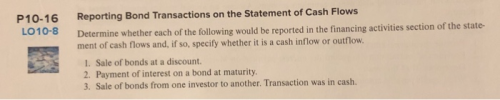 P10-16 LO10-8 Reporting Bond Transactions on the Statement of Cash Flows Determine whether each of the following would be reported in the financing activities section of the state. ment of cash flows and, if so, specify whether it is a cash inflow or outflow. 1. Sale of bonds at a discount. 2. Payment of interest on a bond at maturity. 3. Sale of bonds from one investor to another. Transaction was in cash.
18. An $80,000 bond issue priced at 97 is sold for 19. Term bonds for $78,200 are of shorter duration than serial bonds and pays interest semiannually percent, a face value of $20,000, a int...
 18. An $80,000 bond issue priced at 97 is sold for 19. Term bonds for $78,200 are of shorter duration than serial bonds and pays interest semiannually percent, a face value of $20,000, a interest paynmeterest rate of each period intive interest method of amortizing a bond discount, the bond interest expense each period increase recorded for s over the life of the bond. 22. Extra gains and losses are a component of income from operations 23. A gain on...
Help A statement of cash flows explains the differences between the beginning and ending balances of 0 Net Inc...
 Help A statement of cash flows explains the differences between the beginning and ending balances of 0 Net Income 0 0 Cash Cash equivalents, and short term mements 0 Cash and cash equivalents 0 Working on The statement of cash flows is Multiple Choice Ο Another name for the statement of financial position Ο A financial statement that is the types and amounts of assets, labies and equity of a business on a specific date Ο O A financial statement...
 Reporting Land Transactions on Statement of Cash Flows On the basis of the details of the following fixed asset account, indicate the items to be reported on the statement of cash flows: ACCOUNT Land ACCOUNT NO. Balance Date Item Debit Credit Credit Jan. 1 Mar. 12 Oct. 4 Balance Purchased for cash Sold for $204,000 Debit 1,131,000 1,504,000 1,329,000 373,000 175,000 Section of Statement of Cash Flows Item Added or Deducted Amount Mar. 12: Purchase of fixed asset Investing activities...
 Help ASAP pleasee!!
Common stock transactions on the statement of cash flows Jones Industries received $800,000 from issuing shares of its common stock and $700,000 from issuing bonds. During the year, Jones Industries also paid dividends of $90,000. How are the effects of these transactions reported on the statement of cash flows? Use the minus sign to indicate cash out flows, cash payments, decreases in cash and for any adjustments, if required. If a transaction has no effect on the...
Help ASAP pleasee!!
Common stock transactions on the statement of cash flows Jones Industries received $800,000 from issuing shares of its common stock and $700,000 from issuing bonds. During the year, Jones Industries also paid dividends of $90,000. How are the effects of these transactions reported on the statement of cash flows? Use the minus sign to indicate cash out flows, cash payments, decreases in cash and for any adjustments, if required. If a transaction has no effect on the...
 P10-16 LO10-8 Reporting Bond Transactions on the Statement of Cash Flows Determine whether each of the following would be reported in the financing activities section of the state. ment of cash flows and, if so, specify whether it is a cash inflow or outflow. 1. Sale of bonds at a discount. 2. Payment of interest on a bond at maturity. 3. Sale of bonds from one investor to another. Transaction was in cash.
 18. An $80,000 bond issue priced at 97 is sold for 19. Term bonds for $78,200 are of shorter duration than serial bonds and pays interest semiannually percent, a face value of $20,000, a interest paynmeterest rate of each period intive interest method of amortizing a bond discount, the bond interest expense each period increase recorded for s over the life of the bond. 22. Extra gains and losses are a component of income from operations 23. A gain on...
 Help A statement of cash flows explains the differences between the beginning and ending balances of 0 Net Income 0 0 Cash Cash equivalents, and short term mements 0 Cash and cash equivalents 0 Working on The statement of cash flows is Multiple Choice Ο Another name for the statement of financial position Ο A financial statement that is the types and amounts of assets, labies and equity of a business on a specific date Ο O A financial statement...
Most questions answered within 3 hours.
-
Where is the error in this code sequence?
String s1 = "Hello";
String s2 = "ello";...
asked 10 months ago -
Financial data for Joel de Paris, Inc., for last year
follow:
Joel de Paris, Inc.
Balance...
asked 10 months ago -
Consider this reaction:
Al2(SO4)3 (aq)+ BaCl3
(aq) Al2Cl6 (aq)- +
3BaSO4(s) . What is the...
asked 10 months ago -
Suppose that Savneet is considering increasing her
recent random sample from 20 car rentals to 40...
asked 10 months ago -
Trucks arrive at an unloading terminal at an average rate of 120
per hour.
Trucks arrive...
asked 10 months ago -
Why are methanol and ethanol completely soluble in water while
octanol is not very little soluble....
asked 10 months ago -
A facilities manager at a university reads in a research report
that the mean amount of...
asked 10 months ago -
When the CuSO4 is rehydrated by adding water to the anhydrous
compound, is this an endothermic...
asked 10 months ago -
A ray of sunlight is passing from diamond into crown glass; the
angle of incidence is...
asked 10 months ago -
A block of mass 0.249 kg is placed on top of a light, vertical
spring of...
asked 10 months ago -
how do the kidneys compensate in the presences of acidosis
a) trigger hyperventilate
b) reserve acid...
asked 10 months ago -
Question 501 pts
The rental rate of capital to the firm increases. Which of the
following...
asked 10 months ago