
Homework Answers
Part-a

Part-b


This force is attractive
Add Answer to:
One type of polar molecule can be represented as opposite charges of -e and te separated...
Determine the distance ro, the most stable distance for 2 like charges to be separated by...
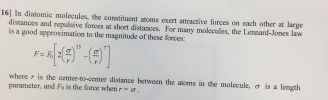 Determine the distance ro, the most stable distance
for 2 like charges to be separated by under this type of force, in
terms of ?.
161 In diatomic molecules, the constituent atoms exert attractive forces on each other at large distances and repulsive forces at short distances. For many molecules, the Lennard-Jones law is a good approximation to the magnitude of these forces 13 where r is the center-to-center distance between the atoms in the molecule, o is a length...
Determine the distance ro, the most stable distance
for 2 like charges to be separated by under this type of force, in
terms of ?.
161 In diatomic molecules, the constituent atoms exert attractive forces on each other at large distances and repulsive forces at short distances. For many molecules, the Lennard-Jones law is a good approximation to the magnitude of these forces 13 where r is the center-to-center distance between the atoms in the molecule, o is a length...
1 Dipole Forces Water is a polar molecule. It has an electric dipole strength of p...
 1 Dipole Forces Water is a polar molecule. It has an electric dipole strength of p 6-10-30 C-n This is roughly equivalent to a proton and an electron separated by a distance of d 4.101 m (about the radius of a hydrogen atom) In this problem, we will use Coulomb's law to compare the force between two protons, a proton and a water molecule, and two water molecules. Use the arrangement of the charges shown in the figure for your...
1 Dipole Forces Water is a polar molecule. It has an electric dipole strength of p-6-10-30...
 1 Dipole Forces Water is a polar molecule. It has an electric dipole strength of p-6-10-30 С . m. This is roughly equivalent to a proton and an electron separated by a distance of d- 4 10-11 m (about the radius of a hydrogen atom) In this problem, we will use Coulomb's law to compare the force between two protons, a proton and a water molecule, and two water molecules. Use the arrangement of the charges shown in the figure...
Water is a polar molecule. It has an electric dipole strength of p-6-10 30 C-n. This...
 Water is a polar molecule. It has an electric dipole strength of p-6-10 30 C-n. This is roughly equivalent to a proton and an electron separated by a distance of d 4-10-11 m (about the radius of a hydrogen atom) In this problem, we will use Coulomb's law to compare the force between two protons, a proton and a water molecule, and two water molecules. Use the arrangement of the charges shown in the figure for your calculations. (a) What...
Chapter 18, Problem 21 (Vector Drawing) The drawing shows three point charges fixed in place. The...
 Chapter 18, Problem 21 (Vector Drawing) The drawing shows three point charges fixed in place. The charge at the coordinate origin has a value of q1 but opposite signs: q2 (magnitude and direction) exerted on q1 by the other two charges. (c) If q1 had a mass of 1.50 g and it were free to move, what would be its acceleration? +8.00 HC; the other two charges have identical magnitudes, = +5.00 HC. (a) Draw the free-body diagram showing the...
kq1q2 k102f. Coulomb's Law is an empirical law. Through experiment, one can see that as the...
 kq1q2 k102f. Coulomb's Law is an empirical law. Through experiment, one can see that as the product of the two charges increases, the force between them increases. Further, if the separation between the charges increases, the Coulomb force between them decreases. But unlike the gravitational force between two masses, the Coulomb force can be either attractive or repulsive Theoretical Activi Consider the figure of a hanging charge (mass) on a string, and a prod with a charge of the same...
Suppose two children push horizontally, but in exactly opposite directions, on a third child in a...
 Suppose two children push horizontally, but in exactly opposite directions, on a third child in a wagon. The first child exerts a force of 75.0 N, the second a force of 97.0 N, friction is 12.0 N, and the mass of the third child plus wagon is 28.0 kg. (a) What is the system of interest if the acceleration of the child in the wagon is to be calculated? (Select all that apply.) the children outside the wagon the wagon...
Suppose two children push horizontally, but in exactly opposite directions, on a third child in a...
Suppose two children push horizontally, but in exactly opposite directions, on a third child in a wagon. The first child exerts a force of 75.0 N, the second a force of 94.0 N, friction is 12.0 N, and the mass of the third child plus wagon is 22.0 kg. (a) What is the system of interest if the acceleration of the child in the wagon is to be calculated? (Select all that apply.) the children outside the wagonthe child in...
(Revised on 2/4/19) 1. Two point charges, separated by 1.5 cn, have charge values of +2.0...
 (Revised on 2/4/19) 1. Two point charges, separated by 1.5 cn, have charge values of +2.0 and-4.0 pc, respectively. What is the value of the mutual force between them? (ke 8.99 x 10% Nm2/c2 (ANS:320 N) 2. Two point charges each have a value of 30.0 mC and are separated by a distance of 4.00 cm. What is the electric field midway between the two charges? (ANS: zero) 3. If О--16-nc..,. 3.0 n, and b-4.0 m, what is the magnitude...
Question1 Below is a diagram of a dipole with charges A- 4.71021 C and B-4.7 1021...
 Question1 Below is a diagram of a dipole with charges A- 4.71021 C and B-4.7 1021 Ca distance of 18 nm apart on either end of a massless rod. It is free to rotate about a fixed center point P e- Draw the electric field lines associated with this dipole. Draw equipotential lines at points Q and R. e. f. If we hold an electron (q-1.602 10-19 C) a distance of 23 nm away from point P, which side of...
 Determine the distance ro, the most stable distance
for 2 like charges to be separated by under this type of force, in
terms of ?.
161 In diatomic molecules, the constituent atoms exert attractive forces on each other at large distances and repulsive forces at short distances. For many molecules, the Lennard-Jones law is a good approximation to the magnitude of these forces 13 where r is the center-to-center distance between the atoms in the molecule, o is a length...
Determine the distance ro, the most stable distance
for 2 like charges to be separated by under this type of force, in
terms of ?.
161 In diatomic molecules, the constituent atoms exert attractive forces on each other at large distances and repulsive forces at short distances. For many molecules, the Lennard-Jones law is a good approximation to the magnitude of these forces 13 where r is the center-to-center distance between the atoms in the molecule, o is a length...
 1 Dipole Forces Water is a polar molecule. It has an electric dipole strength of p 6-10-30 C-n This is roughly equivalent to a proton and an electron separated by a distance of d 4.101 m (about the radius of a hydrogen atom) In this problem, we will use Coulomb's law to compare the force between two protons, a proton and a water molecule, and two water molecules. Use the arrangement of the charges shown in the figure for your...
 1 Dipole Forces Water is a polar molecule. It has an electric dipole strength of p-6-10-30 С . m. This is roughly equivalent to a proton and an electron separated by a distance of d- 4 10-11 m (about the radius of a hydrogen atom) In this problem, we will use Coulomb's law to compare the force between two protons, a proton and a water molecule, and two water molecules. Use the arrangement of the charges shown in the figure...
 Water is a polar molecule. It has an electric dipole strength of p-6-10 30 C-n. This is roughly equivalent to a proton and an electron separated by a distance of d 4-10-11 m (about the radius of a hydrogen atom) In this problem, we will use Coulomb's law to compare the force between two protons, a proton and a water molecule, and two water molecules. Use the arrangement of the charges shown in the figure for your calculations. (a) What...
 Chapter 18, Problem 21 (Vector Drawing) The drawing shows three point charges fixed in place. The charge at the coordinate origin has a value of q1 but opposite signs: q2 (magnitude and direction) exerted on q1 by the other two charges. (c) If q1 had a mass of 1.50 g and it were free to move, what would be its acceleration? +8.00 HC; the other two charges have identical magnitudes, = +5.00 HC. (a) Draw the free-body diagram showing the...
 kq1q2 k102f. Coulomb's Law is an empirical law. Through experiment, one can see that as the product of the two charges increases, the force between them increases. Further, if the separation between the charges increases, the Coulomb force between them decreases. But unlike the gravitational force between two masses, the Coulomb force can be either attractive or repulsive Theoretical Activi Consider the figure of a hanging charge (mass) on a string, and a prod with a charge of the same...
 Suppose two children push horizontally, but in exactly opposite directions, on a third child in a wagon. The first child exerts a force of 75.0 N, the second a force of 97.0 N, friction is 12.0 N, and the mass of the third child plus wagon is 28.0 kg. (a) What is the system of interest if the acceleration of the child in the wagon is to be calculated? (Select all that apply.) the children outside the wagon the wagon...
 (Revised on 2/4/19) 1. Two point charges, separated by 1.5 cn, have charge values of +2.0 and-4.0 pc, respectively. What is the value of the mutual force between them? (ke 8.99 x 10% Nm2/c2 (ANS:320 N) 2. Two point charges each have a value of 30.0 mC and are separated by a distance of 4.00 cm. What is the electric field midway between the two charges? (ANS: zero) 3. If О--16-nc..,. 3.0 n, and b-4.0 m, what is the magnitude...
 Question1 Below is a diagram of a dipole with charges A- 4.71021 C and B-4.7 1021 Ca distance of 18 nm apart on either end of a massless rod. It is free to rotate about a fixed center point P e- Draw the electric field lines associated with this dipole. Draw equipotential lines at points Q and R. e. f. If we hold an electron (q-1.602 10-19 C) a distance of 23 nm away from point P, which side of...
Most questions answered within 3 hours.
-
Where is the error in this code sequence?
String s1 = "Hello";
String s2 = "ello";...
asked 10 months ago -
Financial data for Joel de Paris, Inc., for last year
follow:
Joel de Paris, Inc.
Balance...
asked 10 months ago -
Consider this reaction:
Al2(SO4)3 (aq)+ BaCl3
(aq) Al2Cl6 (aq)- +
3BaSO4(s) . What is the...
asked 10 months ago -
Suppose that Savneet is considering increasing her
recent random sample from 20 car rentals to 40...
asked 10 months ago -
Trucks arrive at an unloading terminal at an average rate of 120
per hour.
Trucks arrive...
asked 10 months ago -
Why are methanol and ethanol completely soluble in water while
octanol is not very little soluble....
asked 10 months ago -
A facilities manager at a university reads in a research report
that the mean amount of...
asked 10 months ago -
When the CuSO4 is rehydrated by adding water to the anhydrous
compound, is this an endothermic...
asked 10 months ago -
A ray of sunlight is passing from diamond into crown glass; the
angle of incidence is...
asked 10 months ago -
A block of mass 0.249 kg is placed on top of a light, vertical
spring of...
asked 10 months ago -
how do the kidneys compensate in the presences of acidosis
a) trigger hyperventilate
b) reserve acid...
asked 10 months ago -
Question 501 pts
The rental rate of capital to the firm increases. Which of the
following...
asked 11 months ago