
Homework Answers
Add Answer to:
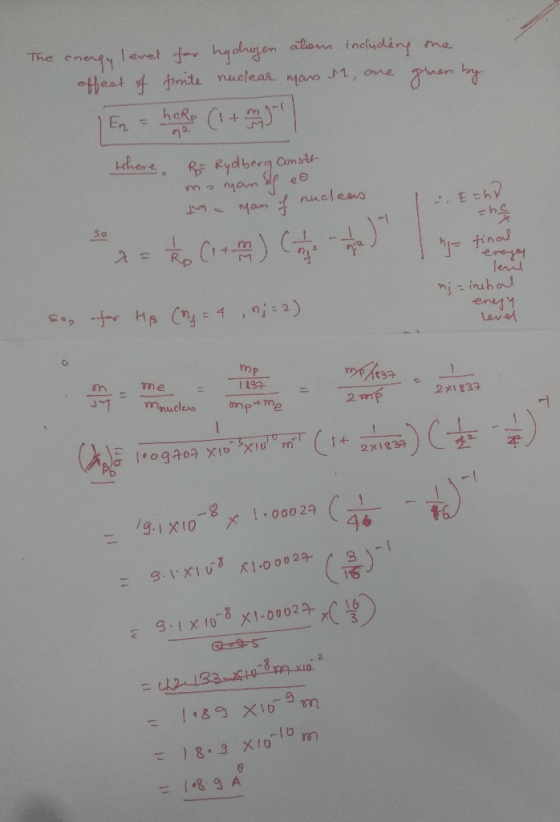
Determine the wavelength of the H line of deuterium if the H, line of hydrogen is...
The deuteron, the nucleus of deuterium (heavy hydrogen), was first recognized from the spectrum of hydrogen....
 The deuteron, the nucleus of deuterium (heavy hydrogen), was first recognized from the spectrum of hydrogen. The deuteron has a mass that is approximately twice the mass of the proton. (a) Calculate the Rydberg constant for hydrogen and for deuterium using the reduced mass μ = meMO, + me)). (Give your answers to seven significant figures.) deuterium (b) Using the result obtained in Part (a), determine the difference between the longest wavelength Balmer line of hydrogen (protium) and the longest...
Please help!! Consider the atomic spectra of hydrogen and deuterium. For atomic hydrogen, the first tran-...
 Please help!!
Consider the atomic spectra of hydrogen and deuterium. For atomic hydrogen, the first tran- sition in the Balmer series (n = 3 + 2) occurs at 656.45377 nm. At what wavelength would you expect the analogous transition to be observed for atomic deuterium? Would you be able to distinguish these two transitions with a spectrograph that has 0.01 nm resolution?
Please help!!
Consider the atomic spectra of hydrogen and deuterium. For atomic hydrogen, the first tran- sition in the Balmer series (n = 3 + 2) occurs at 656.45377 nm. At what wavelength would you expect the analogous transition to be observed for atomic deuterium? Would you be able to distinguish these two transitions with a spectrograph that has 0.01 nm resolution?
Calculate the wavelength (in nm) of the red line in the visible spectrum of excited H...
 Calculate the wavelength (in nm) of the red line in the visible
spectrum of excited H atoms using Bohr Theory.
(Question #2)
QUESTIONS 1. Determine the energy change (in Joules) associated with the transition from n = 2 to n 4 in the Hydrogen atom. AE 2.18 x 10 J nf - tests AE2.1io o.as-o.o6d5) x IDJ -/4 2. Calculate the wavelength (in nm) of the red line in the visible spectrum of excited H atoms using Bohr Theory.
Calculate the wavelength (in nm) of the red line in the visible
spectrum of excited H atoms using Bohr Theory.
(Question #2)
QUESTIONS 1. Determine the energy change (in Joules) associated with the transition from n = 2 to n 4 in the Hydrogen atom. AE 2.18 x 10 J nf - tests AE2.1io o.as-o.o6d5) x IDJ -/4 2. Calculate the wavelength (in nm) of the red line in the visible spectrum of excited H atoms using Bohr Theory.
how would you synthesize the following Deuterium (D)) is an isotope of hydrogen (H). Both D...
 how would you synthesize the following
Deuterium (D)) is an isotope of hydrogen (H). Both D and H have one proton and one electron; H has no neutrons and D has one. Consequently, D and H have nearly identical behavior. but they can be distinguished from each other experimentally due to their different masses. Therefore, replacing an H with a D in a molecule - deuterium isotope labeling-can provide valuable information about a mechanism. With this in mind, how would...
how would you synthesize the following
Deuterium (D)) is an isotope of hydrogen (H). Both D and H have one proton and one electron; H has no neutrons and D has one. Consequently, D and H have nearly identical behavior. but they can be distinguished from each other experimentally due to their different masses. Therefore, replacing an H with a D in a molecule - deuterium isotope labeling-can provide valuable information about a mechanism. With this in mind, how would...
Determine the wavelength of the line in the hydrogen atom spectrum corresponding to the n1 =...
Determine the wavelength of the line in the hydrogen atom spectrum corresponding to the n1 = 4 to n2 = 8 transition. a. 421 nm b. 1947 nm c. 725 nm d. 1058 nm e. 1632nm
What is the wavelength of the line in the Paschen series of hydrogen that is comprised...
 What is the wavelength of the line in the Paschen series of hydrogen that is comprised of transitions from the n=6 to the n = 3 levels? (R = 1.097 x 10?m-' and 1 nm= 10-ºm) 820 nm 547 nm 1 090 nm 1 200 nm 600 nm
Calculate the wavelength of the line in the absorption line spectrum of hydrogen caused by the...
Calculate the wavelength of the line in the absorption line spectrum of hydrogen caused by the transition of the electron from an orbital with =n11 to an orbital with =n12. Round your answer to 3 significant digits. E= -(Ry/n^2)
In the line spectrum of hydrogen there is a ultraviolet line with wavelength 383.5 nm. The...
In the line spectrum of hydrogen there is a ultraviolet line with wavelength 383.5 nm. The frequency of this line is ______ Hz. The energy is _____ J per photon, or ______ kJ/mol. This line corresponds to a transition from the excited state with n=9 to a lower state with n=2. The energy of the lower state is -5.45×10⁻¹⁹ J, so the energy of the excited state with n=9 must be ______ J.
What is the wavelength (in nm) of the line in the spectrum of the hydrogen atom...
What is the wavelength (in nm) of the line in the spectrum of the hydrogen atom that arises from the transition of the electron from the orbital with n =6 to the orbital with n = 3?
(a) Determine the longest wavelength in the Ly- man series (nf = 1) of hydrogen. The...
(a) Determine the longest wavelength in the Ly- man series (nf = 1) of hydrogen. The Ryd- berg constant is 1.09737 × 10⁷ m−1. Answer in units of nm. (b) Determine the shortest wavelength in the Ly- man series (nf = 1) of hydrogen. Answer in units of nm. (c) Determine the longest wavelength in the Paschen series (nf = 3) of hydrogen. Answer in units of nm. (d) Determine the shortest wavelength in the Paschen series (nf = 3)...
 The deuteron, the nucleus of deuterium (heavy hydrogen), was first recognized from the spectrum of hydrogen. The deuteron has a mass that is approximately twice the mass of the proton. (a) Calculate the Rydberg constant for hydrogen and for deuterium using the reduced mass μ = meMO, + me)). (Give your answers to seven significant figures.) deuterium (b) Using the result obtained in Part (a), determine the difference between the longest wavelength Balmer line of hydrogen (protium) and the longest...
 Please help!!
Consider the atomic spectra of hydrogen and deuterium. For atomic hydrogen, the first tran- sition in the Balmer series (n = 3 + 2) occurs at 656.45377 nm. At what wavelength would you expect the analogous transition to be observed for atomic deuterium? Would you be able to distinguish these two transitions with a spectrograph that has 0.01 nm resolution?
Please help!!
Consider the atomic spectra of hydrogen and deuterium. For atomic hydrogen, the first tran- sition in the Balmer series (n = 3 + 2) occurs at 656.45377 nm. At what wavelength would you expect the analogous transition to be observed for atomic deuterium? Would you be able to distinguish these two transitions with a spectrograph that has 0.01 nm resolution?
 Calculate the wavelength (in nm) of the red line in the visible
spectrum of excited H atoms using Bohr Theory.
(Question #2)
QUESTIONS 1. Determine the energy change (in Joules) associated with the transition from n = 2 to n 4 in the Hydrogen atom. AE 2.18 x 10 J nf - tests AE2.1io o.as-o.o6d5) x IDJ -/4 2. Calculate the wavelength (in nm) of the red line in the visible spectrum of excited H atoms using Bohr Theory.
Calculate the wavelength (in nm) of the red line in the visible
spectrum of excited H atoms using Bohr Theory.
(Question #2)
QUESTIONS 1. Determine the energy change (in Joules) associated with the transition from n = 2 to n 4 in the Hydrogen atom. AE 2.18 x 10 J nf - tests AE2.1io o.as-o.o6d5) x IDJ -/4 2. Calculate the wavelength (in nm) of the red line in the visible spectrum of excited H atoms using Bohr Theory.
 how would you synthesize the following
Deuterium (D)) is an isotope of hydrogen (H). Both D and H have one proton and one electron; H has no neutrons and D has one. Consequently, D and H have nearly identical behavior. but they can be distinguished from each other experimentally due to their different masses. Therefore, replacing an H with a D in a molecule - deuterium isotope labeling-can provide valuable information about a mechanism. With this in mind, how would...
how would you synthesize the following
Deuterium (D)) is an isotope of hydrogen (H). Both D and H have one proton and one electron; H has no neutrons and D has one. Consequently, D and H have nearly identical behavior. but they can be distinguished from each other experimentally due to their different masses. Therefore, replacing an H with a D in a molecule - deuterium isotope labeling-can provide valuable information about a mechanism. With this in mind, how would...
 What is the wavelength of the line in the Paschen series of hydrogen that is comprised of transitions from the n=6 to the n = 3 levels? (R = 1.097 x 10?m-' and 1 nm= 10-ºm) 820 nm 547 nm 1 090 nm 1 200 nm 600 nm
Most questions answered within 3 hours.
-
Where is the error in this code sequence?
String s1 = "Hello";
String s2 = "ello";...
asked 11 months ago -
Financial data for Joel de Paris, Inc., for last year
follow:
Joel de Paris, Inc.
Balance...
asked 11 months ago -
Consider this reaction:
Al2(SO4)3 (aq)+ BaCl3
(aq) Al2Cl6 (aq)- +
3BaSO4(s) . What is the...
asked 11 months ago -
Suppose that Savneet is considering increasing her
recent random sample from 20 car rentals to 40...
asked 11 months ago -
Trucks arrive at an unloading terminal at an average rate of 120
per hour.
Trucks arrive...
asked 11 months ago -
Why are methanol and ethanol completely soluble in water while
octanol is not very little soluble....
asked 11 months ago -
A facilities manager at a university reads in a research report
that the mean amount of...
asked 11 months ago -
When the CuSO4 is rehydrated by adding water to the anhydrous
compound, is this an endothermic...
asked 11 months ago -
A ray of sunlight is passing from diamond into crown glass; the
angle of incidence is...
asked 11 months ago -
A block of mass 0.249 kg is placed on top of a light, vertical
spring of...
asked 11 months ago -
how do the kidneys compensate in the presences of acidosis
a) trigger hyperventilate
b) reserve acid...
asked 11 months ago -
Question 501 pts
The rental rate of capital to the firm increases. Which of the
following...
asked 11 months ago