describe with words and pictures, how an Sn1 reaction on a chiral structure leads to a...
Homework Answers
- SN1 reaction is a nucleophilic reaction, which goes through two step mechanism. First step is formation of carbocation and second step is attack of nucleophile. The first step is slower and therefore is called rate determining step (R.D.S.).
 (R.D.S.)
 (fast)
- Rate = K[R - X]
- Partial racemization occurs due to ion pair formation.

(solvent separated
system) (some back attack
occurs before complete detachment)
In the below image you may check the stereochemistry of the chiral molecule.

As you can see, first step of the reaction is carbocation formation in which the leaving group Br leaves and then nucleophile can attack on either side on the carbocation. So, there will be two possibilities of the product formation (i.e. retention and inversion) which are shown in the image. In other words racemization has occured at the carbon center. So in SN1 reaction on one chiral centered molecule racemic mixture is obtained, but in this inversion is more than retention.
Add Answer to:
describe with words and pictures, how an Sn1 reaction on a chiral
structure leads to a...
For SN1 reactions, a chiral substrate will yield a mixture of enantiomers. In this reaction, there...
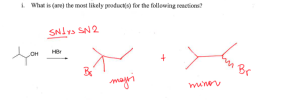 For SN1 reactions, a chiral substrate will yield a
mixture of enantiomers. In this reaction, there is only one
SN1 product given as the major product even though the
substrate is chiral. Why does the SN1 product not
exhibit stereochemistry?
i. What is (are) the most likely product(s) for the following reactions? SNdys SN 2 HBO from t he majo muno
For SN1 reactions, a chiral substrate will yield a
mixture of enantiomers. In this reaction, there is only one
SN1 product given as the major product even though the
substrate is chiral. Why does the SN1 product not
exhibit stereochemistry?
i. What is (are) the most likely product(s) for the following reactions? SNdys SN 2 HBO from t he majo muno
because it is 3° carbon shouldnt it be an SN1 reaction? even though it is in...
 because it is 3° carbon shouldnt it be an SN1 reaction? even though
it is in a aprotic solvent with a strong Nu?
Sodium Cyanide reacts with 2-bromobutane in dimethylsulfoxide to form a substitution product. Identify the configuration of the 2-bromobutane structure shown below. Then draw the substitution product formed when this enantiomer reacts with NaCN in DMSO, and indicate the stereochemistry of the product. O O (R)-2-bromobutane (S)-2-bromobutane Use wedge-and-dash bonds to show stereochemistry, and show explicitly the hydrogen...
because it is 3° carbon shouldnt it be an SN1 reaction? even though
it is in a aprotic solvent with a strong Nu?
Sodium Cyanide reacts with 2-bromobutane in dimethylsulfoxide to form a substitution product. Identify the configuration of the 2-bromobutane structure shown below. Then draw the substitution product formed when this enantiomer reacts with NaCN in DMSO, and indicate the stereochemistry of the product. O O (R)-2-bromobutane (S)-2-bromobutane Use wedge-and-dash bonds to show stereochemistry, and show explicitly the hydrogen...
Would the following SN 1 reaction produce a racemic mixture? (Hint: remember that a chiral center...
 Would the following SN 1 reaction produce a racemic mixture? (Hint: remember that a chiral center has four different groups attached) CH 3 H3C CH3CH2OH major product(s) H heat CH3 O AYes. A racemic mixture is produced O B No. A racemic mixture is not produced
9. a) Write the detailed Sn1 mechanism for the reaction of (S)-3-bromo-3-methylhexane with H20, showing curved...
 9. a) Write the detailed Sn1 mechanism for the reaction of (S)-3-bromo-3-methylhexane with H20, showing curved arrows, relevant lone pairs, formal charges, stereochemistry for each step. Include any transition states and/or intermediates, and name the product(s). b) A racemic mixture results from a reaction of the chiral alkylbromide starting material below, and acetate. at hope ܬ Write the complete mechanism for the synthesis. Show the curly arrows, relevant lone pairs and all formal charges for each step. Include any transition...
If the following reaction proceeds via an Sn1 mechanism, what's the correct curly arrow diagram for...
 If the following reaction proceeds via an Sn1 mechanism, what's the correct curly arrow diagram for the FIRST step of the process and how will the stereochemistry of the product differ from the starting material? [Hint: you're being asked about the FIRST step; the overall reaction may require only a single step, or it may require more than one step. ? Br Select one: Br O a. ; product will be the inverse stereochemistry of the starting material O b....
Quinine is a chiral molecule. This would mean that the final product derived from synthesis could...
Quinine is a chiral molecule. This would mean that the final product derived from synthesis could be a mixture of several enantiomers diastereomers (this mixture is called a racemic mixture). How would you separate the components of this racemic mixture? To answer this question, do the following: -draw the structure of quinine. -identify the # of stereogenic centers in it. -How many stereoisomers are possible for quinine? -How many enantiomeric pairs? -How many diastereomeric pairs? -How would you separate the...
5) For an Sn1 reaction what is the reaction rate order? How many steps are in...
 5) For an Sn1 reaction what is the reaction rate order? How many steps are in the reaction? Which step is the slow step and why is it the slow step? What happens if you form a chiral center when performing an Sn1 reaction?
Học CH,Co? (5)-(1-bromopropyl)benzene (t)-1-phenylpropyl acetate The reaction of the chiral alkyl halide shown below with acetate...
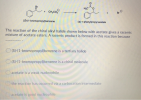 Học CH,Co? (5)-(1-bromopropyl)benzene (t)-1-phenylpropyl acetate The reaction of the chiral alkyl halide shown below with acetate gives a racemic mixture of acetate esters. A racemic product is formed in this reaction because O(S)-(1-bromopropylbenzene is a tertiary halide O(S)-(1-bromopropyl)benzene is a chiral molecule acetate is a weak nucleophile the reaction has occurred via a carbocation intermediate acetate is good nucleophile
5. What is the major product of the following reaction? Assume chiral products are racemic. ressurc...
 5. What is the major product of the following reaction? Assume
chiral products are racemic.
ressurc 5. What is the major product of the following reaction? Assume chiral products are racemic. OCH3 OCH3 a. b. H3 C. d. e. not a.-d.
5. What is the major product of the following reaction? Assume
chiral products are racemic.
ressurc 5. What is the major product of the following reaction? Assume chiral products are racemic. OCH3 OCH3 a. b. H3 C. d. e. not a.-d.
The question is about E1,E2 reaction of organic chemistry. If a product is chiral, be sure...
 The question is about E1,E2 reaction of organic chemistry. If a
product is chiral, be sure to label it as optically active or
racemic.
Predict the major deuterium containing product(s). If a product is chiral, be sure to label it as optically active or racemic. A. 1.) NaH он D3c 2.) Br Br В. KOTBU D3C racemic С. Br КОE+ D3C racemic D. NaN3 Br CD3
The question is about E1,E2 reaction of organic chemistry. If a
product is chiral, be sure to label it as optically active or
racemic.
Predict the major deuterium containing product(s). If a product is chiral, be sure to label it as optically active or racemic. A. 1.) NaH он D3c 2.) Br Br В. KOTBU D3C racemic С. Br КОE+ D3C racemic D. NaN3 Br CD3
 For SN1 reactions, a chiral substrate will yield a
mixture of enantiomers. In this reaction, there is only one
SN1 product given as the major product even though the
substrate is chiral. Why does the SN1 product not
exhibit stereochemistry?
i. What is (are) the most likely product(s) for the following reactions? SNdys SN 2 HBO from t he majo muno
For SN1 reactions, a chiral substrate will yield a
mixture of enantiomers. In this reaction, there is only one
SN1 product given as the major product even though the
substrate is chiral. Why does the SN1 product not
exhibit stereochemistry?
i. What is (are) the most likely product(s) for the following reactions? SNdys SN 2 HBO from t he majo muno
 because it is 3° carbon shouldnt it be an SN1 reaction? even though
it is in a aprotic solvent with a strong Nu?
Sodium Cyanide reacts with 2-bromobutane in dimethylsulfoxide to form a substitution product. Identify the configuration of the 2-bromobutane structure shown below. Then draw the substitution product formed when this enantiomer reacts with NaCN in DMSO, and indicate the stereochemistry of the product. O O (R)-2-bromobutane (S)-2-bromobutane Use wedge-and-dash bonds to show stereochemistry, and show explicitly the hydrogen...
because it is 3° carbon shouldnt it be an SN1 reaction? even though
it is in a aprotic solvent with a strong Nu?
Sodium Cyanide reacts with 2-bromobutane in dimethylsulfoxide to form a substitution product. Identify the configuration of the 2-bromobutane structure shown below. Then draw the substitution product formed when this enantiomer reacts with NaCN in DMSO, and indicate the stereochemistry of the product. O O (R)-2-bromobutane (S)-2-bromobutane Use wedge-and-dash bonds to show stereochemistry, and show explicitly the hydrogen...
 Would the following SN 1 reaction produce a racemic mixture? (Hint: remember that a chiral center has four different groups attached) CH 3 H3C CH3CH2OH major product(s) H heat CH3 O AYes. A racemic mixture is produced O B No. A racemic mixture is not produced
 9. a) Write the detailed Sn1 mechanism for the reaction of (S)-3-bromo-3-methylhexane with H20, showing curved arrows, relevant lone pairs, formal charges, stereochemistry for each step. Include any transition states and/or intermediates, and name the product(s). b) A racemic mixture results from a reaction of the chiral alkylbromide starting material below, and acetate. at hope ܬ Write the complete mechanism for the synthesis. Show the curly arrows, relevant lone pairs and all formal charges for each step. Include any transition...
 If the following reaction proceeds via an Sn1 mechanism, what's the correct curly arrow diagram for the FIRST step of the process and how will the stereochemistry of the product differ from the starting material? [Hint: you're being asked about the FIRST step; the overall reaction may require only a single step, or it may require more than one step. ? Br Select one: Br O a. ; product will be the inverse stereochemistry of the starting material O b....
 5) For an Sn1 reaction what is the reaction rate order? How many steps are in the reaction? Which step is the slow step and why is it the slow step? What happens if you form a chiral center when performing an Sn1 reaction?
 Học CH,Co? (5)-(1-bromopropyl)benzene (t)-1-phenylpropyl acetate The reaction of the chiral alkyl halide shown below with acetate gives a racemic mixture of acetate esters. A racemic product is formed in this reaction because O(S)-(1-bromopropylbenzene is a tertiary halide O(S)-(1-bromopropyl)benzene is a chiral molecule acetate is a weak nucleophile the reaction has occurred via a carbocation intermediate acetate is good nucleophile
 5. What is the major product of the following reaction? Assume
chiral products are racemic.
ressurc 5. What is the major product of the following reaction? Assume chiral products are racemic. OCH3 OCH3 a. b. H3 C. d. e. not a.-d.
5. What is the major product of the following reaction? Assume
chiral products are racemic.
ressurc 5. What is the major product of the following reaction? Assume chiral products are racemic. OCH3 OCH3 a. b. H3 C. d. e. not a.-d.
 The question is about E1,E2 reaction of organic chemistry. If a
product is chiral, be sure to label it as optically active or
racemic.
Predict the major deuterium containing product(s). If a product is chiral, be sure to label it as optically active or racemic. A. 1.) NaH он D3c 2.) Br Br В. KOTBU D3C racemic С. Br КОE+ D3C racemic D. NaN3 Br CD3
The question is about E1,E2 reaction of organic chemistry. If a
product is chiral, be sure to label it as optically active or
racemic.
Predict the major deuterium containing product(s). If a product is chiral, be sure to label it as optically active or racemic. A. 1.) NaH он D3c 2.) Br Br В. KOTBU D3C racemic С. Br КОE+ D3C racemic D. NaN3 Br CD3
Most questions answered within 3 hours.
-
Where is the error in this code sequence?
String s1 = "Hello";
String s2 = "ello";...
asked 11 months ago -
Financial data for Joel de Paris, Inc., for last year
follow:
Joel de Paris, Inc.
Balance...
asked 11 months ago -
Consider this reaction:
Al2(SO4)3 (aq)+ BaCl3
(aq) Al2Cl6 (aq)- +
3BaSO4(s) . What is the...
asked 11 months ago -
Suppose that Savneet is considering increasing her
recent random sample from 20 car rentals to 40...
asked 11 months ago -
Trucks arrive at an unloading terminal at an average rate of 120
per hour.
Trucks arrive...
asked 11 months ago -
Why are methanol and ethanol completely soluble in water while
octanol is not very little soluble....
asked 11 months ago -
A facilities manager at a university reads in a research report
that the mean amount of...
asked 11 months ago -
When the CuSO4 is rehydrated by adding water to the anhydrous
compound, is this an endothermic...
asked 11 months ago -
A ray of sunlight is passing from diamond into crown glass; the
angle of incidence is...
asked 11 months ago -
A block of mass 0.249 kg is placed on top of a light, vertical
spring of...
asked 11 months ago -
how do the kidneys compensate in the presences of acidosis
a) trigger hyperventilate
b) reserve acid...
asked 11 months ago -
Question 501 pts
The rental rate of capital to the firm increases. Which of the
following...
asked 11 months ago