A tire is filled with air at 13 ℃ to a gauge pressure of 220 kPa.
A tire is filled with air at 13 ℃ to a gauge pressure of 220 kPa.
Part A
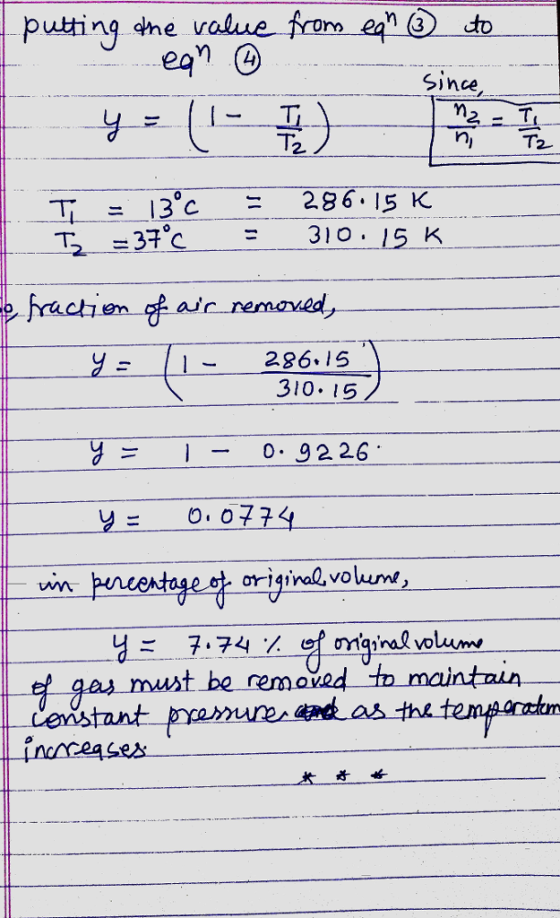
If the tire reaches a temperature of 37 ° C, what fraction of the original air must be removed if the original pressure of 220 kPa is to be maintained?
Homework Answers
This problem can be simply solved by using ideal gas relation
when pressure and volume remains constant. 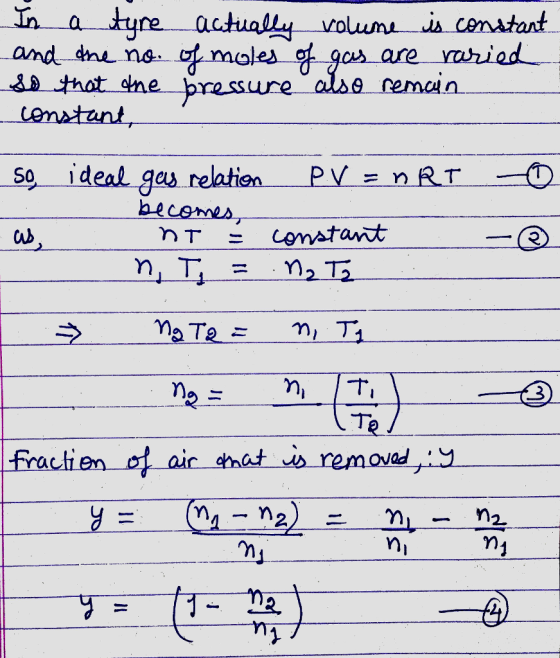
An automobile tire is filled to a gauge pressure of 185 kPa when its temperature is...
 An automobile tire is filled to a gauge pressure of 185 kPa when
its temperature is 20°C. (Gauge pressure is the difference between
the actual pressure and atmospheric pressure.) After the car has
been driven at high speeds, the tire temperature increases to
57°C.
Please help with both parts of this problem. Thanks!
An automobile tire is filled to a gauge pressure of 185 kPa when its temperature is 20°C. (Gauge pressure is the difference between the actual pressure and...
An automobile tire is filled to a gauge pressure of 185 kPa when
its temperature is 20°C. (Gauge pressure is the difference between
the actual pressure and atmospheric pressure.) After the car has
been driven at high speeds, the tire temperature increases to
57°C.
Please help with both parts of this problem. Thanks!
An automobile tire is filled to a gauge pressure of 185 kPa when its temperature is 20°C. (Gauge pressure is the difference between the actual pressure and...
1) An automobile tire is filled to a gauge pressure of 196 kPa when its temperature...
1) An automobile tire is filled to a gauge pressure of 196 kPa when its temperature is 20°C. (Gauge pressure is the difference between the actual pressure and atmospheric pressure.) After the car has been driven at high speeds, the tire temperature increases to 51°C. (a) Assuming that the volume of the tire does not change, and that air behaves as an ideal gas, find the gauge pressure of the air in the tire. (b) Calculate the gauge pressure if...
_______ Q2) 2) An automobile tire is filled to a gauge pressure of 196 kPa when...
 _______
Q2)
2) An automobile tire is filled to a gauge pressure of 196 kPa
when its temperature is 20°C. (Gauge pressure is the difference
between the actual pressure and atmospheric pressure.) After the
car has been driven at high speeds, the tire temperature increases
to 51°C.
(a) Assuming that the volume of the tire does not change, and
that air behaves as an ideal gas, find the gauge pressure of the
air in the tire.
(b) Calculate the gauge...
_______
Q2)
2) An automobile tire is filled to a gauge pressure of 196 kPa
when its temperature is 20°C. (Gauge pressure is the difference
between the actual pressure and atmospheric pressure.) After the
car has been driven at high speeds, the tire temperature increases
to 51°C.
(a) Assuming that the volume of the tire does not change, and
that air behaves as an ideal gas, find the gauge pressure of the
air in the tire.
(b) Calculate the gauge...
14. An automobile tire is inflated to a gauge pressure of 207 kPa (30 lb/in.2) at a time when the surrounding pressure is 1 atm (101.3 kPa) and the temperature is 25°C After the car is driven, th...
 14. An automobile tire is inflated to a gauge pressure of 207 kPa (30 lb/in.2) at a time when the surrounding pressure is 1 atm (101.3 kPa) and the temperature is 25°C After the car is driven, the temperature of the air in the tire increases to 40°C. Assuming the volume changes only slightly, what will be the new gauge pressure in the tire? d) An oxygen tank with an internal volume of 20 liters is filled with oxygen under...
Air is pumped into a bicycle tire. The 14 moles of air initially in the tire have a gauge pressure of 3 atm
Air is pumped into a bicycle tire. The 14 moles of air initially in the tire have a gauge pressure of 3 atm. How many moles of air must be pumped into the tire in order to raise the gauge pressure to 4 atm? Assume that the volume and temperature of the air inside the tire are approximately constant.
1. The pressure in an automobile tire depends on the temperature of the air in the...
 1. The pressure in an automobile tire depends on the temperature of the air in the tire. When the air temperature is 25C, the pressure gage reads 210 kPa. If the volume of the tire is 0.025 m determine the pressure rise in the tire when the air temperature in the tire rises to S0C. Also, determine the amount of air that must be bled off to restore pressure to its original value at this temperature. Assume the atmospheric pressure...
An automobile tire has a volume of 1.64x10⁻²m3 and contains air at a gauge pressure of...
An automobile tire has a volume of 1.64x10⁻²m3 and contains air at a gauge pressure of 165 KPa when the temperature is 0.00ºC. Assume atmospheric pressure is 1.013x10⁵ Pa Determine the number of molecules of gas in the tire
(a) A truck tire at rest and at a temperature of 7.00°C has a gauge pressure...
 (a) A truck tire at rest and at a temperature of 7.00°C has a gauge pressure of 3.80 atm. When the truck is moving, the temperature of the rolling tire rises to 45.0°C. If the volume of the tire does not change, what is the gauge pressure (in atm) in the tire at the higher temperature? (Round your answer to at least one decimal place.) atm (b) What If? If the tire fails when inflated to a maximum gauge pressure...
Your tire pressure gauge indicates that the pressure in your cold tires is 250 kPa on...
Your tire pressure gauge indicates that the pressure in your cold tires is 250 kPa on a mountain at an elevation of 3500 m. (a) What is the absolute pressure in your tires? (b) After your drive down to sea level, your tires have warmed to 25 C. What does your tire pressure gauge indicate now? assume standard atmospheric conditions
The air pressure inside the tube of a car tire is 320 kPa at a temperature...
The air pressure inside the tube of a car tire is 320 kPa at a temperature of 12.0 °C. What is the pressure of the air, if the temperature of the tire increases to 60.5 °C? Assume that the volume of the tube doesn't change. What is the air pressure inside the tube, if the volume of the tube is not constant, but it increases from 23.7 l to 24.4 l during the warming process described above?
 An automobile tire is filled to a gauge pressure of 185 kPa when
its temperature is 20°C. (Gauge pressure is the difference between
the actual pressure and atmospheric pressure.) After the car has
been driven at high speeds, the tire temperature increases to
57°C.
Please help with both parts of this problem. Thanks!
An automobile tire is filled to a gauge pressure of 185 kPa when its temperature is 20°C. (Gauge pressure is the difference between the actual pressure and...
An automobile tire is filled to a gauge pressure of 185 kPa when
its temperature is 20°C. (Gauge pressure is the difference between
the actual pressure and atmospheric pressure.) After the car has
been driven at high speeds, the tire temperature increases to
57°C.
Please help with both parts of this problem. Thanks!
An automobile tire is filled to a gauge pressure of 185 kPa when its temperature is 20°C. (Gauge pressure is the difference between the actual pressure and...
 _______
Q2)
2) An automobile tire is filled to a gauge pressure of 196 kPa
when its temperature is 20°C. (Gauge pressure is the difference
between the actual pressure and atmospheric pressure.) After the
car has been driven at high speeds, the tire temperature increases
to 51°C.
(a) Assuming that the volume of the tire does not change, and
that air behaves as an ideal gas, find the gauge pressure of the
air in the tire.
(b) Calculate the gauge...
_______
Q2)
2) An automobile tire is filled to a gauge pressure of 196 kPa
when its temperature is 20°C. (Gauge pressure is the difference
between the actual pressure and atmospheric pressure.) After the
car has been driven at high speeds, the tire temperature increases
to 51°C.
(a) Assuming that the volume of the tire does not change, and
that air behaves as an ideal gas, find the gauge pressure of the
air in the tire.
(b) Calculate the gauge...
 14. An automobile tire is inflated to a gauge pressure of 207 kPa (30 lb/in.2) at a time when the surrounding pressure is 1 atm (101.3 kPa) and the temperature is 25°C After the car is driven, the temperature of the air in the tire increases to 40°C. Assuming the volume changes only slightly, what will be the new gauge pressure in the tire? d) An oxygen tank with an internal volume of 20 liters is filled with oxygen under...
 1. The pressure in an automobile tire depends on the temperature of the air in the tire. When the air temperature is 25C, the pressure gage reads 210 kPa. If the volume of the tire is 0.025 m determine the pressure rise in the tire when the air temperature in the tire rises to S0C. Also, determine the amount of air that must be bled off to restore pressure to its original value at this temperature. Assume the atmospheric pressure...
 (a) A truck tire at rest and at a temperature of 7.00°C has a gauge pressure of 3.80 atm. When the truck is moving, the temperature of the rolling tire rises to 45.0°C. If the volume of the tire does not change, what is the gauge pressure (in atm) in the tire at the higher temperature? (Round your answer to at least one decimal place.) atm (b) What If? If the tire fails when inflated to a maximum gauge pressure...
Most questions answered within 3 hours.
-
Where is the error in this code sequence?
String s1 = "Hello";
String s2 = "ello";...
asked 11 months ago -
Financial data for Joel de Paris, Inc., for last year
follow:
Joel de Paris, Inc.
Balance...
asked 11 months ago -
Consider this reaction:
Al2(SO4)3 (aq)+ BaCl3
(aq) Al2Cl6 (aq)- +
3BaSO4(s) . What is the...
asked 11 months ago -
Suppose that Savneet is considering increasing her
recent random sample from 20 car rentals to 40...
asked 11 months ago -
Trucks arrive at an unloading terminal at an average rate of 120
per hour.
Trucks arrive...
asked 11 months ago -
Why are methanol and ethanol completely soluble in water while
octanol is not very little soluble....
asked 11 months ago -
A facilities manager at a university reads in a research report
that the mean amount of...
asked 11 months ago -
When the CuSO4 is rehydrated by adding water to the anhydrous
compound, is this an endothermic...
asked 11 months ago -
A ray of sunlight is passing from diamond into crown glass; the
angle of incidence is...
asked 11 months ago -
A block of mass 0.249 kg is placed on top of a light, vertical
spring of...
asked 11 months ago -
how do the kidneys compensate in the presences of acidosis
a) trigger hyperventilate
b) reserve acid...
asked 11 months ago -
Question 501 pts
The rental rate of capital to the firm increases. Which of the
following...
asked 11 months ago