
Homework Answers
Add Answer to:
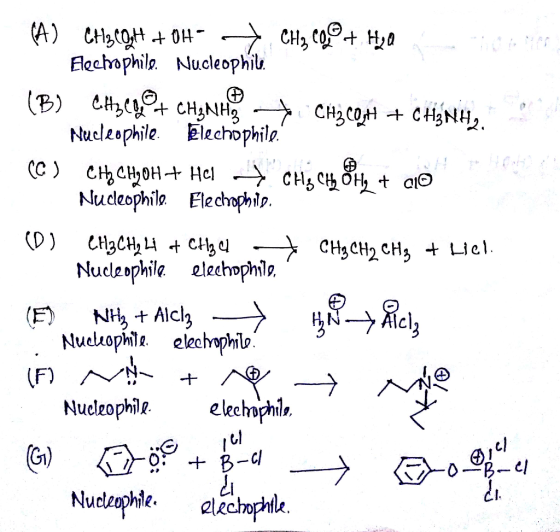
4. Complete the following reactions (use curved arrows to show the flow of electron pairs in...
Answer Questions 3 & 4 please Rank each of the following sets of compounds in order...
 Answer Questions 3 & 4 please
Rank each of the following sets of compounds in order of increase acidity A (a) CH4 (b) CHCI; (c) CH3CI (d) CH2Cl2 CI B (a) OH (b) (c) OH ОН (а) (b) OH 4. Complete the following reactions (use curved arrows to show the flow of electron pairs in each reaction) and label the reagent that acts as a nucleophile and the one that acts as electrophile. If any. A CH3CO2H + OH- B...
Answer Questions 3 & 4 please
Rank each of the following sets of compounds in order of increase acidity A (a) CH4 (b) CHCI; (c) CH3CI (d) CH2Cl2 CI B (a) OH (b) (c) OH ОН (а) (b) OH 4. Complete the following reactions (use curved arrows to show the flow of electron pairs in each reaction) and label the reagent that acts as a nucleophile and the one that acts as electrophile. If any. A CH3CO2H + OH- B...
12. Use curved arrows to show the movement of electron pairs as the reactions proceed from...
 12. Use curved arrows to show the movement of electron pairs as the reactions proceed from left to right. (15 pts). a. H.C-S-CH, + BF, = S (H,C),S+-BF, b. CH,0 + CH,SH - CH,OH + CH,S. "Hc L CH + Hot - Hot i & Chcąc + H = CHCECCHO- H.Cach, + HCI = H,C-CH+ + Ci
Add bonds, nonbonding electron pairs (lone pairs), and curved arrows where indicated. Complete the electron -...
 Add bonds, nonbonding electron pairs (lone pairs), and curved
arrows where indicated.
Complete the electron - pushing mechanism for the following decarboxylation reaction. Add bonds, nonbonding electron pairs (lone pairs), and curved arrows where indicated.
Add bonds, nonbonding electron pairs (lone pairs), and curved
arrows where indicated.
Complete the electron - pushing mechanism for the following decarboxylation reaction. Add bonds, nonbonding electron pairs (lone pairs), and curved arrows where indicated.
2.11 Complete a net ionic equation for each proton-transfer reaction, using curved arrows to show the...
 2.11 Complete a net ionic equation for each proton-transfer reaction, using curved arrows to show the flow of electron pairs in each reaction. In addition, write Lewis structures for all starting materials and products. Label the original acid and its conjugate base; label the original base and its conjugate acid. If you are uncertain about which substance in each equa- tion is the proton donor, refer to Table 2.2 for the pk, values of proton acids. (See Examples 2.3, 2.5)...
2. Suggest reasonable mechanisms for each of the following reactions. Use curved arrows to show electron...
 2. Suggest reasonable mechanisms for each of the following reactions. Use curved arrows to show electron flow. (6) CH, + H2O HO (mixture of stereoisomers) -CH OH
3. Show the complete mechanism for the following nucleophilic aromatic substitution reaction. Use curved arrows to...
 3. Show the complete mechanism for the following nucleophilic aromatic substitution reaction. Use curved arrows to indicate the direction of electron flow. Cl OH KOH + KCI NE 0
Show curved arrows to indicate the flow of electrons. Show appropriate charges and/or lone electron pairs...
 Show curved arrows to indicate the flow of electrons. Show
appropriate charges and/or lone electron pairs to initiate electron
movement. Show any bonds that must be explicitly drawn when
transferring bonding electrons.
KOCN HNCO ОН OK
Show curved arrows to indicate the flow of electrons. Show
appropriate charges and/or lone electron pairs to initiate electron
movement. Show any bonds that must be explicitly drawn when
transferring bonding electrons.
KOCN HNCO ОН OK
Provide a detailed mechanism including curved arrows showing including curved arrows showing electron flow, intermediate structures,...
 Provide a detailed mechanism including curved arrows showing including curved arrows showing electron flow, intermediate structures, formal charges, and reaction arrows. Be su Charges, and reaction arrows. Be sure to show all relevant bonds. Then, answer the associated question. (8 points) Me Me Me Me I TOU VYY 1. NaOH, H2O 2. H2O, HCI Mon ATMe Melanie OH CO2H Mé meste amooodsam slupent This reaction is often in competition with the Aldol processes. Why is this ring contraction favored over...
12. Use curved arrows to show the movement of electron pairs as the reactions proceed from...
 12. Use curved arrows to show the movement of electron pairs as the reactions proceed from left to right. (15 pts). aH,C-S-CH,BF, (H,C)S-BF, b. снHо- CH,SH CH,S снон н C. н.о + H,O нс "сн, нс сн, d. CH,CECCH,O сH,CEC е. н.с-сн, + CI + Hа нс-сн,
Give TWO examples of an E2 reaction. Use curved arrows to show electron flow involved in...
 Give TWO examples of an E2 reaction. Use curved arrows to show electron flow involved in the mechanism of reaction. Name ALL molecules involved in each reaction. Outline the mechanism for the E2 elimination of 3-bromopentane with sodium ethoxide. Show the Lewis structure for all molecules and use curved arrows to show electron flow.
 Answer Questions 3 & 4 please
Rank each of the following sets of compounds in order of increase acidity A (a) CH4 (b) CHCI; (c) CH3CI (d) CH2Cl2 CI B (a) OH (b) (c) OH ОН (а) (b) OH 4. Complete the following reactions (use curved arrows to show the flow of electron pairs in each reaction) and label the reagent that acts as a nucleophile and the one that acts as electrophile. If any. A CH3CO2H + OH- B...
Answer Questions 3 & 4 please
Rank each of the following sets of compounds in order of increase acidity A (a) CH4 (b) CHCI; (c) CH3CI (d) CH2Cl2 CI B (a) OH (b) (c) OH ОН (а) (b) OH 4. Complete the following reactions (use curved arrows to show the flow of electron pairs in each reaction) and label the reagent that acts as a nucleophile and the one that acts as electrophile. If any. A CH3CO2H + OH- B...
 12. Use curved arrows to show the movement of electron pairs as the reactions proceed from left to right. (15 pts). a. H.C-S-CH, + BF, = S (H,C),S+-BF, b. CH,0 + CH,SH - CH,OH + CH,S. "Hc L CH + Hot - Hot i & Chcąc + H = CHCECCHO- H.Cach, + HCI = H,C-CH+ + Ci
 Add bonds, nonbonding electron pairs (lone pairs), and curved
arrows where indicated.
Complete the electron - pushing mechanism for the following decarboxylation reaction. Add bonds, nonbonding electron pairs (lone pairs), and curved arrows where indicated.
Add bonds, nonbonding electron pairs (lone pairs), and curved
arrows where indicated.
Complete the electron - pushing mechanism for the following decarboxylation reaction. Add bonds, nonbonding electron pairs (lone pairs), and curved arrows where indicated.
 2.11 Complete a net ionic equation for each proton-transfer reaction, using curved arrows to show the flow of electron pairs in each reaction. In addition, write Lewis structures for all starting materials and products. Label the original acid and its conjugate base; label the original base and its conjugate acid. If you are uncertain about which substance in each equa- tion is the proton donor, refer to Table 2.2 for the pk, values of proton acids. (See Examples 2.3, 2.5)...
 2. Suggest reasonable mechanisms for each of the following reactions. Use curved arrows to show electron flow. (6) CH, + H2O HO (mixture of stereoisomers) -CH OH
 3. Show the complete mechanism for the following nucleophilic aromatic substitution reaction. Use curved arrows to indicate the direction of electron flow. Cl OH KOH + KCI NE 0
 Show curved arrows to indicate the flow of electrons. Show
appropriate charges and/or lone electron pairs to initiate electron
movement. Show any bonds that must be explicitly drawn when
transferring bonding electrons.
KOCN HNCO ОН OK
Show curved arrows to indicate the flow of electrons. Show
appropriate charges and/or lone electron pairs to initiate electron
movement. Show any bonds that must be explicitly drawn when
transferring bonding electrons.
KOCN HNCO ОН OK
 Provide a detailed mechanism including curved arrows showing including curved arrows showing electron flow, intermediate structures, formal charges, and reaction arrows. Be su Charges, and reaction arrows. Be sure to show all relevant bonds. Then, answer the associated question. (8 points) Me Me Me Me I TOU VYY 1. NaOH, H2O 2. H2O, HCI Mon ATMe Melanie OH CO2H Mé meste amooodsam slupent This reaction is often in competition with the Aldol processes. Why is this ring contraction favored over...
 12. Use curved arrows to show the movement of electron pairs as the reactions proceed from left to right. (15 pts). aH,C-S-CH,BF, (H,C)S-BF, b. снHо- CH,SH CH,S снон н C. н.о + H,O нс "сн, нс сн, d. CH,CECCH,O сH,CEC е. н.с-сн, + CI + Hа нс-сн,
 Give TWO examples of an E2 reaction. Use curved arrows to show electron flow involved in the mechanism of reaction. Name ALL molecules involved in each reaction. Outline the mechanism for the E2 elimination of 3-bromopentane with sodium ethoxide. Show the Lewis structure for all molecules and use curved arrows to show electron flow.
Most questions answered within 3 hours.
-
Where is the error in this code sequence?
String s1 = "Hello";
String s2 = "ello";...
asked 10 months ago -
Financial data for Joel de Paris, Inc., for last year
follow:
Joel de Paris, Inc.
Balance...
asked 10 months ago -
Consider this reaction:
Al2(SO4)3 (aq)+ BaCl3
(aq) Al2Cl6 (aq)- +
3BaSO4(s) . What is the...
asked 10 months ago -
Suppose that Savneet is considering increasing her
recent random sample from 20 car rentals to 40...
asked 10 months ago -
Trucks arrive at an unloading terminal at an average rate of 120
per hour.
Trucks arrive...
asked 10 months ago -
Why are methanol and ethanol completely soluble in water while
octanol is not very little soluble....
asked 10 months ago -
A facilities manager at a university reads in a research report
that the mean amount of...
asked 10 months ago -
When the CuSO4 is rehydrated by adding water to the anhydrous
compound, is this an endothermic...
asked 10 months ago -
A ray of sunlight is passing from diamond into crown glass; the
angle of incidence is...
asked 10 months ago -
A block of mass 0.249 kg is placed on top of a light, vertical
spring of...
asked 10 months ago -
how do the kidneys compensate in the presences of acidosis
a) trigger hyperventilate
b) reserve acid...
asked 10 months ago -
Question 501 pts
The rental rate of capital to the firm increases. Which of the
following...
asked 10 months ago