what is the relationship between the force and distance as stated in Coulomb’s Law? Explanation
what is the relationship between the force and distance as stated in Coulomb’s Law? Explanation
Homework Answers

Add Answer to:
what is the relationship between the force and distance as
stated in Coulomb’s Law? Explanation
Coulomb’s law says that the electric force F= k1 k2 / d2 . If the charge...
Coulomb’s law says that the electric force F= k1 k2 / d2 . If the charge of each particle tripled and the distance also tripled, how would the electrostatic force between the particles change? a. 3X greater b. 3X less c. 9X greater d. no change
Coulomb’s Law describes the force between two (and only two!) charged objects. Suppose Object 1 has...
Coulomb’s Law describes the force between two (and only two!) charged objects. Suppose Object 1 has a charge of +2.71 μC and Object 2 has a charge of +18.5 μC. Object 2 is located a distance of 0.04480 m to the right of Object 1 (Yes — please break down and draw a quick sketch!). What is the magnitude and direction of the electrical force on Object 2 due to Object 1? What is the magnitude and direction of the...
Coulomb’s Law Two protons are separated by a distance of 3.00 x 10^-10 meters and fixed...
 Coulomb’s Law
Two protons are separated by a distance of 3.00 x 10^-10 meters
and fixed in place. a) What is the magnitude of the repulsive
electric force between the protons? b) What is the magnitude of the
attractive gravitational force between the protons? c) Is there any
value of the distance between the protons (besides infinity) for
which the gravitational force is equal to the electric force? If
yes, what is the distance. If no, explain why. d) Assume...
Coulomb’s Law
Two protons are separated by a distance of 3.00 x 10^-10 meters
and fixed in place. a) What is the magnitude of the repulsive
electric force between the protons? b) What is the magnitude of the
attractive gravitational force between the protons? c) Is there any
value of the distance between the protons (besides infinity) for
which the gravitational force is equal to the electric force? If
yes, what is the distance. If no, explain why. d) Assume...
Adding to Newton’s law of universal gravitation, the gravitational force between two masses is proportional to...
Adding to Newton’s law of universal gravitation, the gravitational force between two masses is proportional to 1/r^2, where r is the distance between the masses. Surprisingly, the electric force between two electric charges is also proportional to 1/r^2, where r is the distance between the electric charges. (Coulomb’s law) These facts are called the “inverse-square laws” -> Now give “your answer” to the question: Why (or How) are these forces proportional to 1/r^2 (not 1/r, 1/r^3, 1/r^100, etc)?
Two charges attract each other with a force of 4.0 N. What will be the force...
Two charges attract each other with a force of 4.0 N. What will be the force if the distance between them is reduced by a factor one-ninth? Show how you get this from Coulomb’s Law.
ow let’s apply Coulomb’s law and the superposition principle tocalculate the force on a point...
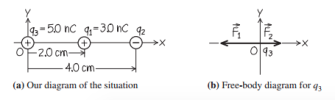 ow let’s apply Coulomb’s law and the superposition principle to
calculate the force on a point charge due to the presence of other
nearby charges. Two point charges are located on the positive x
axis of a coordinate system. Charge q1=3.0nC is 2.0 cm from the
origin, and charge q2 = -7.0 nC is 4.0 cm from the origin.1. What is the total force (magnitude and direction) exerted by
these two charges on a third point charge q3=5.0nC located at...
ow let’s apply Coulomb’s law and the superposition principle to
calculate the force on a point charge due to the presence of other
nearby charges. Two point charges are located on the positive x
axis of a coordinate system. Charge q1=3.0nC is 2.0 cm from the
origin, and charge q2 = -7.0 nC is 4.0 cm from the origin.1. What is the total force (magnitude and direction) exerted by
these two charges on a third point charge q3=5.0nC located at...
Coulomb’s Law and Electric field analysis
 Two positive point charges with equal magnitudes q1=q2=2.0 μC interact with a third point charge q= 4.0 μC.A. Using the Coulomb’s Law, find the F13 and F23B. Find the x and y component using the component methodC. Find the magnitude and direction of the net force on q3.
Coulomb’s Law A massless sphere of charge q1 = 0.640 µC is at the end of...
 Coulomb’s Law
A massless sphere of charge q1 = 0.640 µC is at the end of a
spring in equilibrium as shown below in figure a. When a charge q2
= -0.410 µC is held beneath the positively charged sphere as shown
in figure b, the spring stretches by a distance d = 3.60 cm from
its position in figure a. When equilibrium is reestablished, the
distance r between the charges is 5.20 cm. What is the spring
constant of...
Coulomb’s Law
A massless sphere of charge q1 = 0.640 µC is at the end of a
spring in equilibrium as shown below in figure a. When a charge q2
= -0.410 µC is held beneath the positively charged sphere as shown
in figure b, the spring stretches by a distance d = 3.60 cm from
its position in figure a. When equilibrium is reestablished, the
distance r between the charges is 5.20 cm. What is the spring
constant of...
According to Coulomb’s Law, a charge Q sitting at the origin will exert a force kQq/r2...
According to Coulomb’s Law, a charge Q sitting at the origin will exert a force kQq/r2 on a point charge q located at r, with the force along the r direction. The electric field E at r due to Q is equal to the force experienced by a unit charge (i.e., q = 1 unit) at r. Based on these two pieces of information, one can conclude that the magnitude of E at r is Question 1 options: 1) kq/r2. 2) kQ/r....
Where q1 and q2 is the amount of charge in Coulombs r is the distance in...
Where q1 and q2 is the amount of charge in Coulombs r is the distance in meters between the charges k is the Coulomb’s Law constant = 9×10⁹ N•m2/C2 or 9,000,000,000 N•m2/C2 1. What is the force between two identical positive charges with a magnitude of 6 x 10⁻⁶ coulombs each and separated by 1m? (Related to chapter 23) Ohm's Law deals with the relationship between voltage (V) and current (I) and resistance (R). This relationship gives Ohm's Law. V...
 Coulomb’s Law
Two protons are separated by a distance of 3.00 x 10^-10 meters
and fixed in place. a) What is the magnitude of the repulsive
electric force between the protons? b) What is the magnitude of the
attractive gravitational force between the protons? c) Is there any
value of the distance between the protons (besides infinity) for
which the gravitational force is equal to the electric force? If
yes, what is the distance. If no, explain why. d) Assume...
Coulomb’s Law
Two protons are separated by a distance of 3.00 x 10^-10 meters
and fixed in place. a) What is the magnitude of the repulsive
electric force between the protons? b) What is the magnitude of the
attractive gravitational force between the protons? c) Is there any
value of the distance between the protons (besides infinity) for
which the gravitational force is equal to the electric force? If
yes, what is the distance. If no, explain why. d) Assume...
 ow let’s apply Coulomb’s law and the superposition principle to
calculate the force on a point charge due to the presence of other
nearby charges. Two point charges are located on the positive x
axis of a coordinate system. Charge q1=3.0nC is 2.0 cm from the
origin, and charge q2 = -7.0 nC is 4.0 cm from the origin.1. What is the total force (magnitude and direction) exerted by
these two charges on a third point charge q3=5.0nC located at...
ow let’s apply Coulomb’s law and the superposition principle to
calculate the force on a point charge due to the presence of other
nearby charges. Two point charges are located on the positive x
axis of a coordinate system. Charge q1=3.0nC is 2.0 cm from the
origin, and charge q2 = -7.0 nC is 4.0 cm from the origin.1. What is the total force (magnitude and direction) exerted by
these two charges on a third point charge q3=5.0nC located at...
 Coulomb’s Law
A massless sphere of charge q1 = 0.640 µC is at the end of a
spring in equilibrium as shown below in figure a. When a charge q2
= -0.410 µC is held beneath the positively charged sphere as shown
in figure b, the spring stretches by a distance d = 3.60 cm from
its position in figure a. When equilibrium is reestablished, the
distance r between the charges is 5.20 cm. What is the spring
constant of...
Coulomb’s Law
A massless sphere of charge q1 = 0.640 µC is at the end of a
spring in equilibrium as shown below in figure a. When a charge q2
= -0.410 µC is held beneath the positively charged sphere as shown
in figure b, the spring stretches by a distance d = 3.60 cm from
its position in figure a. When equilibrium is reestablished, the
distance r between the charges is 5.20 cm. What is the spring
constant of...
Most questions answered within 3 hours.
-
Where is the error in this code sequence?
String s1 = "Hello";
String s2 = "ello";...
asked 10 months ago -
Financial data for Joel de Paris, Inc., for last year
follow:
Joel de Paris, Inc.
Balance...
asked 10 months ago -
Consider this reaction:
Al2(SO4)3 (aq)+ BaCl3
(aq) Al2Cl6 (aq)- +
3BaSO4(s) . What is the...
asked 10 months ago -
Suppose that Savneet is considering increasing her
recent random sample from 20 car rentals to 40...
asked 10 months ago -
Trucks arrive at an unloading terminal at an average rate of 120
per hour.
Trucks arrive...
asked 10 months ago -
Why are methanol and ethanol completely soluble in water while
octanol is not very little soluble....
asked 10 months ago -
A facilities manager at a university reads in a research report
that the mean amount of...
asked 10 months ago -
When the CuSO4 is rehydrated by adding water to the anhydrous
compound, is this an endothermic...
asked 10 months ago -
A ray of sunlight is passing from diamond into crown glass; the
angle of incidence is...
asked 10 months ago -
A block of mass 0.249 kg is placed on top of a light, vertical
spring of...
asked 10 months ago -
how do the kidneys compensate in the presences of acidosis
a) trigger hyperventilate
b) reserve acid...
asked 10 months ago -
Question 501 pts
The rental rate of capital to the firm increases. Which of the
following...
asked 10 months ago