
Homework Answers
Add Answer to:
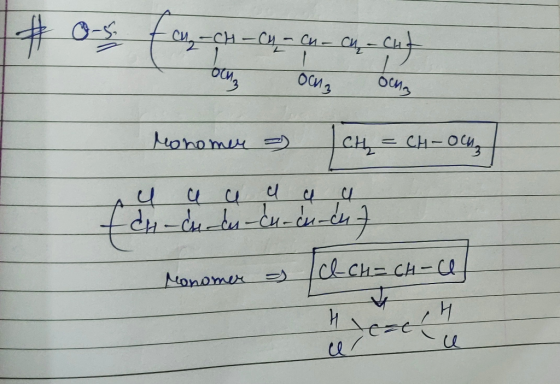
5. What kind of monomer should be used to synthesize the following polymer: OCH3 CH3 CH3...
What kind of monomer should be used to synthesize the following polymer: OCH3 OCH3 OCH3 CH2-CH-CH2-CH-CH2-CH...
 What kind of monomer should be used to synthesize the following
polymer:
OCH3 OCH3 OCH3 CH2-CH-CH2-CH-CH2-CH CI CI CI CI CI CI CH-CH-CH-CH-CHCH-
What kind of monomer should be used to synthesize the following
polymer:
OCH3 OCH3 OCH3 CH2-CH-CH2-CH-CH2-CH CI CI CI CI CI CI CH-CH-CH-CH-CHCH-
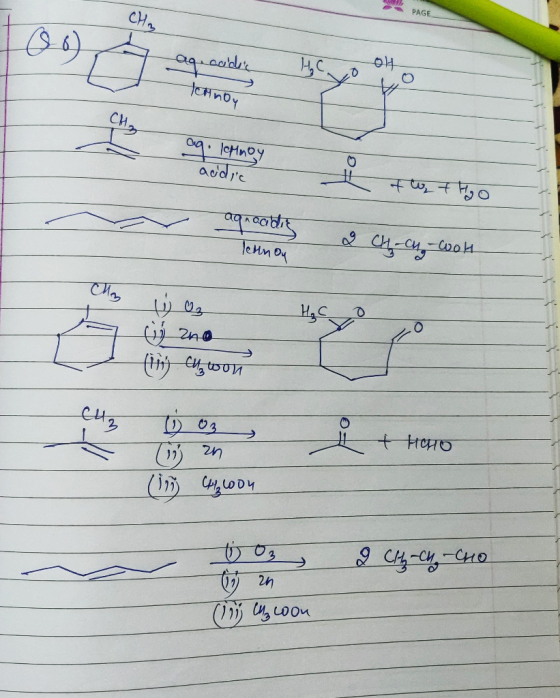
What products would you expect from reaction of 1-methylcyclohexene, 2-methylpropene, 3-hexene with the following reagents? (draw...
What products would you expect from reaction of 1-methylcyclohexene, 2-methylpropene, 3-hexene with the following reagents? (draw it out) a) aqueous acidic KMnO4 b) O3, followed by Zn, CH3CO2H
please answer all questions 1. (2) Give the structure of the monomer that would be used...
 please answer all questions
1. (2) Give the structure of the monomer that would be used to produce each of the following polymers. -CH2-CH-CH2-CH-CH2-CH -CH2-CH-CH2-CH-CH2-CH- Ci Ci Ci CH3 CH3 CH3 2. (5) Where are you most likely to find each of the following polymers in your everyday life: polyethylene terephthalate (PET) high-density polyethylene (HDPE) polypropylene (PP) polyvinyl chloride (PVC) polystyrene 3. (1) Polyester is an example of an addition or a condensation polymer? 4. (1) What must be done...
please answer all questions
1. (2) Give the structure of the monomer that would be used to produce each of the following polymers. -CH2-CH-CH2-CH-CH2-CH -CH2-CH-CH2-CH-CH2-CH- Ci Ci Ci CH3 CH3 CH3 2. (5) Where are you most likely to find each of the following polymers in your everyday life: polyethylene terephthalate (PET) high-density polyethylene (HDPE) polypropylene (PP) polyvinyl chloride (PVC) polystyrene 3. (1) Polyester is an example of an addition or a condensation polymer? 4. (1) What must be done...
5. What one monomer was used to prepare the polymer below? Circle your answer. (3 pts.)...
 5. What one monomer was used to prepare the polymer below? Circle your answer. (3 pts.) 1 CH2=CHCH2CH3 II) CH3CH=CHCH3 III) CH2=CHCH3 IV) CH2=C(CH3)2 / 18 1 6. Given the relative rate of hydrogen abstraction for a radical bromination mechanism, as discussed in class, follows the order of: 1640 : 82: 1 (3° : 2° : 1°) calculate the expected product distribution for the following reaction. Show all work for partial credit. (9 pts.) Br Br2, h Br II %...
23) What is the product of the following reaction? 23) Hас CH3 c=c н OSO4, (CH3)3COOH...
 23) What is the product of the following reaction? 23) Hас CH3 c=c н OSO4, (CH3)3COOH (CH);CОН, ОН н A) CH3CH=0 B) cis-2,3-epoxybutane D) 1,3-butanediol C) 2,3-butanediol 24) Which of the following reagents will convert cyclohexene into cis-1,2-cyclohexanediol? 24) CIP НОlи TO(E p (CH d bavrollo A) CH3CO3H (peroxyacetic acid) B) Os04, (CH3)3COOH, (CH3)3COH, OH C) 03 followed by Zn/H20 D) HIO4 (CE
(9) What monomer should be used to make the following polymer? (A) (B) (C) (D) (10)...
 (9) What monomer should be used to make the following polymer? (A) (B) (C) (D) (10) Which of the following structures is an intermediate in the mechanism for the reaction below? HBr Br Br Br (A) (B) (C) (D)
Need Help On Questions 2-5. Subject is organic chemistry 2. What are the products of the...
 Need Help On Questions 2-5. Subject is organic
chemistry
2. What are the products of the hot alkaline KMnO4 oxidation of the following compounds: a. l-methylcyclohexene b. 3-methylcyclohexene c. 1,2-dimethylcyclohexene d. 1,3-dimethylcyclohexene e. 1,2-dimethylcyclopentene f. 1,3-cyclopentadiene 3. What will be the products in question 2 if hot KMnO4 is replaced with 03/Zn, H20? 4. What will be the products in question 2 if cold, dilute KMnO4 is used instead? 5. Balance reactions 2(a) and 2(b) using Mn04 → MnO2 (in...
Need Help On Questions 2-5. Subject is organic
chemistry
2. What are the products of the hot alkaline KMnO4 oxidation of the following compounds: a. l-methylcyclohexene b. 3-methylcyclohexene c. 1,2-dimethylcyclohexene d. 1,3-dimethylcyclohexene e. 1,2-dimethylcyclopentene f. 1,3-cyclopentadiene 3. What will be the products in question 2 if hot KMnO4 is replaced with 03/Zn, H20? 4. What will be the products in question 2 if cold, dilute KMnO4 is used instead? 5. Balance reactions 2(a) and 2(b) using Mn04 → MnO2 (in...
1. Which Wittig reagent would be used to synthesize 2 CH-CH=P(CAH) CH=P(CHẠh. P(CH3)3 CH,CH,CH-P(CH3)3 IV 2....
 1. Which Wittig reagent would be used to synthesize 2 CH-CH=P(CAH) CH=P(CHẠh. P(CH3)3 CH,CH,CH-P(CH3)3 IV 2. What is the correct IUPAC name for the following compound? 6 eye 3. What is the correct structure for 7-methyl-4-octanone? 3 4. The products, D and E, of the following reaction sequence, S "CN HCI HCN CH.NO H20 heat would be: CH2CH2CN CH,CH,MgBe HO E ? ether Show how you would synthesize the following compound, beginning with 1-butene, Bromobenzene and any necessary additional reagents....
1. What is the IUPAC name for the following compound? CH3 CI CH3-CH-C- CH-CH CH3 CH3...
 1. What is the IUPAC name for the following compound? CH3 CI CH3-CH-C- CH-CH CH3 CH3 A) 4-chloro-4,5-dimethyl-2-hexene B) 3-chloro-1,3,4-trimethyl-1-pentene C) 3-chloro-2,3-dimethyl-4-hexene D) 3-chloro-2,3,5-trimethyl-4-pentene E) 3-chloro-1,3,4,4-tetramethyl-1-butene 2. Name the following compound. CH-CH2 CH,CH CH CCH H-CH A) 2,2-diethylpenatane B) 2,2-diethylpentene C) 4-ethyl-4-methyl-5-hexene D) 3-ethyl-3-methyl-1-hexene E) 4-ethyl-4-methylhexane 3. Name the following compound. CH CH CH, CH,CH CC CH CH2CH CH A) 3-butyl-3-propyl-1-pentyne B) 3-butyl-3-propyl-4-pentyne C) 3-ethyl-3-propyl-1-heptyne D) 5-ethyl-5-propyl-6-heptyne E) 3-ethyl-3-butyl-1-hexyne
Questions 12-20 are true and false! (12) Hydrolysis of nitriles is a method to synthesize carboxylic...
 Questions 12-20 are true and false!
(12) Hydrolysis of nitriles is a method to synthesize carboxylic acid. (13) The order of reactivity of carboxylic acid derivatives is as follow: Acyl chloride > Acid anhydride > Ester > Amide. (14) SOCI2, PC13 and PCls are three types of special reagents to convert carboxylic acid to acyl chloride (15) Acyl chlorides are the most reactive common acyl derivatives, and can be used to synthesize anhydride, ester, and amide. (16) Acyl chloride is...
Questions 12-20 are true and false!
(12) Hydrolysis of nitriles is a method to synthesize carboxylic acid. (13) The order of reactivity of carboxylic acid derivatives is as follow: Acyl chloride > Acid anhydride > Ester > Amide. (14) SOCI2, PC13 and PCls are three types of special reagents to convert carboxylic acid to acyl chloride (15) Acyl chlorides are the most reactive common acyl derivatives, and can be used to synthesize anhydride, ester, and amide. (16) Acyl chloride is...
 What kind of monomer should be used to synthesize the following
polymer:
OCH3 OCH3 OCH3 CH2-CH-CH2-CH-CH2-CH CI CI CI CI CI CI CH-CH-CH-CH-CHCH-
What kind of monomer should be used to synthesize the following
polymer:
OCH3 OCH3 OCH3 CH2-CH-CH2-CH-CH2-CH CI CI CI CI CI CI CH-CH-CH-CH-CHCH-
 please answer all questions
1. (2) Give the structure of the monomer that would be used to produce each of the following polymers. -CH2-CH-CH2-CH-CH2-CH -CH2-CH-CH2-CH-CH2-CH- Ci Ci Ci CH3 CH3 CH3 2. (5) Where are you most likely to find each of the following polymers in your everyday life: polyethylene terephthalate (PET) high-density polyethylene (HDPE) polypropylene (PP) polyvinyl chloride (PVC) polystyrene 3. (1) Polyester is an example of an addition or a condensation polymer? 4. (1) What must be done...
please answer all questions
1. (2) Give the structure of the monomer that would be used to produce each of the following polymers. -CH2-CH-CH2-CH-CH2-CH -CH2-CH-CH2-CH-CH2-CH- Ci Ci Ci CH3 CH3 CH3 2. (5) Where are you most likely to find each of the following polymers in your everyday life: polyethylene terephthalate (PET) high-density polyethylene (HDPE) polypropylene (PP) polyvinyl chloride (PVC) polystyrene 3. (1) Polyester is an example of an addition or a condensation polymer? 4. (1) What must be done...
 5. What one monomer was used to prepare the polymer below? Circle your answer. (3 pts.) 1 CH2=CHCH2CH3 II) CH3CH=CHCH3 III) CH2=CHCH3 IV) CH2=C(CH3)2 / 18 1 6. Given the relative rate of hydrogen abstraction for a radical bromination mechanism, as discussed in class, follows the order of: 1640 : 82: 1 (3° : 2° : 1°) calculate the expected product distribution for the following reaction. Show all work for partial credit. (9 pts.) Br Br2, h Br II %...
 23) What is the product of the following reaction? 23) Hас CH3 c=c н OSO4, (CH3)3COOH (CH);CОН, ОН н A) CH3CH=0 B) cis-2,3-epoxybutane D) 1,3-butanediol C) 2,3-butanediol 24) Which of the following reagents will convert cyclohexene into cis-1,2-cyclohexanediol? 24) CIP НОlи TO(E p (CH d bavrollo A) CH3CO3H (peroxyacetic acid) B) Os04, (CH3)3COOH, (CH3)3COH, OH C) 03 followed by Zn/H20 D) HIO4 (CE
 (9) What monomer should be used to make the following polymer? (A) (B) (C) (D) (10) Which of the following structures is an intermediate in the mechanism for the reaction below? HBr Br Br Br (A) (B) (C) (D)
 Need Help On Questions 2-5. Subject is organic
chemistry
2. What are the products of the hot alkaline KMnO4 oxidation of the following compounds: a. l-methylcyclohexene b. 3-methylcyclohexene c. 1,2-dimethylcyclohexene d. 1,3-dimethylcyclohexene e. 1,2-dimethylcyclopentene f. 1,3-cyclopentadiene 3. What will be the products in question 2 if hot KMnO4 is replaced with 03/Zn, H20? 4. What will be the products in question 2 if cold, dilute KMnO4 is used instead? 5. Balance reactions 2(a) and 2(b) using Mn04 → MnO2 (in...
Need Help On Questions 2-5. Subject is organic
chemistry
2. What are the products of the hot alkaline KMnO4 oxidation of the following compounds: a. l-methylcyclohexene b. 3-methylcyclohexene c. 1,2-dimethylcyclohexene d. 1,3-dimethylcyclohexene e. 1,2-dimethylcyclopentene f. 1,3-cyclopentadiene 3. What will be the products in question 2 if hot KMnO4 is replaced with 03/Zn, H20? 4. What will be the products in question 2 if cold, dilute KMnO4 is used instead? 5. Balance reactions 2(a) and 2(b) using Mn04 → MnO2 (in...
 1. Which Wittig reagent would be used to synthesize 2 CH-CH=P(CAH) CH=P(CHẠh. P(CH3)3 CH,CH,CH-P(CH3)3 IV 2. What is the correct IUPAC name for the following compound? 6 eye 3. What is the correct structure for 7-methyl-4-octanone? 3 4. The products, D and E, of the following reaction sequence, S "CN HCI HCN CH.NO H20 heat would be: CH2CH2CN CH,CH,MgBe HO E ? ether Show how you would synthesize the following compound, beginning with 1-butene, Bromobenzene and any necessary additional reagents....
 1. What is the IUPAC name for the following compound? CH3 CI CH3-CH-C- CH-CH CH3 CH3 A) 4-chloro-4,5-dimethyl-2-hexene B) 3-chloro-1,3,4-trimethyl-1-pentene C) 3-chloro-2,3-dimethyl-4-hexene D) 3-chloro-2,3,5-trimethyl-4-pentene E) 3-chloro-1,3,4,4-tetramethyl-1-butene 2. Name the following compound. CH-CH2 CH,CH CH CCH H-CH A) 2,2-diethylpenatane B) 2,2-diethylpentene C) 4-ethyl-4-methyl-5-hexene D) 3-ethyl-3-methyl-1-hexene E) 4-ethyl-4-methylhexane 3. Name the following compound. CH CH CH, CH,CH CC CH CH2CH CH A) 3-butyl-3-propyl-1-pentyne B) 3-butyl-3-propyl-4-pentyne C) 3-ethyl-3-propyl-1-heptyne D) 5-ethyl-5-propyl-6-heptyne E) 3-ethyl-3-butyl-1-hexyne
 Questions 12-20 are true and false!
(12) Hydrolysis of nitriles is a method to synthesize carboxylic acid. (13) The order of reactivity of carboxylic acid derivatives is as follow: Acyl chloride > Acid anhydride > Ester > Amide. (14) SOCI2, PC13 and PCls are three types of special reagents to convert carboxylic acid to acyl chloride (15) Acyl chlorides are the most reactive common acyl derivatives, and can be used to synthesize anhydride, ester, and amide. (16) Acyl chloride is...
Questions 12-20 are true and false!
(12) Hydrolysis of nitriles is a method to synthesize carboxylic acid. (13) The order of reactivity of carboxylic acid derivatives is as follow: Acyl chloride > Acid anhydride > Ester > Amide. (14) SOCI2, PC13 and PCls are three types of special reagents to convert carboxylic acid to acyl chloride (15) Acyl chlorides are the most reactive common acyl derivatives, and can be used to synthesize anhydride, ester, and amide. (16) Acyl chloride is...
Most questions answered within 3 hours.
-
Where is the error in this code sequence?
String s1 = "Hello";
String s2 = "ello";...
asked 11 months ago -
Financial data for Joel de Paris, Inc., for last year
follow:
Joel de Paris, Inc.
Balance...
asked 11 months ago -
Consider this reaction:
Al2(SO4)3 (aq)+ BaCl3
(aq) Al2Cl6 (aq)- +
3BaSO4(s) . What is the...
asked 11 months ago -
Suppose that Savneet is considering increasing her
recent random sample from 20 car rentals to 40...
asked 11 months ago -
Trucks arrive at an unloading terminal at an average rate of 120
per hour.
Trucks arrive...
asked 11 months ago -
Why are methanol and ethanol completely soluble in water while
octanol is not very little soluble....
asked 11 months ago -
A facilities manager at a university reads in a research report
that the mean amount of...
asked 11 months ago -
When the CuSO4 is rehydrated by adding water to the anhydrous
compound, is this an endothermic...
asked 11 months ago -
A ray of sunlight is passing from diamond into crown glass; the
angle of incidence is...
asked 11 months ago -
A block of mass 0.249 kg is placed on top of a light, vertical
spring of...
asked 11 months ago -
how do the kidneys compensate in the presences of acidosis
a) trigger hyperventilate
b) reserve acid...
asked 11 months ago -
Question 501 pts
The rental rate of capital to the firm increases. Which of the
following...
asked 11 months ago