A 4.117 g impure sample of glucose (C6H12O6) was burned in a constant-volume calorimeter having a...
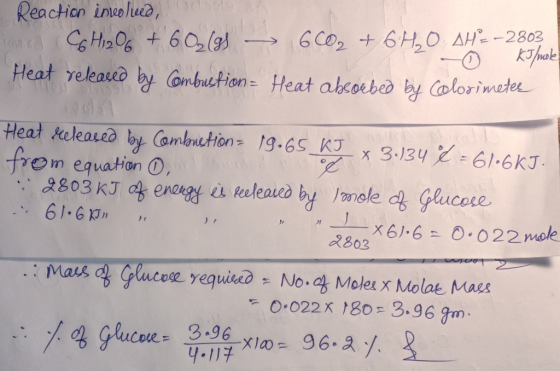
A 4.117 g impure sample of glucose (C6H12O6) was burned in a constant-volume calorimeter having a heat capacity of 19.65 kJ/C. If the rise in temperature is 3.134C, calculate the percent by mass of the glucose in the sample. Assume that the impurities are unaffected by the combustion process and that (change in U = change in H). Check any necessary thermodynamic data in the appendices of your textbook/online.
Homework Answers
Add Answer to:
A 4.117 g impure sample of glucose (C6H12O6) was burned in a
constant-volume calorimeter having a...
Under constant-volume conditions the heat of combustion of glucose (C6H12O6) is 15.57 kJ/g. A 3.800-g sample...
 Under constant-volume conditions the heat of combustion of glucose (C6H12O6) is 15.57 kJ/g. A 3.800-g sample of glucose is burned in a bomb calorimeter. The temperature of the calorimeter increased from 20.94 °C to 24.77 °C Review Ca Part A What is the total heat capacity of the calorimeter? ? kJ C Request Answer Submit Part B If the size of the glucose sample had been exactly twice as large. what would the temperature change of the calorimeter have been?...
A 1.0422 g sample of powdered aluminum is burned in a constant volume bomb calorimeter containing...
 A 1.0422 g sample of powdered aluminum is burned in a constant volume bomb calorimeter containing excess oxygen to form Al_2 O_3 (s) The calorimeter has a heat capacity of 8.775 kJ degree C^-1. The temperature of the calorimeter increases by 3.680 degree C. Determine the molar internal energy of combustion delta U and the molar enthalpy of combustion delta H for aluminum at 25 degree C. 4 Al (s) + 3 O_2 (g) middot 2 Al_2 O_3 (s)
the combustion of 1.00 mol of glucose, C6H12O6, releases 2820 kJ of heat. If 2.0g of...
the combustion of 1.00 mol of glucose, C6H12O6, releases 2820 kJ of heat. If 2.0g of glucose is burned in a calorimeter containing 1.0 kg of water, and the temperature increases by 3.5°C, what is the heat capacity of the calorimeter?
PQ-12. A 1.00 g sample of glucose, C H20. is burned in a bomb calorimeter, the...
 PQ-12. A 1.00 g sample of glucose, C H20. is burned in a bomb calorimeter, the temperature of the calorimeter rises by 9.40 C6H1206(S) °C. What is the heat capacity of the calorimeter2 AH combustion (A) -301 kJ.C (B) -1.67 kJC-1 (C) 1.67 kJCI Table of Data 180.2 g.mol-' -2.83x10 kJ mol-' (D) 301 kJ.°C-!
A sample of fructose (C6H12O6), which has a mass of 4.50 grams, is burned in a...
A sample of fructose (C6H12O6), which has a mass of 4.50 grams, is burned in a bomb calorimeter that contains 1.00 L of water (d=1.00 g/mL). The heat capacity of the calorimeter is 16.97 kJ/oC. The temperature of the calorimeter and the water rises from 23.49oC to 27.72oC. What is q for the combustion of one mole of fructose?.
A 1.25-g sample of a compound is burned in a bomb calorimeter
A 1.25-g sample of a compound is burned in a bomb calorimeter, producing a temperature change from 20.23 °C to 27.65 °C. The heat capacity of the calorimeter is determined to be 5.81 kJ/°C. What is ΔE (aka s ΔU, in kJ/g) for the combustion of this compound? Enter your answer as an integer.
Ignition wires heat sample Thermometer Stirrer A bomb calorimeter, or constant volume calorimeter...
 Ignition wires heat sample Thermometer Stirrer A bomb calorimeter, or constant volume calorimeter, is a device often used to determine the heat of combustion of fuels and the energy content of foods. Since the "bomb" itself can absorb energy, a separate experiment is needed to determine the heat capacity of the calorimeter This is known as calibrating the calorimeter In the laboratory a student burns a 0.319-g sample of phenanthrene (C14H10 in a bomb calorimeter containing 1070. g of water....
A 0.2075−g sample of solid magnesium is burned in a constant-volume bomb calorimeter that has a...
A 0.2075−g sample of solid magnesium is burned in a constant-volume bomb calorimeter that has a heat capacity of 3024 J/°C. The temperature increases by 1.700°C. (a) Calculate the heat given off by the burning Mg in kJ/g. kJ/g (b) Calculate the heat given off by the burning Mg in kJ/mol. kJ/mol
A 0.500g sample of C7H5N2O6 is burned in a calorimeter containing 600 g of water at...
A 0.500g sample of C7H5N2O6 is burned in a calorimeter containing 600 g of water at 20 .0 degrees celicus . if the hear capicity of the bomb calorimeter is 420J/c and the heat of combustion at constabt volume of the sample is -3374 kj/mol ,calculate temperature of reaction in Celisus . specfic heat capacity of water is 4.184J/g degress celsius
A quantity of 1.922 g of methanol (CH3OH) was burned in a constant-volume bomb calorimeter. Consequently,...
A quantity of 1.922 g of methanol (CH3OH) was burned in a constant-volume bomb calorimeter. Consequently, the temperature rose by 5.52°C. If the heat capacity of the bomb plus water was 8.75 kJ / °C, calculate the molar heat of combustion of methanol.
 Under constant-volume conditions the heat of combustion of glucose (C6H12O6) is 15.57 kJ/g. A 3.800-g sample of glucose is burned in a bomb calorimeter. The temperature of the calorimeter increased from 20.94 °C to 24.77 °C Review Ca Part A What is the total heat capacity of the calorimeter? ? kJ C Request Answer Submit Part B If the size of the glucose sample had been exactly twice as large. what would the temperature change of the calorimeter have been?...
 A 1.0422 g sample of powdered aluminum is burned in a constant volume bomb calorimeter containing excess oxygen to form Al_2 O_3 (s) The calorimeter has a heat capacity of 8.775 kJ degree C^-1. The temperature of the calorimeter increases by 3.680 degree C. Determine the molar internal energy of combustion delta U and the molar enthalpy of combustion delta H for aluminum at 25 degree C. 4 Al (s) + 3 O_2 (g) middot 2 Al_2 O_3 (s)
 PQ-12. A 1.00 g sample of glucose, C H20. is burned in a bomb calorimeter, the temperature of the calorimeter rises by 9.40 C6H1206(S) °C. What is the heat capacity of the calorimeter2 AH combustion (A) -301 kJ.C (B) -1.67 kJC-1 (C) 1.67 kJCI Table of Data 180.2 g.mol-' -2.83x10 kJ mol-' (D) 301 kJ.°C-!
 Ignition wires heat sample Thermometer Stirrer A bomb calorimeter, or constant volume calorimeter, is a device often used to determine the heat of combustion of fuels and the energy content of foods. Since the "bomb" itself can absorb energy, a separate experiment is needed to determine the heat capacity of the calorimeter This is known as calibrating the calorimeter In the laboratory a student burns a 0.319-g sample of phenanthrene (C14H10 in a bomb calorimeter containing 1070. g of water....
Most questions answered within 3 hours.
-
Where is the error in this code sequence?
String s1 = "Hello";
String s2 = "ello";...
asked 11 months ago -
Financial data for Joel de Paris, Inc., for last year
follow:
Joel de Paris, Inc.
Balance...
asked 11 months ago -
Consider this reaction:
Al2(SO4)3 (aq)+ BaCl3
(aq) Al2Cl6 (aq)- +
3BaSO4(s) . What is the...
asked 11 months ago -
Suppose that Savneet is considering increasing her
recent random sample from 20 car rentals to 40...
asked 11 months ago -
Trucks arrive at an unloading terminal at an average rate of 120
per hour.
Trucks arrive...
asked 11 months ago -
Why are methanol and ethanol completely soluble in water while
octanol is not very little soluble....
asked 11 months ago -
A facilities manager at a university reads in a research report
that the mean amount of...
asked 11 months ago -
When the CuSO4 is rehydrated by adding water to the anhydrous
compound, is this an endothermic...
asked 11 months ago -
A ray of sunlight is passing from diamond into crown glass; the
angle of incidence is...
asked 11 months ago -
A block of mass 0.249 kg is placed on top of a light, vertical
spring of...
asked 11 months ago -
how do the kidneys compensate in the presences of acidosis
a) trigger hyperventilate
b) reserve acid...
asked 11 months ago -
Question 501 pts
The rental rate of capital to the firm increases. Which of the
following...
asked 11 months ago