Calculate the percentage composition by weight for a mixture of ammonium chloride, silicon dioxide and sodium...
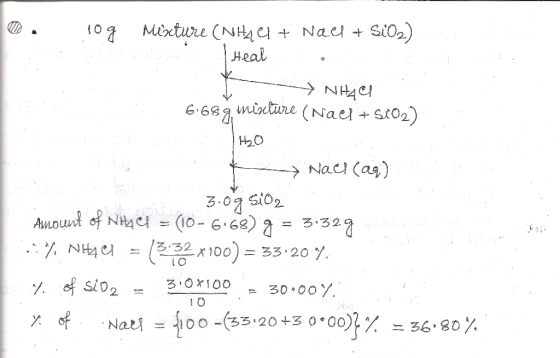
Calculate the percentage composition by weight for a mixture of ammonium chloride, silicon dioxide and sodium chloride using the following data:
1. After heating a mixture with a mass of 10 grams in a fume hood for 15 minutes. The mass of the sample decreased to 6.68 grams.
2.You then added several 5 ML portions of water to the sample, stir for 2 minutes and collected the liquid in a beaker. After heating the silicon dioxide, cool in a d desiccator, the mass was determined to be 3 grams.
3. %ammonium chloride-------- % silicon dioxide--------% sodium chloride
Homework Answers
Add Answer to:
Calculate the percentage composition by weight for a mixture of
ammonium chloride, silicon dioxide and sodium...
Calculate the percentage composition by weight for a mixture of ammonium chloride, silicon dioxide and sodium...
Calculate the percentage composition by weight for a mixture of ammonium chloride, silicon dioxide and sodium chloride using the following data: a.) After heating a mixture with a mass of 10 grams in a fume hood for 15 minutes. The mass of the sample decreased to 6.68 grams. b.) You then add several 5 mL portions of water to the sample, stir for 2 minutes and collected the liquid in a beaker. After heating the silicon dioxide, cool in a...
6 Calculate the percentage composition by weight for a mixture of ammonium chloride, silicon dioxide and sodium chl...
 6 Calculate the percentage composition by weight for a mixture of ammonium chloride, silicon dioxide and sodium chloride using the following data: • After heating a mixture with a mass of 10 grams in a fume hood for 15 minutes. The mass of the Sample decreased to 6.58 grams • You the added several m. portions of water to the sample, stir for 2 minutes and collected the liquid na beaker, Alter heating the silicon dioxide, cool in a desiccator,...
Metal carbonates decompose to form metal oxides and carbon dioxide. An experiment was done to determine...
 Metal carbonates decompose to form metal oxides and carbon dioxide. An experiment was done to determine the composition of a mixture of sodium chloride and sodium carbonate. A sample of the mixture with a mass of 5.47 grams was heated until gas production stopped. After the reaction, the sample had a mass of 4.24 grams. Assuming that sodium chloride does not react and that the decrease in mass was due to the creation of CO2 gas, what wass the mass...
Metal carbonates decompose to form metal oxides and carbon dioxide. An experiment was done to determine...
 Metal carbonates decompose to form metal oxides and carbon dioxide. An experiment was done to determine the composition of a mixture of sodium chloride and sodium carbonate. A sample of the mixture with a mass of 5.86 grams was heated until gas production stopped. After the reaction, the sample had a mass of 4.36 grams. Assuming that sodium chloride does not react and that the decrease in mass was due to the creation of CO2 gas, what wass the mass...
help with percent calculations in sand salt and ammonium chloride lab Partner's Name SAMPLE ID. BAY...
 help with percent calculations in sand salt and ammonium chloride
lab
Partner's Name SAMPLE ID. BAY (1 pt) Mass of Evaporating Dish 58.273 a (3 pts) Mass of Evaporating Dish and Sample_60.5588 (3 pts) Mass of Sample 2.2854 (4 pts) AMMONIUM CHLORIDE Mass of Evaporating Dish and Sample..... After First heating 60.4689 (2 pts) After Second heating 60.466d (2 pts) After Third heating (if necessary) Mass of ammonium chloride 0.088. (3 pts) Using the lowest mass measured, calculate the mass...
help with percent calculations in sand salt and ammonium chloride
lab
Partner's Name SAMPLE ID. BAY (1 pt) Mass of Evaporating Dish 58.273 a (3 pts) Mass of Evaporating Dish and Sample_60.5588 (3 pts) Mass of Sample 2.2854 (4 pts) AMMONIUM CHLORIDE Mass of Evaporating Dish and Sample..... After First heating 60.4689 (2 pts) After Second heating 60.466d (2 pts) After Third heating (if necessary) Mass of ammonium chloride 0.088. (3 pts) Using the lowest mass measured, calculate the mass...
Part A 1. If you had used more methylene chloride in each step, you could have...
 Part A 1. If you had used more methylene chloride in each step, you could have extracted more caffeine. Explain why you did not. Hint - What step would have taken longer (Hint: not drying). PART A Mass of Beaker & Caffeine Mass of Beaker 167.750g 67.6809 Mass of Caffeine 0.0 75 Calculations. Show your work and circle the answers. Mass of caffeine recovered: 012919 b) Actual:.07 % caffeine recovered: a) Predicted: 9 7:213% b) Actual: 92.105% PART B Unknown...
Why is it important to completely dissolve both the alkene and alkyne before adding the pyridiumium...
Why is it important to completely dissolve both the alkene and alkyne before adding the pyridiumium tribromide to the reaction vial. Why is this important? Hint: the alkene and alkyne do not have the same solubility in acetic acid. this is the experiment, In the fume hood, measure 2.0 mL of glacial acetic acid into your 10 mL microscale reaction vial. Add trans-stilbene (135 mg, 0.75 mmol) and diphenylacetlyene (135 mg, 0.75 mmol). Add a stir bar and place the...
can someone please answer number one? im so lost DYES AND DYEING CHAPTER 1. Calculate the...
 can someone please answer number one? im so lost
DYES AND DYEING CHAPTER 1. Calculate the amounts of salicylic acid, 1-naphthol, 2-naphthol, 8-anilino-1-naph- thalenesulfonic acid ammonium salt, or N,N-dimethylaniline needed for Part 1B of this experiment (use molecules as assigned by your TA). 190mg 3-aminobenzene 2.5mL Sulfonic acid 2.5% sodium carbonate solution 81mg Sodium nitrate 2. What is the purpose of the sodium carbonate in Part 1A? Why do we add glacial acetic acid in Part 13 when we react...
can someone please answer number one? im so lost
DYES AND DYEING CHAPTER 1. Calculate the amounts of salicylic acid, 1-naphthol, 2-naphthol, 8-anilino-1-naph- thalenesulfonic acid ammonium salt, or N,N-dimethylaniline needed for Part 1B of this experiment (use molecules as assigned by your TA). 190mg 3-aminobenzene 2.5mL Sulfonic acid 2.5% sodium carbonate solution 81mg Sodium nitrate 2. What is the purpose of the sodium carbonate in Part 1A? Why do we add glacial acetic acid in Part 13 when we react...
5. Let a square represent an ammonium ion and a circle represent a sulfate ion. Which...
 5. Let a square represent an ammonium ion and a circle represent a sulfate ion. Which of the following depicts a small representative volume of a 0.10 M aqueous solution of ammonium sulfate? Water molecules have not been included. For each incorrect answer, state why it is incorrect; be as specific as possible. A в C о ‑ G F None of B these O ODO epresents an ato At 25°C in a 50 mL Erlenmeyer flask were combined 1.050...
are there any synthetic transformations produced in this lab Step 1. Preparation and Recrystallization of a...
 are there any synthetic transformations produced in this
lab
Step 1. Preparation and Recrystallization of a Diastereomeric Salt - Synthesis of (R,R)-1,2-Diammoniumcyclohexane mono-(+)-tartrate: In a 150 ml beaker, L-(+)-Tartaric acid (7.5 g, 0.05 mol) is dissolved in 25 mL of distilled water. The solution is stirred as 11.4 g (12.2 mL, 0.10 mol) of 1,2-diaminocyclohexane is added carefully in one portion. (The addition of the diamine is exothermic.) A slurry is formed initially but complete dissolution is observed once addition...
are there any synthetic transformations produced in this
lab
Step 1. Preparation and Recrystallization of a Diastereomeric Salt - Synthesis of (R,R)-1,2-Diammoniumcyclohexane mono-(+)-tartrate: In a 150 ml beaker, L-(+)-Tartaric acid (7.5 g, 0.05 mol) is dissolved in 25 mL of distilled water. The solution is stirred as 11.4 g (12.2 mL, 0.10 mol) of 1,2-diaminocyclohexane is added carefully in one portion. (The addition of the diamine is exothermic.) A slurry is formed initially but complete dissolution is observed once addition...
 6 Calculate the percentage composition by weight for a mixture of ammonium chloride, silicon dioxide and sodium chloride using the following data: • After heating a mixture with a mass of 10 grams in a fume hood for 15 minutes. The mass of the Sample decreased to 6.58 grams • You the added several m. portions of water to the sample, stir for 2 minutes and collected the liquid na beaker, Alter heating the silicon dioxide, cool in a desiccator,...
 Metal carbonates decompose to form metal oxides and carbon dioxide. An experiment was done to determine the composition of a mixture of sodium chloride and sodium carbonate. A sample of the mixture with a mass of 5.47 grams was heated until gas production stopped. After the reaction, the sample had a mass of 4.24 grams. Assuming that sodium chloride does not react and that the decrease in mass was due to the creation of CO2 gas, what wass the mass...
 Metal carbonates decompose to form metal oxides and carbon dioxide. An experiment was done to determine the composition of a mixture of sodium chloride and sodium carbonate. A sample of the mixture with a mass of 5.86 grams was heated until gas production stopped. After the reaction, the sample had a mass of 4.36 grams. Assuming that sodium chloride does not react and that the decrease in mass was due to the creation of CO2 gas, what wass the mass...
 help with percent calculations in sand salt and ammonium chloride
lab
Partner's Name SAMPLE ID. BAY (1 pt) Mass of Evaporating Dish 58.273 a (3 pts) Mass of Evaporating Dish and Sample_60.5588 (3 pts) Mass of Sample 2.2854 (4 pts) AMMONIUM CHLORIDE Mass of Evaporating Dish and Sample..... After First heating 60.4689 (2 pts) After Second heating 60.466d (2 pts) After Third heating (if necessary) Mass of ammonium chloride 0.088. (3 pts) Using the lowest mass measured, calculate the mass...
help with percent calculations in sand salt and ammonium chloride
lab
Partner's Name SAMPLE ID. BAY (1 pt) Mass of Evaporating Dish 58.273 a (3 pts) Mass of Evaporating Dish and Sample_60.5588 (3 pts) Mass of Sample 2.2854 (4 pts) AMMONIUM CHLORIDE Mass of Evaporating Dish and Sample..... After First heating 60.4689 (2 pts) After Second heating 60.466d (2 pts) After Third heating (if necessary) Mass of ammonium chloride 0.088. (3 pts) Using the lowest mass measured, calculate the mass...
 Part A 1. If you had used more methylene chloride in each step, you could have extracted more caffeine. Explain why you did not. Hint - What step would have taken longer (Hint: not drying). PART A Mass of Beaker & Caffeine Mass of Beaker 167.750g 67.6809 Mass of Caffeine 0.0 75 Calculations. Show your work and circle the answers. Mass of caffeine recovered: 012919 b) Actual:.07 % caffeine recovered: a) Predicted: 9 7:213% b) Actual: 92.105% PART B Unknown...
 can someone please answer number one? im so lost
DYES AND DYEING CHAPTER 1. Calculate the amounts of salicylic acid, 1-naphthol, 2-naphthol, 8-anilino-1-naph- thalenesulfonic acid ammonium salt, or N,N-dimethylaniline needed for Part 1B of this experiment (use molecules as assigned by your TA). 190mg 3-aminobenzene 2.5mL Sulfonic acid 2.5% sodium carbonate solution 81mg Sodium nitrate 2. What is the purpose of the sodium carbonate in Part 1A? Why do we add glacial acetic acid in Part 13 when we react...
can someone please answer number one? im so lost
DYES AND DYEING CHAPTER 1. Calculate the amounts of salicylic acid, 1-naphthol, 2-naphthol, 8-anilino-1-naph- thalenesulfonic acid ammonium salt, or N,N-dimethylaniline needed for Part 1B of this experiment (use molecules as assigned by your TA). 190mg 3-aminobenzene 2.5mL Sulfonic acid 2.5% sodium carbonate solution 81mg Sodium nitrate 2. What is the purpose of the sodium carbonate in Part 1A? Why do we add glacial acetic acid in Part 13 when we react...
 5. Let a square represent an ammonium ion and a circle represent a sulfate ion. Which of the following depicts a small representative volume of a 0.10 M aqueous solution of ammonium sulfate? Water molecules have not been included. For each incorrect answer, state why it is incorrect; be as specific as possible. A в C о ‑ G F None of B these O ODO epresents an ato At 25°C in a 50 mL Erlenmeyer flask were combined 1.050...
 are there any synthetic transformations produced in this
lab
Step 1. Preparation and Recrystallization of a Diastereomeric Salt - Synthesis of (R,R)-1,2-Diammoniumcyclohexane mono-(+)-tartrate: In a 150 ml beaker, L-(+)-Tartaric acid (7.5 g, 0.05 mol) is dissolved in 25 mL of distilled water. The solution is stirred as 11.4 g (12.2 mL, 0.10 mol) of 1,2-diaminocyclohexane is added carefully in one portion. (The addition of the diamine is exothermic.) A slurry is formed initially but complete dissolution is observed once addition...
are there any synthetic transformations produced in this
lab
Step 1. Preparation and Recrystallization of a Diastereomeric Salt - Synthesis of (R,R)-1,2-Diammoniumcyclohexane mono-(+)-tartrate: In a 150 ml beaker, L-(+)-Tartaric acid (7.5 g, 0.05 mol) is dissolved in 25 mL of distilled water. The solution is stirred as 11.4 g (12.2 mL, 0.10 mol) of 1,2-diaminocyclohexane is added carefully in one portion. (The addition of the diamine is exothermic.) A slurry is formed initially but complete dissolution is observed once addition...
Most questions answered within 3 hours.
-
Where is the error in this code sequence?
String s1 = "Hello";
String s2 = "ello";...
asked 10 months ago -
Financial data for Joel de Paris, Inc., for last year
follow:
Joel de Paris, Inc.
Balance...
asked 10 months ago -
Consider this reaction:
Al2(SO4)3 (aq)+ BaCl3
(aq) Al2Cl6 (aq)- +
3BaSO4(s) . What is the...
asked 10 months ago -
Suppose that Savneet is considering increasing her
recent random sample from 20 car rentals to 40...
asked 10 months ago -
Trucks arrive at an unloading terminal at an average rate of 120
per hour.
Trucks arrive...
asked 10 months ago -
Why are methanol and ethanol completely soluble in water while
octanol is not very little soluble....
asked 10 months ago -
A facilities manager at a university reads in a research report
that the mean amount of...
asked 10 months ago -
When the CuSO4 is rehydrated by adding water to the anhydrous
compound, is this an endothermic...
asked 10 months ago -
A ray of sunlight is passing from diamond into crown glass; the
angle of incidence is...
asked 10 months ago -
A block of mass 0.249 kg is placed on top of a light, vertical
spring of...
asked 10 months ago -
how do the kidneys compensate in the presences of acidosis
a) trigger hyperventilate
b) reserve acid...
asked 10 months ago -
Question 501 pts
The rental rate of capital to the firm increases. Which of the
following...
asked 10 months ago