
Homework Answers

Add Answer to:
The drag coefficient of a car is to be determined experimentally with a full scaleWind tunnel...
In a wind tunnel which includes the effects of a moving road, we measure a drag...
In a wind tunnel which includes the effects of a moving road, we measure a drag force at a wind speed of 200 km/h on a 1/5th scale model of a car to be [X] N ● What is the drag force on the full-scale vehicle operating at 100 km/h? ● Given that power = velocity X force, if we neglect tire rolling resistance, how much engine power is needed to overcome the drag in the full vehicle at 100...
The drag coefficient of a car at the design conditions of 1 atm, 25°C, and 90...
 The drag coefficient of a car at the design conditions of 1 atm, 25°C, and 90 km/h is to be determined experimentally in a large wind tunnel in a full-scale test. The height and width of the car are 1.25 m and 1.65 m, respectively. If the horizontal force acting on the car is measured to be 300 N, determine the total drag coefficient of this car. Take the density of air at 1 atm and 25°C as p 1164...
A new sports car has a drag coefficient of 0.29, a frontal area of 1.9 m2...
A new sports car has a drag coefficient of 0.29, a frontal area of 1.9 m2 , and is traveling at 160 km/h. How much power is required to overcome aerodynamic resistance if ρ = 1.2256 kg/m3
The answer is given as V = 60.3 mph, but no solution is provided The aerodynamic drag on a car depends on the shape of the car. For example, the car shown in Fig. 3 has a drag coefficient of 0.36 wit...
 The answer is given as V = 60.3 mph, but no solution is
provided
The aerodynamic drag on a car depends on the shape of the car. For example, the car shown in Fig. 3 has a drag coefficient of 0.36 with the windows and roof closed. With the windows and roof open, the drag coefficient increases to 045. With the windows and roof open, at what speed is the amount of power needed to overcome aerodynamic drag the same...
The answer is given as V = 60.3 mph, but no solution is
provided
The aerodynamic drag on a car depends on the shape of the car. For example, the car shown in Fig. 3 has a drag coefficient of 0.36 with the windows and roof closed. With the windows and roof open, the drag coefficient increases to 045. With the windows and roof open, at what speed is the amount of power needed to overcome aerodynamic drag the same...
The aerodynamic drag of a new sports car is to be predicted at a speed of 75 km/h at an air temperature of 25°C. Automot...
The aerodynamic drag of a new sports car is to be predicted at a speed of 75 km/h at an air temperature of 25°C. Automotive engineers build a one-fifth scale model of the car to test in a wind tunnel. It is winter and the wind tunnel is located in an unheated building. The temperature of the wind tunnel air is only 5°C. a) Determine how fast the engineers should run the wind tunnel in order to achieve similarity between...
A 2790 lb car has a frontal cross-sectional area A of 21.1 ft2, a drag coefficient...
 A 2790 lb car has a frontal cross-sectional area A of 21.1 ft2, a drag coefficient Cd of 0.25, and a drive (or tractive) force of 280 lbs. Assume an air density of 2.3x10⁻³ slug/ft?, Here is a list of frontal areas and drag coefficients for cars. This web site has interesting information on how the physics we are learning is incorporated into video games with cars. NOTES IMAGES DISCUSS UNITS STATS HELP Part Description Answer chk History 11.11 pts....
A car travels at a constant velocity of 90 km/h along an expressway under-ambient temperature and...
 A car travels at a constant velocity of 90 km/h along an
expressway under-ambient temperature and pressure conditions. The
width of the car is 1.5 m while its height is 1.2 m. The wheelbase
(length between the front and rear wheels) is 2.5 m. The drag
coefficient is 0.22.
[Use
air, ambient density of the air = 1.12 kg/m3 and,
fuel, density of the fuel = 930 kg/m3. You may neglect
any energy contained in the exhaust gases and any...
A car travels at a constant velocity of 90 km/h along an
expressway under-ambient temperature and pressure conditions. The
width of the car is 1.5 m while its height is 1.2 m. The wheelbase
(length between the front and rear wheels) is 2.5 m. The drag
coefficient is 0.22.
[Use
air, ambient density of the air = 1.12 kg/m3 and,
fuel, density of the fuel = 930 kg/m3. You may neglect
any energy contained in the exhaust gases and any...
A Toyota Prius has the following attributes: Drag Coefficient Ca = 0.24, Frontal Area Af =...
 A Toyota Prius has the following attributes: Drag Coefficient Ca = 0.24, Frontal Area Af = 25.83 ft?, weight = 3064 lb, and Speed = 90 mph. Use air density p = 0.002378 slugs/ft3. The vehicle from problem 2 above is travelling down a 4% grade on pavement located at 5000-ft altitude (p = 0.002045 slugs/ft?) with its maximum speed. Overall resistance for the motion of the car at maximum speed is overcome with a power of 28hp. Determine the...
To reduce the drag coefficient and thus to improve the fuel efficiency of cars, the design...
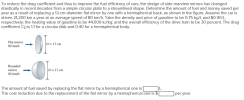 To reduce the drag coefficient and thus to improve the fuel efficiency of cars, the design of side rearview mirrors has changed drastically in recent decades from a simple circular plate to a streamlined shape. Determine the amount of fuel and money saved per year as a result of replacing a 13-cm-diameter flat mirror by one with a hemispherical back, as shown in the figure. Assume the car is driven 21,200 km a year at an average speed of 80...
2. The electric vehicle Tesla Model S has a drag coefficient of 0.24, a mass of 2100 kg, and a frontal area of 2.4 m2....
 2. The electric vehicle Tesla Model S has a drag coefficient of 0.24, a mass of 2100 kg, and a frontal area of 2.4 m2. The coefficient of rolling resistance of its tires is 0.01. Recall the density of air at sea level is 1.3 kg/m3. How much kinetic energy is required to overcome rolling resistance and air resistance (drag) at Autobahn speeds of 180 km/hr for a 200 km trip? How much useful energy (in MJ) and money (in...
 The drag coefficient of a car at the design conditions of 1 atm, 25°C, and 90 km/h is to be determined experimentally in a large wind tunnel in a full-scale test. The height and width of the car are 1.25 m and 1.65 m, respectively. If the horizontal force acting on the car is measured to be 300 N, determine the total drag coefficient of this car. Take the density of air at 1 atm and 25°C as p 1164...
 The answer is given as V = 60.3 mph, but no solution is
provided
The aerodynamic drag on a car depends on the shape of the car. For example, the car shown in Fig. 3 has a drag coefficient of 0.36 with the windows and roof closed. With the windows and roof open, the drag coefficient increases to 045. With the windows and roof open, at what speed is the amount of power needed to overcome aerodynamic drag the same...
The answer is given as V = 60.3 mph, but no solution is
provided
The aerodynamic drag on a car depends on the shape of the car. For example, the car shown in Fig. 3 has a drag coefficient of 0.36 with the windows and roof closed. With the windows and roof open, the drag coefficient increases to 045. With the windows and roof open, at what speed is the amount of power needed to overcome aerodynamic drag the same...
 A 2790 lb car has a frontal cross-sectional area A of 21.1 ft2, a drag coefficient Cd of 0.25, and a drive (or tractive) force of 280 lbs. Assume an air density of 2.3x10⁻³ slug/ft?, Here is a list of frontal areas and drag coefficients for cars. This web site has interesting information on how the physics we are learning is incorporated into video games with cars. NOTES IMAGES DISCUSS UNITS STATS HELP Part Description Answer chk History 11.11 pts....
 A car travels at a constant velocity of 90 km/h along an
expressway under-ambient temperature and pressure conditions. The
width of the car is 1.5 m while its height is 1.2 m. The wheelbase
(length between the front and rear wheels) is 2.5 m. The drag
coefficient is 0.22.
[Use
air, ambient density of the air = 1.12 kg/m3 and,
fuel, density of the fuel = 930 kg/m3. You may neglect
any energy contained in the exhaust gases and any...
A car travels at a constant velocity of 90 km/h along an
expressway under-ambient temperature and pressure conditions. The
width of the car is 1.5 m while its height is 1.2 m. The wheelbase
(length between the front and rear wheels) is 2.5 m. The drag
coefficient is 0.22.
[Use
air, ambient density of the air = 1.12 kg/m3 and,
fuel, density of the fuel = 930 kg/m3. You may neglect
any energy contained in the exhaust gases and any...
 A Toyota Prius has the following attributes: Drag Coefficient Ca = 0.24, Frontal Area Af = 25.83 ft?, weight = 3064 lb, and Speed = 90 mph. Use air density p = 0.002378 slugs/ft3. The vehicle from problem 2 above is travelling down a 4% grade on pavement located at 5000-ft altitude (p = 0.002045 slugs/ft?) with its maximum speed. Overall resistance for the motion of the car at maximum speed is overcome with a power of 28hp. Determine the...
 To reduce the drag coefficient and thus to improve the fuel efficiency of cars, the design of side rearview mirrors has changed drastically in recent decades from a simple circular plate to a streamlined shape. Determine the amount of fuel and money saved per year as a result of replacing a 13-cm-diameter flat mirror by one with a hemispherical back, as shown in the figure. Assume the car is driven 21,200 km a year at an average speed of 80...
 2. The electric vehicle Tesla Model S has a drag coefficient of 0.24, a mass of 2100 kg, and a frontal area of 2.4 m2. The coefficient of rolling resistance of its tires is 0.01. Recall the density of air at sea level is 1.3 kg/m3. How much kinetic energy is required to overcome rolling resistance and air resistance (drag) at Autobahn speeds of 180 km/hr for a 200 km trip? How much useful energy (in MJ) and money (in...
Most questions answered within 3 hours.
-
Where is the error in this code sequence?
String s1 = "Hello";
String s2 = "ello";...
asked 11 months ago -
Financial data for Joel de Paris, Inc., for last year
follow:
Joel de Paris, Inc.
Balance...
asked 11 months ago -
Consider this reaction:
Al2(SO4)3 (aq)+ BaCl3
(aq) Al2Cl6 (aq)- +
3BaSO4(s) . What is the...
asked 11 months ago -
Suppose that Savneet is considering increasing her
recent random sample from 20 car rentals to 40...
asked 11 months ago -
Trucks arrive at an unloading terminal at an average rate of 120
per hour.
Trucks arrive...
asked 11 months ago -
Why are methanol and ethanol completely soluble in water while
octanol is not very little soluble....
asked 11 months ago -
A facilities manager at a university reads in a research report
that the mean amount of...
asked 11 months ago -
When the CuSO4 is rehydrated by adding water to the anhydrous
compound, is this an endothermic...
asked 11 months ago -
A ray of sunlight is passing from diamond into crown glass; the
angle of incidence is...
asked 11 months ago -
A block of mass 0.249 kg is placed on top of a light, vertical
spring of...
asked 11 months ago -
how do the kidneys compensate in the presences of acidosis
a) trigger hyperventilate
b) reserve acid...
asked 11 months ago -
Question 501 pts
The rental rate of capital to the firm increases. Which of the
following...
asked 11 months ago