
Homework Answers
1)
When pipets are calibrated, generally they are done so assuming that a certain amount of liquid will remain inside the pipet due to the surface tension. Thus, if we blow out the liquid, the actual volume delivered will be more than the recorded volume and hence, there can be inaccuracies.
2)
We need to make 5% solution having 50.00 mL volume. Thus, volume of solute will be,
Volume = 5% of 50.00 mL = 5*50.00/ 100 = 2.5 mL
Thus, we need to take 2.5 mL of the solute to make 5% solution.
Note that we have used only 1 decimal place because the pipet can measure only up to 1/10th of a mL
3)
We need to convert the 5% (0.05) solution to a 2% (0.02) solution having 10.00 mL total volume
Volume of Solute in 2% solution = 2 % of 10.00 mL 0.02 * 10.00 mL= 0.2 mL
Volume of Solution needed = 0.2 mL / 0.05 = 4.0 mL
Alternatively, we can use the formula,

Here, C1 = Initial concentration = 5%. C2 = Final Concentration = 2%
Initial Volume = V1 which we need to find out. Volume Final, V2 = 10.00 mL.
Thus, we will have,
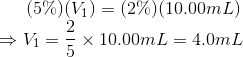
Note that we have used only 1 decimal place because the pipet can measure only up to 1/10th of a mL
4)
To find the percent from a fraction, we need to multiply it by 100
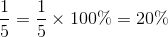
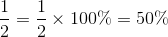
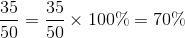
5)
For a colorless liquid which forms concave meniscus when looked from top, we always take the reading of the lower meniscus which is 1.4 mL in this case.
Add Answer to:
You must read the experiment and then answer these questions. 1. Look at the procedure for...
PRE-LAR STUY GESTIONS The Solution is Dilution LA 20 You must read the experiment and then...
 PRE-LAR STUY GESTIONS The Solution is Dilution LA 20 You must read the experiment and then werde n 1. Look at the procedure for amount of liquit of the y o u 2. If you have a 50.00 ml. volumetric raskask a ta specife womendappe that measures up to 10-ml, with marks to the nearest 1/10 ml. how much more word you add to the flask to make 5000 mlofaS005 solution? 3. The 3,00 % solution needs to be diluted...
can someone help me with the first and the second matching questions A 10.00 ml pipette...
 can someone help me with the first and the second matching
questions
A 10.00 ml pipette delivers portions of a diluted vinegar solution into 3 separate Erlenmeyer flasks, then the acetic acid is titrated using a standard solution of 0.060 M NaOH to a phenolphthalein end point. The results of the three trials are given below. What was the average M (mol/L) of the diluted vinegar? Trial # Vinegar Volume (mL) Initial Buret Volume (mL) Final Buret Volume (mL) 1...
can someone help me with the first and the second matching
questions
A 10.00 ml pipette delivers portions of a diluted vinegar solution into 3 separate Erlenmeyer flasks, then the acetic acid is titrated using a standard solution of 0.060 M NaOH to a phenolphthalein end point. The results of the three trials are given below. What was the average M (mol/L) of the diluted vinegar? Trial # Vinegar Volume (mL) Initial Buret Volume (mL) Final Buret Volume (mL) 1...
You have 659.3 mL of a stock solution 4.660 M HCl. For a particular experiment, your...
You have 659.3 mL of a stock solution 4.660 M HCl. For a particular experiment, your lab partner prepared a diluted solution for you to use. In her notes, you read: " Using a volumetric pipet, took 246.54 mL of stock solution and diluted it to 739.21 ml in a volumetric flask. Then, took 100.00 mL of that solution and diluted it to 194.63 mL in a second volumetric flask. " What is the concentration that you should report for...
Ferric Thiocyanate Standard Solution In Part A of this experiment you are instructed to prepare a...
 Ferric Thiocyanate Standard Solution In Part A of this experiment you are instructed to prepare a solution as follows Pipette 10.00 mL of 0.150 M Fe3 solution, and 5.00 mL of 5.00x 10⁻⁴ M SCN solution in a 25.00 mL volumetric flask. Dilute to the mark with 0.100 M HNO3 and mix well. Calculate and enter the concentration of FeSCN2+ in this solution and, also, write it in your notebook. (It will be required for your Report sheet.) [FesCN2+1 6M...
Calculate initial concentration of Fe+3 for tubes 1-3. Show your work. Procedure A. Determination of B...
 Calculate initial concentration of Fe+3 for tubes 1-3. Show your
work.
Procedure A. Determination of B for Beer's Law 1. Using a buret, add 4.00 mL of 0.0025 M Fe(NO3)s (which is in 0.1 M HNOs) to a 100- mL volumetric flask. Add enough deionized water to bring the total volume to the mark on the neck of the flask. Stopper and shake the flask. Label this flask “Diluted Fe.” spectrophotometer tubes (cuvettes), they are too small to use at...
Calculate initial concentration of Fe+3 for tubes 1-3. Show your
work.
Procedure A. Determination of B for Beer's Law 1. Using a buret, add 4.00 mL of 0.0025 M Fe(NO3)s (which is in 0.1 M HNOs) to a 100- mL volumetric flask. Add enough deionized water to bring the total volume to the mark on the neck of the flask. Stopper and shake the flask. Label this flask “Diluted Fe.” spectrophotometer tubes (cuvettes), they are too small to use at...
Report your answer is molarity, with the correct significant digits, but no units. Blank 1: 0.9...
 Report your answer is molarity, with the correct significant digits, but no units. Blank 1: 0.9 Question 8 (2 points) If 10.00 mL of the diluted solution from the last question (Q7) is further diluted with water in a volumetric flask to a final volume of M. 50.00 mL, the concentration of the final solution is Report your answer in molarity, with the correct significant digits, but no units. Do not use scientific notation Schoology cannor understand it. Blank 1:1...
Please type in the Computer so I can be able to read it. A student need...
 Please type in the Computer so I can be able to read it.
A student need to prepare four standard solutions by serially diluting a stock solution with concentration 5.0 times 10^-4 N. Standard I will be created by transferring 5.00 mL of the stock solution to the mark with deionized water. The remaining standard solutions (Standards 2 - 4) will be created by transferring 25.00 mL of the previously made standard solution to a 50.00 mL volumetric flask, then...
Please type in the Computer so I can be able to read it.
A student need to prepare four standard solutions by serially diluting a stock solution with concentration 5.0 times 10^-4 N. Standard I will be created by transferring 5.00 mL of the stock solution to the mark with deionized water. The remaining standard solutions (Standards 2 - 4) will be created by transferring 25.00 mL of the previously made standard solution to a 50.00 mL volumetric flask, then...
I need it right now, please help me?? PROCEDURE PART I: DILUTING THE VINEGAR SOLUTION The...
 I
need it right now, please help me??
PROCEDURE PART I: DILUTING THE VINEGAR SOLUTION The vinegar solution must be diluted by a factor of 5 to be suitable for titration. 1. Obtain - 20 ml of the stock vinegar solution from the fume hood. 2. Using the 10-ml. pipet, pipet" 10 mL of the stock solution to a 50-ml volumetric flask. 3. Fill the volumetric flask to the calibration line with distilled water. Be sure not to go over...
I
need it right now, please help me??
PROCEDURE PART I: DILUTING THE VINEGAR SOLUTION The vinegar solution must be diluted by a factor of 5 to be suitable for titration. 1. Obtain - 20 ml of the stock vinegar solution from the fume hood. 2. Using the 10-ml. pipet, pipet" 10 mL of the stock solution to a 50-ml volumetric flask. 3. Fill the volumetric flask to the calibration line with distilled water. Be sure not to go over...
1) You need to make an aqueous solution of 0.209 M potassium fluoride for an experiment...
1) You need to make an aqueous solution of 0.209 M potassium fluoride for an experiment in lab, using a 300 mL volumetric flask. How much solid potassium fluoride should you add? grams 2)How many milliliters of an aqueous solution of 0.244 M zinc acetate is needed to obtain 11.1 grams of the salt? mL 3) In the laboratory you dissolve 13.9 g of copper(II) chloride in a volumetric flask and add water to a total volume of 125 ....
Solve the following with chemsitry knowledge. QUESTIONS 1. What is the molarity of each of the...
 Solve the following with chemsitry knowledge.
QUESTIONS 1. What is the molarity of each of the following solutions? You pipet 25.00 mL of 0.355 M KCI into a 100.00 mL volumetric flask and fill to the mark a. tRTO CONSTANTE b. You pipet ten milliliters of the solution from part (a) into a fifty millaliter volumetric flask and dilute to the mark. You pipet five milliliters ofthesolution from part (b) into a beaker and then pipet twenty milliliters of DI...
Solve the following with chemsitry knowledge.
QUESTIONS 1. What is the molarity of each of the following solutions? You pipet 25.00 mL of 0.355 M KCI into a 100.00 mL volumetric flask and fill to the mark a. tRTO CONSTANTE b. You pipet ten milliliters of the solution from part (a) into a fifty millaliter volumetric flask and dilute to the mark. You pipet five milliliters ofthesolution from part (b) into a beaker and then pipet twenty milliliters of DI...
 PRE-LAR STUY GESTIONS The Solution is Dilution LA 20 You must read the experiment and then werde n 1. Look at the procedure for amount of liquit of the y o u 2. If you have a 50.00 ml. volumetric raskask a ta specife womendappe that measures up to 10-ml, with marks to the nearest 1/10 ml. how much more word you add to the flask to make 5000 mlofaS005 solution? 3. The 3,00 % solution needs to be diluted...
 can someone help me with the first and the second matching
questions
A 10.00 ml pipette delivers portions of a diluted vinegar solution into 3 separate Erlenmeyer flasks, then the acetic acid is titrated using a standard solution of 0.060 M NaOH to a phenolphthalein end point. The results of the three trials are given below. What was the average M (mol/L) of the diluted vinegar? Trial # Vinegar Volume (mL) Initial Buret Volume (mL) Final Buret Volume (mL) 1...
can someone help me with the first and the second matching
questions
A 10.00 ml pipette delivers portions of a diluted vinegar solution into 3 separate Erlenmeyer flasks, then the acetic acid is titrated using a standard solution of 0.060 M NaOH to a phenolphthalein end point. The results of the three trials are given below. What was the average M (mol/L) of the diluted vinegar? Trial # Vinegar Volume (mL) Initial Buret Volume (mL) Final Buret Volume (mL) 1...
 Ferric Thiocyanate Standard Solution In Part A of this experiment you are instructed to prepare a solution as follows Pipette 10.00 mL of 0.150 M Fe3 solution, and 5.00 mL of 5.00x 10⁻⁴ M SCN solution in a 25.00 mL volumetric flask. Dilute to the mark with 0.100 M HNO3 and mix well. Calculate and enter the concentration of FeSCN2+ in this solution and, also, write it in your notebook. (It will be required for your Report sheet.) [FesCN2+1 6M...
 Calculate initial concentration of Fe+3 for tubes 1-3. Show your
work.
Procedure A. Determination of B for Beer's Law 1. Using a buret, add 4.00 mL of 0.0025 M Fe(NO3)s (which is in 0.1 M HNOs) to a 100- mL volumetric flask. Add enough deionized water to bring the total volume to the mark on the neck of the flask. Stopper and shake the flask. Label this flask “Diluted Fe.” spectrophotometer tubes (cuvettes), they are too small to use at...
Calculate initial concentration of Fe+3 for tubes 1-3. Show your
work.
Procedure A. Determination of B for Beer's Law 1. Using a buret, add 4.00 mL of 0.0025 M Fe(NO3)s (which is in 0.1 M HNOs) to a 100- mL volumetric flask. Add enough deionized water to bring the total volume to the mark on the neck of the flask. Stopper and shake the flask. Label this flask “Diluted Fe.” spectrophotometer tubes (cuvettes), they are too small to use at...
 Report your answer is molarity, with the correct significant digits, but no units. Blank 1: 0.9 Question 8 (2 points) If 10.00 mL of the diluted solution from the last question (Q7) is further diluted with water in a volumetric flask to a final volume of M. 50.00 mL, the concentration of the final solution is Report your answer in molarity, with the correct significant digits, but no units. Do not use scientific notation Schoology cannor understand it. Blank 1:1...
 Please type in the Computer so I can be able to read it.
A student need to prepare four standard solutions by serially diluting a stock solution with concentration 5.0 times 10^-4 N. Standard I will be created by transferring 5.00 mL of the stock solution to the mark with deionized water. The remaining standard solutions (Standards 2 - 4) will be created by transferring 25.00 mL of the previously made standard solution to a 50.00 mL volumetric flask, then...
Please type in the Computer so I can be able to read it.
A student need to prepare four standard solutions by serially diluting a stock solution with concentration 5.0 times 10^-4 N. Standard I will be created by transferring 5.00 mL of the stock solution to the mark with deionized water. The remaining standard solutions (Standards 2 - 4) will be created by transferring 25.00 mL of the previously made standard solution to a 50.00 mL volumetric flask, then...
 I
need it right now, please help me??
PROCEDURE PART I: DILUTING THE VINEGAR SOLUTION The vinegar solution must be diluted by a factor of 5 to be suitable for titration. 1. Obtain - 20 ml of the stock vinegar solution from the fume hood. 2. Using the 10-ml. pipet, pipet" 10 mL of the stock solution to a 50-ml volumetric flask. 3. Fill the volumetric flask to the calibration line with distilled water. Be sure not to go over...
I
need it right now, please help me??
PROCEDURE PART I: DILUTING THE VINEGAR SOLUTION The vinegar solution must be diluted by a factor of 5 to be suitable for titration. 1. Obtain - 20 ml of the stock vinegar solution from the fume hood. 2. Using the 10-ml. pipet, pipet" 10 mL of the stock solution to a 50-ml volumetric flask. 3. Fill the volumetric flask to the calibration line with distilled water. Be sure not to go over...
 Solve the following with chemsitry knowledge.
QUESTIONS 1. What is the molarity of each of the following solutions? You pipet 25.00 mL of 0.355 M KCI into a 100.00 mL volumetric flask and fill to the mark a. tRTO CONSTANTE b. You pipet ten milliliters of the solution from part (a) into a fifty millaliter volumetric flask and dilute to the mark. You pipet five milliliters ofthesolution from part (b) into a beaker and then pipet twenty milliliters of DI...
Solve the following with chemsitry knowledge.
QUESTIONS 1. What is the molarity of each of the following solutions? You pipet 25.00 mL of 0.355 M KCI into a 100.00 mL volumetric flask and fill to the mark a. tRTO CONSTANTE b. You pipet ten milliliters of the solution from part (a) into a fifty millaliter volumetric flask and dilute to the mark. You pipet five milliliters ofthesolution from part (b) into a beaker and then pipet twenty milliliters of DI...
Most questions answered within 3 hours.
-
Where is the error in this code sequence?
String s1 = "Hello";
String s2 = "ello";...
asked 10 months ago -
Financial data for Joel de Paris, Inc., for last year
follow:
Joel de Paris, Inc.
Balance...
asked 10 months ago -
Consider this reaction:
Al2(SO4)3 (aq)+ BaCl3
(aq) Al2Cl6 (aq)- +
3BaSO4(s) . What is the...
asked 10 months ago -
Suppose that Savneet is considering increasing her
recent random sample from 20 car rentals to 40...
asked 10 months ago -
Trucks arrive at an unloading terminal at an average rate of 120
per hour.
Trucks arrive...
asked 10 months ago -
Why are methanol and ethanol completely soluble in water while
octanol is not very little soluble....
asked 10 months ago -
A facilities manager at a university reads in a research report
that the mean amount of...
asked 10 months ago -
When the CuSO4 is rehydrated by adding water to the anhydrous
compound, is this an endothermic...
asked 10 months ago -
A ray of sunlight is passing from diamond into crown glass; the
angle of incidence is...
asked 10 months ago -
A block of mass 0.249 kg is placed on top of a light, vertical
spring of...
asked 10 months ago -
how do the kidneys compensate in the presences of acidosis
a) trigger hyperventilate
b) reserve acid...
asked 10 months ago -
Question 501 pts
The rental rate of capital to the firm increases. Which of the
following...
asked 10 months ago