
Homework Answers

Add Answer to:
Ch 18 HW: Problem 18.5-Coulomb's Law Now find the electric force on ch arge q3 (-5.00...
assume charges q1 and q2 are fixed in place. A charge q3 (-5.00 μC) is initially...
 assume charges q1 and q2 are fixed in place. A charge q3 (-5.00
μC) is initially at point A and is later moved to point B. Find the
magnitude and direction of the electric force on q3 when at
location A.
Now find the electric force on charge q3 (-5.00 μC) when it is
moved to location B.
will vote, please show all work if possible
q1 -12.0 μC 45.0 cm
assume charges q1 and q2 are fixed in place. A charge q3 (-5.00
μC) is initially at point A and is later moved to point B. Find the
magnitude and direction of the electric force on q3 when at
location A.
Now find the electric force on charge q3 (-5.00 μC) when it is
moved to location B.
will vote, please show all work if possible
q1 -12.0 μC 45.0 cm
Coulomb’s Law Two protons are separated by a distance of 3.00 x 10^-10 meters and fixed...
 Coulomb’s Law
Two protons are separated by a distance of 3.00 x 10^-10 meters
and fixed in place. a) What is the magnitude of the repulsive
electric force between the protons? b) What is the magnitude of the
attractive gravitational force between the protons? c) Is there any
value of the distance between the protons (besides infinity) for
which the gravitational force is equal to the electric force? If
yes, what is the distance. If no, explain why. d) Assume...
Coulomb’s Law
Two protons are separated by a distance of 3.00 x 10^-10 meters
and fixed in place. a) What is the magnitude of the repulsive
electric force between the protons? b) What is the magnitude of the
attractive gravitational force between the protons? c) Is there any
value of the distance between the protons (besides infinity) for
which the gravitational force is equal to the electric force? If
yes, what is the distance. If no, explain why. d) Assume...
P1 . Ch 1S (30%) !Electric force/neld] Dir a) q 10 uC in Fig. I. Find...
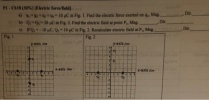 P1 . Ch 1S (30%) !Electric force/neld] Dir a) q 10 uC in Fig. I. Find the electric force exerted on gu Mag b) Qi-o,-20 pC in Fig. 2. Find the electric field at point P., Mag.----, Dir IfQ10 HC, Q-10 HC in Fig. 2. Recalculate electric field at P. Mag. Fig. 2 Dir y-axis /cm y-axis /cm x-axis /cm x-axis /cm
HW Ch 18 Thermodynamics (Heat Engines) and Ch 19 Electric Charges, Forces <HW Ch 18 Thermodynamics...
 HW Ch 18 Thermodynamics (Heat Engines) and Ch 19 Electric Charges, Forces <HW Ch 18 Thermodynamics (Heat Engines) and Ch 19 Electric Charges, Forces Problem 19.26 < 11 of 11 > 1 Review A point charge q = -0.25 nC is fixed at the origin. Part A Where must an electron be placed in order for the electric force acting on it to be exactly opposite to its weight? (Let the y axis be vertical and the x axis be...
Using the same triangle, find the vector components of the electric force on qi and the...
 Using the same triangle, find the vector components of the electric force on qi and the vector's magnitude and direction. 6,00 n 12 5.00 m 91 Problem 15.1 (Page 409) A 4.5x 10.9 C charge is located 3.2 m from a-28x 10-9 C charge. Find the electrostatic force that one charge exerts on the other Problem 15.3 (Page 409) An alpha particle (charge +2e) is sent at high speed toward a gold nucleus (charge 79 ) (a) What is the...
Problem 1 3Q 2 a) The figure shows three charges qi, q2, and q3, situated at...
 Problem 1 3Q 2 a) The figure shows three charges qi, q2, and q3, situated at corners of a rectangle of sides a - 15.0 cm and b-7.0 cm For q,-4.60 pC, q2 =-4.60 μC and q3 = 2.00 μC, find the electric potential at the center of the rectangle. 2.17x10⁵ v You are correct. Computer's answer now shown above. Your receipt is 160-5179 b) Continuing with the figure above, how much work is required in moving q3 to infinity...
Problem l 2 a) The figure shows three charges q1,92, and q3, situated at corners of...
 Problem l 2 a) The figure shows three charges q1,92, and q3, situated at corners of a rectangle of sides a-14.0 cm and b-70 cm. For q,-4.40 μC, q,--4.40 pC,and q3-2.50 pC, find the electric potential at the center of the rectangle. 2.87x10⁵ v You are correct. Computer's answer now shown above. Your receipt is 160-3791 b) Continuing with the figure above, how much work is required in moving q3 to infinity while Ч1 and 2 remain in their positions?...
Need Help? EXAMPLE 15.3 A Charge Triangle GOAL Apply Coulomb's law in two PROBLEM Consider three...
 Need Help? EXAMPLE 15.3 A Charge Triangle GOAL Apply Coulomb's law in two PROBLEM Consider three point charges at the corners of a triangle, as shown in the COS 36.9 figure, where q1 6.00 x 10⁻⁹ c, q2-2.00 x 10⁹ C, and q3- 5.00 x 10⁻⁹ C. (a) Find the components of the force F23 exerted by q2 on g3. (b) Find the components of the force F13 exerted by q1 on q3. (c) Find The foroe the resultant force...
To practice Problem-Solving Strategy 21.1 Coulomb's Law. Three charged particles are placed at each of three...
To practice Problem-Solving Strategy 21.1 Coulomb's Law. Three charged particles are placed at each of three corners of an equilateral triangle whose sides are of length 2.2 cm . Two of the particles have a negative charge: q1 = -8.7 nC and q2 = -17.4 nC . The remaining particle has a positive charge, q3 = 8.0 nC . What is the net electric force acting on particle 3 due to particle 1 and particle 2? Find the net force...
Problem with data for try #2: Consider the picture to the right. The charge of the...
 Problem with data for try #2: Consider the picture to the right. The charge of the middle charge is 2.23 HC. Determine the electric field strength at a point 1.00 cm to the left of the middle charge. 6.00 C 42 -2.00 μC -O Defined symbols: q2 charge of the middle charge in pC q1 charge of the left chargein HC q3 charge of the right charge in HC d12 distance between q1 and q2 in m d23 distance between...
 assume charges q1 and q2 are fixed in place. A charge q3 (-5.00
μC) is initially at point A and is later moved to point B. Find the
magnitude and direction of the electric force on q3 when at
location A.
Now find the electric force on charge q3 (-5.00 μC) when it is
moved to location B.
will vote, please show all work if possible
q1 -12.0 μC 45.0 cm
assume charges q1 and q2 are fixed in place. A charge q3 (-5.00
μC) is initially at point A and is later moved to point B. Find the
magnitude and direction of the electric force on q3 when at
location A.
Now find the electric force on charge q3 (-5.00 μC) when it is
moved to location B.
will vote, please show all work if possible
q1 -12.0 μC 45.0 cm
 Coulomb’s Law
Two protons are separated by a distance of 3.00 x 10^-10 meters
and fixed in place. a) What is the magnitude of the repulsive
electric force between the protons? b) What is the magnitude of the
attractive gravitational force between the protons? c) Is there any
value of the distance between the protons (besides infinity) for
which the gravitational force is equal to the electric force? If
yes, what is the distance. If no, explain why. d) Assume...
Coulomb’s Law
Two protons are separated by a distance of 3.00 x 10^-10 meters
and fixed in place. a) What is the magnitude of the repulsive
electric force between the protons? b) What is the magnitude of the
attractive gravitational force between the protons? c) Is there any
value of the distance between the protons (besides infinity) for
which the gravitational force is equal to the electric force? If
yes, what is the distance. If no, explain why. d) Assume...
 P1 . Ch 1S (30%) !Electric force/neld] Dir a) q 10 uC in Fig. I. Find the electric force exerted on gu Mag b) Qi-o,-20 pC in Fig. 2. Find the electric field at point P., Mag.----, Dir IfQ10 HC, Q-10 HC in Fig. 2. Recalculate electric field at P. Mag. Fig. 2 Dir y-axis /cm y-axis /cm x-axis /cm x-axis /cm
 HW Ch 18 Thermodynamics (Heat Engines) and Ch 19 Electric Charges, Forces <HW Ch 18 Thermodynamics (Heat Engines) and Ch 19 Electric Charges, Forces Problem 19.26 < 11 of 11 > 1 Review A point charge q = -0.25 nC is fixed at the origin. Part A Where must an electron be placed in order for the electric force acting on it to be exactly opposite to its weight? (Let the y axis be vertical and the x axis be...
 Using the same triangle, find the vector components of the electric force on qi and the vector's magnitude and direction. 6,00 n 12 5.00 m 91 Problem 15.1 (Page 409) A 4.5x 10.9 C charge is located 3.2 m from a-28x 10-9 C charge. Find the electrostatic force that one charge exerts on the other Problem 15.3 (Page 409) An alpha particle (charge +2e) is sent at high speed toward a gold nucleus (charge 79 ) (a) What is the...
 Problem 1 3Q 2 a) The figure shows three charges qi, q2, and q3, situated at corners of a rectangle of sides a - 15.0 cm and b-7.0 cm For q,-4.60 pC, q2 =-4.60 μC and q3 = 2.00 μC, find the electric potential at the center of the rectangle. 2.17x10⁵ v You are correct. Computer's answer now shown above. Your receipt is 160-5179 b) Continuing with the figure above, how much work is required in moving q3 to infinity...
 Problem l 2 a) The figure shows three charges q1,92, and q3, situated at corners of a rectangle of sides a-14.0 cm and b-70 cm. For q,-4.40 μC, q,--4.40 pC,and q3-2.50 pC, find the electric potential at the center of the rectangle. 2.87x10⁵ v You are correct. Computer's answer now shown above. Your receipt is 160-3791 b) Continuing with the figure above, how much work is required in moving q3 to infinity while Ч1 and 2 remain in their positions?...
 Need Help? EXAMPLE 15.3 A Charge Triangle GOAL Apply Coulomb's law in two PROBLEM Consider three point charges at the corners of a triangle, as shown in the COS 36.9 figure, where q1 6.00 x 10⁻⁹ c, q2-2.00 x 10⁹ C, and q3- 5.00 x 10⁻⁹ C. (a) Find the components of the force F23 exerted by q2 on g3. (b) Find the components of the force F13 exerted by q1 on q3. (c) Find The foroe the resultant force...
 Problem with data for try #2: Consider the picture to the right. The charge of the middle charge is 2.23 HC. Determine the electric field strength at a point 1.00 cm to the left of the middle charge. 6.00 C 42 -2.00 μC -O Defined symbols: q2 charge of the middle charge in pC q1 charge of the left chargein HC q3 charge of the right charge in HC d12 distance between q1 and q2 in m d23 distance between...
Most questions answered within 3 hours.
-
Where is the error in this code sequence?
String s1 = "Hello";
String s2 = "ello";...
asked 11 months ago -
Financial data for Joel de Paris, Inc., for last year
follow:
Joel de Paris, Inc.
Balance...
asked 11 months ago -
Consider this reaction:
Al2(SO4)3 (aq)+ BaCl3
(aq) Al2Cl6 (aq)- +
3BaSO4(s) . What is the...
asked 11 months ago -
Suppose that Savneet is considering increasing her
recent random sample from 20 car rentals to 40...
asked 11 months ago -
Trucks arrive at an unloading terminal at an average rate of 120
per hour.
Trucks arrive...
asked 11 months ago -
Why are methanol and ethanol completely soluble in water while
octanol is not very little soluble....
asked 11 months ago -
A facilities manager at a university reads in a research report
that the mean amount of...
asked 11 months ago -
When the CuSO4 is rehydrated by adding water to the anhydrous
compound, is this an endothermic...
asked 11 months ago -
A ray of sunlight is passing from diamond into crown glass; the
angle of incidence is...
asked 11 months ago -
A block of mass 0.249 kg is placed on top of a light, vertical
spring of...
asked 11 months ago -
how do the kidneys compensate in the presences of acidosis
a) trigger hyperventilate
b) reserve acid...
asked 11 months ago -
Question 501 pts
The rental rate of capital to the firm increases. Which of the
following...
asked 11 months ago