A baseball has a velocity of 40.9 m/s (91.5 mi/h), directed horizontally, as it is released...
A baseball has a velocity of 40.9 m/s (91.5 mi/h), directed horizontally, as it is released by a pitcher. The ball's velocity 0.0100 s before it is released is 38.3 m/s, directed 2.25° above the horizontal. Calculate the ball's instantaneous acceleration just before it is released. magnitude ? direction below the horizon ?
Homework Answers
Given is:-

thus


similarly


or

and

Time taken during this change in speed is 
Now,
change in the velocity 
which gives us

thus the acceleration will be

by plugging all the values we get
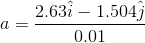
or

thus the magnitude will be

which gives us
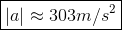
and the direction will be
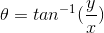
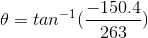

or

Add Answer to:
A baseball has a velocity of 40.9 m/s (91.5 mi/h), directed
horizontally, as it is released...
A baseball has a velocity of 42.5 m/s (95.1 mi/h), directed horizontally, as it is released...
A baseball has a velocity of 42.5 m/s (95.1 mi/h), directed horizontally, as it is released by a pitcher. The ball's velocity 0.0100 s before it is released is 41.1 m/s, directed 4.50° above the horizontal. Calculate the ball's instantaneous acceleration just before it is released. magnitude: direction _____ below the horizon.
A baseball pitcher throws a baseball horizontally at a linear speed of 42.5 m/s (about 95...
A baseball pitcher throws a baseball horizontally at a linear speed of 42.5 m/s (about 95 mi/h). Before being caught, the baseball travels a horizontal distance of 15.3 m and rotates through an angle of 52.1rad. The baseball has a radius of 3.67 cm and is rotating about an axis as it travels, much like the earth does. What is the tangential speed of a point on the "equator" of the baseball? m/s
A baseball bat strikes a baseball (m=140g), with the baseball having an initial horizontal velocity of...
A baseball bat strikes a baseball (m=140g), with the baseball having an initial horizontal velocity of 20 m/s directed towards the batter before contact. The ball leaves the bat at an angle of 30 degrees above the horizon and reaches a maximum height of 20 meters above the point of contact. a. What was the horizontal impulse on the baseball from the bat? b. What was the resultant horizontal force acting on the baseball if the ball and bat were...
The gravitational force exerted on a baseball is 2.31 N down. A pitcher throws the ball...
The gravitational force exerted on a baseball is 2.31 N down. A pitcher throws the ball horizontally with velocity 14.0 m/s by uniformly accelerating it along a straight horizontal line for a time interval of 157 ms. The ball starts from rest. (a) Through what distance does it move before its release? m (b) What are the magnitude and direction of the force the pitcher exerts on the ball? (Enter your magnitude to at least one decimal place.) magnitude N...
A baseball is thrown from the roof of a 30.0-m-tall building with an initial velocity of...
A baseball is thrown from the roof of a 30.0-m-tall building with an initial velocity of magnitude 17.0 m/s and directed at an angle of 53.1° above the horizontal. (a) What is the speed of the ball just before it strikes the ground? Use energy methods and ignore air resistance. m/s (b) What is the answer for part (a) if the initial velocity is at an angle 53.1° below the horizontal? m/s
y. (north) NOT 2. A Canada goose is flying horizontally with a velocity directed 350 north...
 y. (north) NOT 2. A Canada goose is flying horizontally with a velocity directed 350 north of straight east as illustrated in the diagram The x-component of the goose's velocity is 50. mi/h. mih What is the speed v that the goose flying in approximately the northeast direction? Please express your answer for v to 3 Significant digits. x (east) Ve soo mi/h. Y GEN 4. At time 1-0, a ball located a distance H to y = ymax above...
A baseball is thrown at an angle = 21° above the horizontal with an initial vertical velocity v0y = 9.75 m/s
 A baseball is thrown at an angle = 21° above the horizontal with an initial vertical velocity v0y = 9.75 m/s. Use a Cartesian coordinate system with the origin at the baseball's initial position.Part (a) Create an expression for the ball's initial horizontal velocity component, v0x, in terms of v0y, sin(θ), and cos(θ).Part (b) Calculate the initial horizontal velocity component, v0x in m/s. Part (c) Find the ball's initial velocity magnitude, v0 in m/s.
A baseball pitcher throws a 157 g baseball at a velocity of 31 m/s towards home...
A baseball pitcher throws a 157 g baseball at a velocity of 31 m/s towards home plate. The batter hits the ball, and the velocity of the ball coming off the bat is 52 m/s in the opposite direction of the velocity of the pitch. The bat is in contact with the ball for 0.003 seconds. What is the magnitude in Newtons of the average force applied to the ball?
A baseball pitcher throws a 141 g baseball at a velocity of 33 m/s towards home...
A baseball pitcher throws a 141 g baseball at a velocity of 33 m/s towards home plate. The batter hits the ball, and the velocity of the ball coming off the bat is 54 m/s in the opposite direction of the velocity of the pitch. The bat is in contact with the ball for 0.003 seconds. What is the magnitude in Newtons of the average force applied to the ball?
A baseball pitcher throws a 146 g baseball at a velocity of 25 m/s towards home...
A baseball pitcher throws a 146 g baseball at a velocity of 25 m/s towards home plate. The batter hits the ball, and the velocity of the ball coming off the bat is 50 m/s in the opposite direction of the velocity of the pitch. The bat is in contact with the ball for 0.004 seconds. What is the magnitude in Newtons of the average force applied to the ball?
 y. (north) NOT 2. A Canada goose is flying horizontally with a velocity directed 350 north of straight east as illustrated in the diagram The x-component of the goose's velocity is 50. mi/h. mih What is the speed v that the goose flying in approximately the northeast direction? Please express your answer for v to 3 Significant digits. x (east) Ve soo mi/h. Y GEN 4. At time 1-0, a ball located a distance H to y = ymax above...
Most questions answered within 3 hours.
-
Where is the error in this code sequence?
String s1 = "Hello";
String s2 = "ello";...
asked 11 months ago -
Financial data for Joel de Paris, Inc., for last year
follow:
Joel de Paris, Inc.
Balance...
asked 11 months ago -
Consider this reaction:
Al2(SO4)3 (aq)+ BaCl3
(aq) Al2Cl6 (aq)- +
3BaSO4(s) . What is the...
asked 11 months ago -
Suppose that Savneet is considering increasing her
recent random sample from 20 car rentals to 40...
asked 11 months ago -
Trucks arrive at an unloading terminal at an average rate of 120
per hour.
Trucks arrive...
asked 11 months ago -
Why are methanol and ethanol completely soluble in water while
octanol is not very little soluble....
asked 11 months ago -
A facilities manager at a university reads in a research report
that the mean amount of...
asked 11 months ago -
When the CuSO4 is rehydrated by adding water to the anhydrous
compound, is this an endothermic...
asked 11 months ago -
A ray of sunlight is passing from diamond into crown glass; the
angle of incidence is...
asked 11 months ago -
A block of mass 0.249 kg is placed on top of a light, vertical
spring of...
asked 11 months ago -
how do the kidneys compensate in the presences of acidosis
a) trigger hyperventilate
b) reserve acid...
asked 11 months ago -
Question 501 pts
The rental rate of capital to the firm increases. Which of the
following...
asked 11 months ago