organic
1. Give the systematic (IUPAC) name for this molecule.

2. Lewisite (2-chloroethenyldichloroarsine) was once manufactured as a chemical weapon, acting as a lung irritant and a blistering agent. During World War II,British biochemists developed an antidote which came to be known as British anti-Lewisite (BAL) (2,3-disulfanylpropan-1-ol). Today, BAL is used medically to treattoxic metal poisoning. Complete the reaction between Lewisite and BAL by giving the structure of the organic product and indicating the coefficient for the numberof moles of HCl produced in the reaction.
(? before HCL means you need to provide the number of moles for HCl)

Homework Answers
Lewisite (2-chloroethenyldichloroarsine) was once manufactured as a chemical weapon, acting as a lung irritant and a...
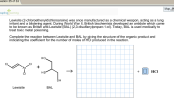 Lewisite (2-chloroethenyldichloroarsine) was once manufactured
as a chemical weapon, acting as a lung irritant and a blistering
agent. During World War II, British biochemists developed an
antidote which came to be known as British anti-Lewisite (BAL)
(2,3-disulfanylpropan-1-ol). Today, BAL is used medically to treat
toxic metal poisoning. Complete the reaction between Lewisite and
BAL by giving the structure of the organic product and indicating
the coefficient for the number of moles of HCl produced in the
reaction.
Lewisite (2-chloroethenyldichloroarsine) was once manufactured
as a chemical weapon, acting as a lung irritant and a blistering
agent. During World War II, British biochemists developed an
antidote which came to be known as British anti-Lewisite (BAL)
(2,3-disulfanylpropan-1-ol). Today, BAL is used medically to treat
toxic metal poisoning. Complete the reaction between Lewisite and
BAL by giving the structure of the organic product and indicating
the coefficient for the number of moles of HCl produced in the
reaction.
 Lewisite (2-chloroethenyldichloroarsine) was once manufactured
as a chemical weapon, acting as a lung irritant and a blistering
agent. During World War II, British biochemists developed an
antidote which came to be known as British anti-Lewisite (BAL)
(2,3-disulfanylpropan-1-ol). Today, BAL is used medically to treat
toxic metal poisoning. Complete the reaction between Lewisite and
BAL by giving the structure of the organic product and indicating
the coefficient for the number of moles of HCl produced in the
reaction.
Lewisite (2-chloroethenyldichloroarsine) was once manufactured
as a chemical weapon, acting as a lung irritant and a blistering
agent. During World War II, British biochemists developed an
antidote which came to be known as British anti-Lewisite (BAL)
(2,3-disulfanylpropan-1-ol). Today, BAL is used medically to treat
toxic metal poisoning. Complete the reaction between Lewisite and
BAL by giving the structure of the organic product and indicating
the coefficient for the number of moles of HCl produced in the
reaction.
Most questions answered within 3 hours.
-
Where is the error in this code sequence?
String s1 = "Hello";
String s2 = "ello";...
asked 10 months ago -
Financial data for Joel de Paris, Inc., for last year
follow:
Joel de Paris, Inc.
Balance...
asked 10 months ago -
Consider this reaction:
Al2(SO4)3 (aq)+ BaCl3
(aq) Al2Cl6 (aq)- +
3BaSO4(s) . What is the...
asked 10 months ago -
Suppose that Savneet is considering increasing her
recent random sample from 20 car rentals to 40...
asked 10 months ago -
Trucks arrive at an unloading terminal at an average rate of 120
per hour.
Trucks arrive...
asked 10 months ago -
Why are methanol and ethanol completely soluble in water while
octanol is not very little soluble....
asked 10 months ago -
A facilities manager at a university reads in a research report
that the mean amount of...
asked 10 months ago -
When the CuSO4 is rehydrated by adding water to the anhydrous
compound, is this an endothermic...
asked 10 months ago -
A ray of sunlight is passing from diamond into crown glass; the
angle of incidence is...
asked 10 months ago -
A block of mass 0.249 kg is placed on top of a light, vertical
spring of...
asked 10 months ago -
how do the kidneys compensate in the presences of acidosis
a) trigger hyperventilate
b) reserve acid...
asked 10 months ago -
Question 501 pts
The rental rate of capital to the firm increases. Which of the
following...
asked 10 months ago