![Problem l Using dimensional analysis, construct a constant, with units of length only, out of all three of the following fundamental constants of Nature: h, G, and c. Here, h is Plancks constant, which has dimensions of [M] [L]2[7]-1, G s Newtons gravitational constant, which has dimensions of M][L] [T]-2, and c is the speed of light, with dimensions [L][7]1](http://img.homeworklib.com/questions/97d4cb60-72a3-11ea-8353-9f1d7b1b1124.png?x-oss-process=image/resize,w_560)
Homework Answers


Add Answer to:
Problem l Using dimensional analysis, construct a constant, with units of length only, out of all...
3.) If you were somehow able to stand on the surface of a neutron star, you...
3.) If you were somehow able to stand on the surface of a neutron star, you would experience acceleration due to gravity of about 1.3 x 10^12 m/sec^2. [If you dropped a ball while standing there, the ball would quickly approach the speed of light in less than one second!] What is the acceleration due to gravity on the surface of a neutron star in \english" units of miles/hr^2? Explicitly show how you converted the units. 4.) There are three...
These physics questions are destroying me. I’m not too sure how to solve vectors and such....
 These physics questions are destroying me. I’m not too sure how to
solve vectors and such. Any help would be amazing. But if possible
please explain so I understand. I promise to give 5 stars and
thumbs up if correct.
PHY 121 Homework Assignment 1 Dr. MacDonald ASU Spring 2019 Due: Wednesday, January 16th 2019, in class Points: 60 (10 per problem) Problem 1 following fundamental constants of Nature: h, G, and c. Here, h is Planck's constant, which has...
These physics questions are destroying me. I’m not too sure how to
solve vectors and such. Any help would be amazing. But if possible
please explain so I understand. I promise to give 5 stars and
thumbs up if correct.
PHY 121 Homework Assignment 1 Dr. MacDonald ASU Spring 2019 Due: Wednesday, January 16th 2019, in class Points: 60 (10 per problem) Problem 1 following fundamental constants of Nature: h, G, and c. Here, h is Planck's constant, which has...
1: Use dimensional analysis to derive the expression for the time period of oscillations of a...
 1: Use dimensional analysis to derive the expression for the time period of oscillations of a simple pendulum that depends on its length and accelaration due to gravity. You can use the known dimensions of mass, length, time and accelaration due to gravity: [M], [L], [T] and [L]T-2], and dimensional constant, k = 27.
Exercise 1 Obtain expressions for the dimensions of the following quantities using both (1) the absolute...
 Exercise 1 Obtain expressions for the dimensions of the following quantities using both (1) the absolute dimensional system, and, (2) the gravitational dimensional system Here, x, x1, and x2 represent lengths , t is time, m is a constant mass, <a represents acceleration, g is a constant acceleration, and F represents force E is an unknown constant quantity drr2(t) dt C2 E mg 「x(t) dt Exercise 2 Given that F is a force. is a displacement. θ is an angle,...
Using dimensional analysis: 1) Prepare 1 L of 0.05 M NaOH using a 1 L volumetric...
Using dimensional analysis: 1) Prepare 1 L of 0.05 M NaOH using a 1 L volumetric flask and 6 M NaOH as the NaOH source. Calculate the amount of 6 M NaOH needed. 2) Calculate the mass of KHP needed to completely react with approximately 35.00 mL of 0.05 M NaOH I got the correct answers to be 1) 8.33 ml NaOH and 2) 0.357 g KHP, but I didn't use dimensional analysis. I just need to know how to...
Only solve part (d) please. The formula derived in part (b) is 1 Dimensional Analysis 34 1.4. The luminosity of certa...
 Only solve part (d) please. The formula derived in part (b) is
1 Dimensional Analysis 34 1.4. The luminosity of certain giant and supergiant stars varies in a periodic manner. It is hypothesized that the period p depends upon the star's average radius r, its lllass ข, alul i.he nravii.aiional cousiałí. G. (a) Newton's law of gravitation asserts that the attractive force between two bodies is proportional to the product of their masses divided by the square of the distance...
Only solve part (d) please. The formula derived in part (b) is
1 Dimensional Analysis 34 1.4. The luminosity of certain giant and supergiant stars varies in a periodic manner. It is hypothesized that the period p depends upon the star's average radius r, its lllass ข, alul i.he nravii.aiional cousiałí. G. (a) Newton's law of gravitation asserts that the attractive force between two bodies is proportional to the product of their masses divided by the square of the distance...
A pendulum consists of a string of length L and a mass m hung at one...
 A pendulum consists of a string of length L and a mass m hung at one end and the mass oscillates along a circular arc. Part a) Familiarize yourself with the derivation of omega = Squareroot g/L to hold. i) Explain succinctly how the angular frequency of oscillation omega = Squareroot g/L comes about from Newton's Law, where g is the gravitational acceleration. ii) One assumption required is the small angle approximation: sin theta = theta and cos theta =...
Dimensional Analysis: Often, we can almost derive formulas (up to an overall constant) just by knowing...
 Dimensional Analysis: Often, we can almost derive formulas (up to an overall constant) just by knowing the units of the relevant quantities. Under the assumption that the pendulum's period can only depend on the pendulum's length L, m, maximum angle 0, and the strength of gravity g (with units [g]=m/s2), explain why we must have a relation like mass L T f(0) (Note that 0 counts as a unitless parameter here.) Asserting f(0)~ f(0) in this formula is the small...
6. Use dimensional analysis to show that in a problem involving shallow water waves (Fig. P7-...
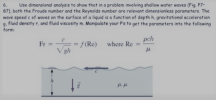 6. Use dimensional analysis to show that in a problem involving shallow water waves (Fig. P7- 87), both the Froude number and the Reynolds number are relevant dimensionless parameters. The wave speed c of waves on the surface of a liquid is a function of depth h, gravitational acceleration g, fluid density r, and fluid viscosity m. Manipulate your P's to get the parameters into the following form: pch Fr f(Re) where ReD gh ?, ?
Homework 1.2-Dimensional Analysis Suppose we know the following Variable Has the dimensions of IT]2 [T IT]...
 Homework 1.2-Dimensional Analysis Suppose we know the following Variable Has the dimensions of IT]2 [T IT] L] LI[M] [LI3 MI[L]2 Determine if each equation is dimensionally valid. 1. u2=ax 2, mvt = dz? 4, max=h Wirie wo ifet variable expressins hat have the dimensonsWM
 These physics questions are destroying me. I’m not too sure how to
solve vectors and such. Any help would be amazing. But if possible
please explain so I understand. I promise to give 5 stars and
thumbs up if correct.
PHY 121 Homework Assignment 1 Dr. MacDonald ASU Spring 2019 Due: Wednesday, January 16th 2019, in class Points: 60 (10 per problem) Problem 1 following fundamental constants of Nature: h, G, and c. Here, h is Planck's constant, which has...
These physics questions are destroying me. I’m not too sure how to
solve vectors and such. Any help would be amazing. But if possible
please explain so I understand. I promise to give 5 stars and
thumbs up if correct.
PHY 121 Homework Assignment 1 Dr. MacDonald ASU Spring 2019 Due: Wednesday, January 16th 2019, in class Points: 60 (10 per problem) Problem 1 following fundamental constants of Nature: h, G, and c. Here, h is Planck's constant, which has...
 1: Use dimensional analysis to derive the expression for the time period of oscillations of a simple pendulum that depends on its length and accelaration due to gravity. You can use the known dimensions of mass, length, time and accelaration due to gravity: [M], [L], [T] and [L]T-2], and dimensional constant, k = 27.
 Exercise 1 Obtain expressions for the dimensions of the following quantities using both (1) the absolute dimensional system, and, (2) the gravitational dimensional system Here, x, x1, and x2 represent lengths , t is time, m is a constant mass, <a represents acceleration, g is a constant acceleration, and F represents force E is an unknown constant quantity drr2(t) dt C2 E mg 「x(t) dt Exercise 2 Given that F is a force. is a displacement. θ is an angle,...
 Only solve part (d) please. The formula derived in part (b) is
1 Dimensional Analysis 34 1.4. The luminosity of certain giant and supergiant stars varies in a periodic manner. It is hypothesized that the period p depends upon the star's average radius r, its lllass ข, alul i.he nravii.aiional cousiałí. G. (a) Newton's law of gravitation asserts that the attractive force between two bodies is proportional to the product of their masses divided by the square of the distance...
Only solve part (d) please. The formula derived in part (b) is
1 Dimensional Analysis 34 1.4. The luminosity of certain giant and supergiant stars varies in a periodic manner. It is hypothesized that the period p depends upon the star's average radius r, its lllass ข, alul i.he nravii.aiional cousiałí. G. (a) Newton's law of gravitation asserts that the attractive force between two bodies is proportional to the product of their masses divided by the square of the distance...
 A pendulum consists of a string of length L and a mass m hung at one end and the mass oscillates along a circular arc. Part a) Familiarize yourself with the derivation of omega = Squareroot g/L to hold. i) Explain succinctly how the angular frequency of oscillation omega = Squareroot g/L comes about from Newton's Law, where g is the gravitational acceleration. ii) One assumption required is the small angle approximation: sin theta = theta and cos theta =...
 Dimensional Analysis: Often, we can almost derive formulas (up to an overall constant) just by knowing the units of the relevant quantities. Under the assumption that the pendulum's period can only depend on the pendulum's length L, m, maximum angle 0, and the strength of gravity g (with units [g]=m/s2), explain why we must have a relation like mass L T f(0) (Note that 0 counts as a unitless parameter here.) Asserting f(0)~ f(0) in this formula is the small...
 6. Use dimensional analysis to show that in a problem involving shallow water waves (Fig. P7- 87), both the Froude number and the Reynolds number are relevant dimensionless parameters. The wave speed c of waves on the surface of a liquid is a function of depth h, gravitational acceleration g, fluid density r, and fluid viscosity m. Manipulate your P's to get the parameters into the following form: pch Fr f(Re) where ReD gh ?, ?
 Homework 1.2-Dimensional Analysis Suppose we know the following Variable Has the dimensions of IT]2 [T IT] L] LI[M] [LI3 MI[L]2 Determine if each equation is dimensionally valid. 1. u2=ax 2, mvt = dz? 4, max=h Wirie wo ifet variable expressins hat have the dimensonsWM
Most questions answered within 3 hours.
-
Where is the error in this code sequence?
String s1 = "Hello";
String s2 = "ello";...
asked 11 months ago -
Financial data for Joel de Paris, Inc., for last year
follow:
Joel de Paris, Inc.
Balance...
asked 11 months ago -
Consider this reaction:
Al2(SO4)3 (aq)+ BaCl3
(aq) Al2Cl6 (aq)- +
3BaSO4(s) . What is the...
asked 11 months ago -
Suppose that Savneet is considering increasing her
recent random sample from 20 car rentals to 40...
asked 11 months ago -
Trucks arrive at an unloading terminal at an average rate of 120
per hour.
Trucks arrive...
asked 11 months ago -
Why are methanol and ethanol completely soluble in water while
octanol is not very little soluble....
asked 11 months ago -
A facilities manager at a university reads in a research report
that the mean amount of...
asked 11 months ago -
When the CuSO4 is rehydrated by adding water to the anhydrous
compound, is this an endothermic...
asked 11 months ago -
A ray of sunlight is passing from diamond into crown glass; the
angle of incidence is...
asked 11 months ago -
A block of mass 0.249 kg is placed on top of a light, vertical
spring of...
asked 11 months ago -
how do the kidneys compensate in the presences of acidosis
a) trigger hyperventilate
b) reserve acid...
asked 11 months ago -
Question 501 pts
The rental rate of capital to the firm increases. Which of the
following...
asked 11 months ago